Imagine a clear night far from city lights. A small group has gathered in a desert, field, garden, or woodland clearing. Phones are dimmed. Aircraft and satellite trackers are open. Participants sit quietly, regulate their breathing, and visualize their location from above, beginning with the immediate landscape and extending outward into space. Some mentally express peaceful intentions. Others play tones, observe the horizon, or operate cameras and environmental sensors.
Then someone notices a light.
It appears brighter than the surrounding stars. It moves slowly, flashes, changes direction, or seems to respond after a participant asks for a signal. Several people see it. A camera records something, although the resulting image may be less impressive than the experience itself. The group feels a surge of recognition. For some participants, the event seems less like an observation than an answer.
What happened?
The light might have been an aircraft, satellite, drone, distant astronomical object, meteor, balloon, or unusual atmospheric effect. It may remain unidentified because the information collected is inadequate. It could also represent an anomaly that cannot be confidently attributed from the available evidence.
The further claim that it appeared in response to human intention requires another evidentiary step.
Modern contact movements inhabit this uncertain territory. They do not merely ask whether UAP exists. They ask whether human beings can invite interaction, recognize a response, prepare psychologically for contact, and form communities around its consequences.
From witnessing contact to attempting it
The defining feature of an initiated-contact movement is agency.
In a conventional sighting, someone unexpectedly observes a phenomenon. In many abduction narratives, the reported contact is involuntary. In a modern contact group, participants deliberately establish conditions in which communication is expected. They may meditate, channel, pray, visualize, travel to locations associated with earlier reports, conduct coordinated skywatches, exchange impressions, or follow a formal protocol.
This changes the role of the witness. The observer also becomes an experimenter, even when the experiment is informal.
The group becomes both an observational community and an interpretive community. A light is no longer judged only by its brightness, shape, duration, or movement. It may also be assessed through timing, emotional intensity, perceived synchronicity, intuitive impressions, and whether its behaviour seemed connected to a request.
The term most closely associated with these practices is CE-5, meaning a close encounter of the fifth kind in contemporary initiated-contact usage. The terminology requires care.

Astronomer J. Allen Hynek introduced his close-encounter classification in The UFO Experience: A Scientific Inquiry. His original system recognized close encounters of the first, second, and third kinds. The first involved an apparently unexplained object seen at close range. The second added reported physical effects. The third involved the reported presence of occupants or entities.
Categories beyond CE-3 were added later and have never achieved a single universally accepted definition. CE-4 later became widely associated with abduction or involuntary removal. Jacques Vallée separately developed a broader classification matrix in which Type 4 generally denoted transformations in a witness’s perceived reality. Within Vallée’s close-encounter category, however, Type 4 denoted abduction.
Contemporary contact communities usually use CE-5 for deliberate human-initiated communication, particularly in connection with methods promoted by Steven Greer and the Center for the Study of Extraterrestrial Intelligence, or CSETI.
Because these later categories were not part of Hynek’s original system, researchers should define precisely what they mean when using CE-4 or CE-5. See UAPedia’s CE-1 to CE-5: Initiated Contact Protocols and Typologies and the Center for UFO Studies overview of classification systems.
Modern contact movements are not one organization or belief system. Some grew around individual contactees. Some became spiritual institutions with teachings, rituals, leadership structures, and humanitarian missions. Others developed into decentralized skywatch networks. Still others focus on experiencer surveys, support communities, or the possible relationship between consciousness and anomalous phenomena.
Their common proposition is that contact may be participatory.
Giant Rock and the desert contact model
Before contact became an app-supported activity, George Van Tassel was gathering people beneath Giant Rock in California’s Mojave Desert.
Van Tassel had worked in aviation and became a prominent contact figure during the 1950s. His meetings at Giant Rock combined group meditation, lectures, metaphysical teachings, technical speculation, and observations of the night sky. Van Tassel claimed that an August 1953 encounter with a being from Venus provided information related to a rejuvenation technology.
He eventually began constructing the Integratron, a domed building that he described as an electrostatic generator capable of influencing human cellular processes. The structure was never completed according to his original technical intentions, although it survives as an architectural and cultural landmark.
Van Tassel also organized the Giant Rock Spacecraft Conventions. These gatherings brought together contactees, lecturers, spiritual seekers, inventors, families, enthusiasts, and curious members of the public.
The Integratron’s institutional history estimates that approximately 11,000 people attended the 1959 convention. Other published and popular histories commonly place the number closer to 10,000 or describe attendance as exceeding 10,000. These figures should be understood as historical estimates rather than audited counts.
The June and July 1959 issue of Van Tassel’s Proceedings confirms that a convention was held on 23 and 24 May of that year. Contemporary photographs and the Integratron’s National Register documentation also establish the convention’s scale and cultural significance, although they do not provide a verified attendance total (College of Universal Wisdom, 1959; Integratron, n.d.; National Register of Historic Places, 2018).
Van Tassel published books and newsletters, including the first-person account I Rode a Flying Saucer! His organizational activities, publications, conventions, meditation meetings, and construction project are historically documented. His claimed encounter, the Venusian identity of the reported communicator, and the proposed rejuvenating mechanism remain unverified.
Giant Rock nevertheless established a social pattern that continues to shape contact culture. It combined a special location, repeated group practice, founder testimony, anticipated aerial phenomena, technical language, spiritual purpose, publications, and public gatherings.
The desert was more than a backdrop. It became a threshold.
This is one way contact sites acquire cultural power. An initial testimony attracts observers. Their presence generates additional reports. The growing archive reinforces the reputation of the location. Over time, the site becomes part field station, part pilgrimage destination, and part social laboratory.
The Aetherius Society: contact as spiritual service
The Aetherius Society emerged in Britain during the mid-1950s under George King. The organization says that King received teachings from advanced intelligences whom it calls the Cosmic Masters. Its practices combine prayer, yoga, spiritual healing, environmental concern, and forms of mediumistic communication.
The Society gives 1955 as its founding year. Independent scholars similarly place its emergence in the mid-1950s, while sometimes distinguishing between King’s earliest activities and the formal development of the organization.
Academic researchers including John A. Saliba, Simon G. Smith, Mikael Rothstein, and David V. Barrett have examined the movement as a syncretic religious organization shaped by Theosophy, Christianity, yoga, millenarian expectations, and contact narratives. Rothstein has also examined the construction of George King’s authority and biography within the movement’s own literature.
This distinction between organizational self-description and independent scholarship is important. The Society presents its teachings as genuine communications. Scholars can document the community, its texts, practices, leadership, and historical development without independently confirming the claimed source of those communications.
In the Aetherius worldview, contact is not primarily a search for visible craft. It is a service.
The Twelve Blessings is presented by the Society as a series of transmissions delivered through King in 1958. Participants direct prayer and spiritual energy toward humanity, Earth, and beings understood as cosmic teachers. Operation Prayer Power is described as a method of invoking, storing, and later releasing spiritual energy during periods of crisis.
The physical existence of the alleged energy mechanism has not been independently established. The rituals, recordings, books, services, humanitarian intentions, and continuing communities are documented.
The movement therefore illustrates an essential distinction: the social and psychological consequences of a contact tradition can be observable even when its cosmological explanation remains disputed.
The Society’s account can be consulted at The Twelve Blessings. Independent contextual treatments include Saliba’s study of the Society’s worldview, Smith’s chapter in UFO Religions, Rothstein’s work on contact religions and charismatic authority, and Barrett’s survey of contemporary esoteric movements.
The organization’s website should be read as a primary source for what members believe and practice, not as independent validation of the claimed transmissions.
Unarius: contact through books, performance, and memory
Ernest and Ruth Norman established the Unarius Educational Foundation in 1954. Unarius describes its teachings as an interdimensional science involving consciousness, energy, reincarnation, personal transformation, and communication with advanced intelligences.
The movement developed an unusually rich visual and media culture. It produced books, paintings, costumes, dramatic reenactments, films, recordings, classes, and public-access television programs. These materials did more than communicate doctrine. They gave form to a shared universe in which cosmic history, remembered lives, spiritual development, and anticipated contact could be experienced collectively.
Unarius remains associated with its center in El Cajon, California. Its official founder history provides the organization’s own account of Ernest and Ruth Norman and the claimed origins of their teachings (Unarius Academy of Science, n.d.).
Sociologist Diana Tumminia spent years attending meetings, interviewing members, and studying the movement’s literature and practices. Her research examines how Unarius members maintained and adapted a coherent worldview when publicly anticipated events did not occur in the expected physical form.
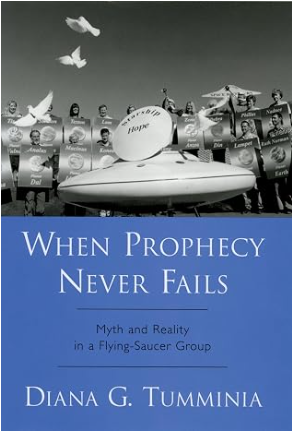
Across her book and related peer-reviewed work, Tumminia describes adaptive storytelling, continuing reinterpretation, and narrative revision as mechanisms through which members accommodated apparent prophetic failure. Her analysis is particularly relevant to the relationship between prophecy, group identity, and the reinterpretation of disconfirmation.
That interpretive flexibility helps explain how communities survive disappointment. It also creates a serious evidentiary difficulty.
A scientific claim must be allowed to fail. When every possible outcome can be absorbed as confirmation, the claim becomes resistant to testing. A movement may remain socially meaningful, but its prediction no longer functions as a falsifiable proposition.
Unarius is therefore important not only as a contact organization but as a case study in narrative resilience. Its members’ experiences cannot be reduced to one failed expectation, yet the continuation of a community does not validate every event it anticipates.
The Raëlian Movement: encounter narrative as worldview
Claude Vorilhon, later known as Raël, reported encountering a being near Clermont-Ferrand, France, in December 1973. He said the being explained that an advanced group called the Elohim had created terrestrial life through biological engineering.
That first-person account became the foundation of an international movement addressing human origins, science, sexuality, meditation, governance, and the proposed construction of an embassy to receive the Elohim.
The reported encounter remains unverified by independent physical evidence. The resulting organization, books, ceremonies, public campaigns, leadership system, and international reach are documented.
Independent summaries by scholars and religious-studies organizations provide context beyond the movement’s own publications. The Religion Media Centre’s Raëlian Movement factsheet offers one accessible secondary overview.
The Raëlian case demonstrates how a limited-duration personal experience can become an origin story for a global community. Once that happens, investigation must extend beyond the original encounter claim. It must also consider governance, authority, consent, financial transparency, public representation, and the way members are taught to distinguish documented history from revealed teaching.
Mission Rama and the meaning of a scheduled observation
One of the most influential contact movements in Latin America emerged in Peru during the 1970s.
Sixto Paz Wells has written that he and members of his family began experimenting with relaxation, telepathic exercises, and automatic writing after attending a lecture about communication with extraterrestrial intelligence. According to Paz Wells’s retrospective account, messages were attributed to a being called Oxalc and directed participants toward the Chilca Desert south of Lima.
The group that developed around these experiences became known as Mission Rama and later, in a range of successor communities, as Mission Rahma. Its practices combined meditation, personal discipline, automatic writing, group preparation, ethical instruction, desert expeditions, and the expectation of observable confirmation.
Three evidentiary layers must be kept separate.
The first is Paz Wells’s retrospective account. His book The Invitation describes the origins of the movement, the alleged communications, and the meaning he assigned to subsequent observations. It is a primary source for his testimony but not independent verification of its cause.
The second layer is the account of Spanish journalist J. J. Benítez. Benítez wrote that he attended a scheduled observation in the Chilca Desert in September 1974 and saw luminous phenomena that he associated with the prediction. His account, later published in Ovnis: S.O.S. a la humanidad, is participant journalism. It provides an additional witness narrative, but it is not equivalent to instrumented scientific confirmation.
The third layer concerns the movement’s wider history. Participant publications and later organizational histories describe Mission Rama as developing communities across Latin America and Spain. These sources document how participants and successor groups understand the movement’s expansion. A comprehensive independent institutional history remains limited, so the scale, continuity, and organizational relationships among different Rama and Rahma communities should not be treated as uniformly established.
The alleged advance prediction at Chilca is also difficult to assess. Available published accounts describe the observation as scheduled in advance, but the evidence reviewed here does not include a securely authenticated, time-stamped primary record created before the event that specifies the prediction’s exact wording, time, location, and expected result.
The event should therefore be described as a retrospectively reported scheduled observation, not as a scientifically verified successful prediction.
This does not make the testimony irrelevant. Advance specification, when properly documented, can be evidentially valuable. A strong test would require a dated record deposited before the event, precise observation windows, independent observers, astronomical and aviation exclusions, synchronized recordings, and predetermined criteria for success.
Mission Rama’s clearest historical importance lies in its role within Spanish-speaking contact culture. Participant literature encouraged ordinary members to regard contact as a capacity that groups could cultivate rather than a privilege granted only to a famous individual.
CSETI, CE-5, and decentralized contact
Steven Greer founded the Center for the Study of Extraterrestrial Intelligence in 1990. CSETI described itself as a research and educational organization concerned with extraterrestrial intelligence and promoted the CE-5 Initiative as an attempt to establish peaceful, human-initiated communication.
This founding history and stated purpose are documented principally in CSETI and Greer’s own publications. These sources establish what CSETI said it was created to do. They do not establish that its contact claims were successful.
CSETI protocols have included meditation, focused intention, visualization of one’s position on Earth, mental invitation, group coordination, night-sky observation, and selected sounds or tones. These descriptions come primarily from CSETI and Greer’s instructional materials. They document what practitioners are instructed to do, but they do not independently establish that the methods cause UAP to appear.
The movement’s major innovation was portability.
A participant no longer needed to join a centralized religious institution, travel to Giant Rock, or wait for a contactee to announce an event. A small group could conduct a session almost anywhere. Books, workshops, films, online communities, downloadable materials, and mobile applications helped transform initiated contact into a distributed practice.
The Rice University archives preserve CSETI-related news clippings, reports and symposia materials, correspondence, book catalogues, and other ephemera within the Brenda Denzler Ufology Collection. The relevant material is catalogued under “CSETI/Steven Greer, 1995–2002” in the university’s public finding aid (Rice University, Woodson Research Center, n.d.).
First-hand CE-5 accounts often describe lights that appear shortly after a mental invitation, brighten after a request, flash in patterns, move in unexpected ways, or coincide with strong intuitive impressions. Participants also report vivid dreams, sensed presences, internal imagery, bodily sensations, and meaningful coincidences after sessions.
These reports should be preserved in the form witnesses give them. They should not be compressed into a single claim.
Seeing a light is one claim. Establishing that it moved anomalously is another. Inferring intelligent control is a stronger claim. Demonstrating that the event occurred because a group meditated is stronger still. Identifying the source as extraterrestrial, interdimensional, spiritual, or otherwise non-human adds another level of interpretation.
A single experience can therefore contain several claims with different evidentiary strengths.
Commercial activity creates a further controversy. Apps, films, workshops, expeditions, conferences, and training programs do not automatically invalidate the testimony associated with them. Commercial incentives do, however, make transparency especially important.
Investigators should ask whether unsuccessful sessions are recorded as carefully as apparent successes, whether raw data are released, whether participants are told that results are uncertain, and whether dramatic interpretations are encouraged before conventional explanations have been excluded.
What experiencer research establishes
The effects of contact movements cannot be understood solely through images of lights. Their most consistent reported consequences may be psychological, ethical, social, and spiritual.
In 2018, Reinerio Hernandez, Robert Davis, Russell Scalpone, and Rudolph Schild published a survey study based on research conducted through the Dr. Edgar Mitchell Foundation for Research into Extraterrestrial and Extraordinary Experiences, known as FREE.
The study involved 3,256 respondents and two surveys totalling 554 questions. Participants were asked to report consciously remembered experiences rather than memories recovered through hypnosis. Approximately 70 percent reported that their experiences had changed their lives positively, while a smaller proportion reported predominantly negative effects. Respondents frequently described changes involving spirituality, compassion, ecological concern, personal meaning, and beliefs about consciousness.
The study reports an international respondent population. Details about geographic distribution should be taken from the paper’s demographic material rather than inferred from the abstract alone.
The research does not establish that respondents encountered non-human beings. It documents the experiences and interpretations reported by a self-selected population recruited through communities interested in UAP, extraordinary experiences, consciousness, and related subjects. The sample cannot be treated as representative of the general public.
The authors also noted limitations involving recruitment and the absence of standardized psychological testing. The results are therefore evidence about reported impact, not proof of origin.
This distinction is essential.
A person can be psychologically healthy and still misidentify an aerial object. A person can experience a genuine anomaly without correctly determining its source. A transformative experience may be sincere and consequential even when its cosmological interpretation remains unresolved.
The study supports a conclusion about impact, not origin.
What official studies do and do not establish
The major official UAP assessments reviewed here, including the 2021 Office of the Director of National Intelligence preliminary assessment and the 2023 NASA UAP Independent Study Team Report, did not test meditation, prayer, channeling, visualization, or CE-5 protocols.
Government recognition that some UAP reports remain unresolved cannot therefore be treated as validation of initiated-contact claims. The subjects overlap, but the evidence is not interchangeable.
The NASA UAP Independent Study Team Report addressed data quality, scientific methodology, reporting, and future research. It was not an investigation or resolution of every historical UAP incident.
The report emphasized that available observations frequently lack calibrated, reproducible, and well-curated information. It recommended standardized collection, improved metadata, multiple sensors, open scientific practices, artificial intelligence tools, and reduced stigma.
NASA also stated that the evidence available to the study did not conclusively establish an extraterrestrial origin.
The 2021 ODNI Preliminary Assessment examined reports submitted through official systems, many involving military aviators and government personnel. It stated that a majority of UAP in its dataset were registered across multiple sensors, including radar, infrared, electro-optical systems, weapon seekers, and visual observation.
The assessment also noted that a limited number of incidents reportedly displayed unusual flight characteristics. At the same time, it emphasized the need to examine sensor error, observer misperception, spoofing, and other possible causes.
These reports support two conclusions relevant to contact research.
First, military and government reporting systems contain observations that were not immediately attributed and, in some instances, involved more than one sensor.
Second, an unresolved observation is not a blank check. It does not establish the object’s identity, intention, origin, or relationship to a contact protocol.
Government sources are also limited by mandate, access, classification, institutional assumptions, and national-security priorities. They are important evidence sources, but they are not final arbiters of every anomalous experience.
Why contact sessions can feel persuasive
Most people rarely spend hours studying the night sky. When they do, it appears far busier than expected.
Satellites brighten and fade. Aircraft approaching almost directly can seem stationary. Navigation lights disappear when an aircraft turns. Bright planets shimmer near the horizon. Meteors appear without warning. Rocket launches, fuel vents, and re-entries can produce extraordinary displays. Drones can hover, accelerate, and change lighting patterns.
A contact protocol adds focused expectation to an unfamiliar environment. Participants may have completed an emotionally intense meditation and may be actively awaiting a response. When a light appears at the expected moment, coincidence can feel inadequate.
This does not mean the light was imagined. It means observation and interpretation must be evaluated separately.
Group dynamics can intensify the effect. One participant notices movement. Another sees a pulse. A third remembers that someone had just requested a sign. These observations may be accurate, partially accurate, or influenced by discussion. Memory then arranges the sequence into a coherent event: invitation, appearance, response.
Psychological explanations should not be used as universal dismissals. They identify known pathways of error, not predetermined solutions to every case.
A properly documented object that changes direction, appears on independent cameras, lacks a conventional track, and recurs preferentially during preregistered contact windows would require detailed investigation.
The responsible position protects both possibilities. Human perception can be mistaken, and genuinely anomalous events may occur.
Controversies that contact movements cannot avoid
The central controversy is causation.
Even when an observed light remains unidentified, how can researchers demonstrate that it appeared because a group attempted contact? Timing is relevant, but temporal coincidence alone does not establish a causal relationship.
A stronger claim requires comparison with ordinary skywatch nights, independent observers, predetermined observation windows, blinding where possible, and repeated effects above the normal background rate.
Leadership presents another challenge. A founder who claims privileged communication may become teacher, interpreter, diplomat, moral authority, and gatekeeper at the same time. Participants may begin judging all experiences through that leader’s cosmology.
Responsible organizations should allow disagreement, disclose governance arrangements, provide clear financial information, respect privacy, avoid coercive practices, and distinguish a leader’s interpretation from independently verified evidence.
Prediction creates a related problem. A movement gains evidentiary strength by making a specific, documented forecast in advance. It loses that strength if every missed event is redefined as an invisible success. Social resilience may help a community survive disappointment, but a scientific proposition must retain the possibility of failure.
Physical safety also matters. Some contact practices have involved handheld lasers directed toward lights in the sky. This is dangerous.
The US Federal Aviation Administration warns that pointing a laser at an aircraft is a federal crime. A public-facing contact protocol should prohibit sky-directed laser activity because participants may be unable to distinguish an aircraft from another light source at night. The FAA’s guidance is available through its Laser Safety page.
Emotional safety is equally important. Some participants report fear, insomnia, obsessive observation, family conflict, or a growing conviction that ordinary events contain personal messages. Group leaders should not diagnose participants, discourage medical care, promise supernatural protection, or treat distress as proof of spiritual advancement.
Unusual beliefs alone are not evidence of illness. Persistent anxiety, paranoia, severe sleep disruption, or impaired daily functioning are reasons to seek respectful professional support.
Consent raises a wider ethical problem. A private contact group may describe itself as representing humanity, but it has no democratic mandate to speak for the species. Initiated contact therefore raises questions about reciprocity, representation, cultural authority, ecological risk, information hazards, and who has the right to send messages on behalf of others.
What a rigorous contact experiment would require
Initiated contact is more testable than many historical UAP claims because practitioners choose the place, time, duration, and method.
A serious investigation would register each session before it began. The record would specify the exact site, observation windows, protocol, anticipated response, equipment, weather conditions, and criteria for success.
A prediction such as “something meaningful will happen” would be too flexible. A useful prediction would identify a time interval, part of the sky, observable behaviour, and detection requirement.
Matched control sessions would be essential. Some nights would include the contact protocol. Others would involve ordinary quiet observation. Participants responsible for later video analysis should not know which condition occurred until their initial classification was complete.
The equipment need not be military grade, but it should be calibrated and time-synchronized. Two or more separated cameras could support triangulation. Researchers might also use optical zoom, spectral gratings, radio-frequency monitoring, magnetometers, weather instruments, ambient audio, and GPS-based timing.
Every candidate event should be checked against aircraft transponders, satellite ephemerides, astronomical objects, rocket activity, balloons, drones, meteors, and local events.
Witnesses should complete independent logs before discussing the observation as a group. Subjective impressions should be recorded, but they should remain analytically separate from sensor data. Raw files, metadata, null sessions, failed predictions, and ordinary identifications should be published alongside the strongest anomalies.
The most persuasive outcome would not be one dramatic video. It would be a statistically meaningful and independently replicated increase in verified anomalies during preregistered contact periods compared with control observations.
Implications of the contact movement
Contact movements already have cultural consequences, even without universally accepted proof that their practices cause external phenomena.
They turn the UAP question from spectacle into practice. Participants become skywatchers, meditators, archivists, amateur instrument operators, experiencer advocates, and members of international communities. Some report less fear of the unknown and greater concern for peace, ecology, or human unity. Others become committed to cosmological narratives that extend far beyond the available evidence.
These movements also blur traditional boundaries between science, spirituality, and religion.
Brenda Denzler’s The Lure of the Edge: Scientific Passions, Religious Beliefs, and the Pursuit of UFOs examines the UAP community’s movement between scientific aspiration and religious meaning. Christopher Partridge’s edited collection UFO Religions documents how contact narratives can generate revelation, ritual, authority, identity, and expectations of transformation.
A contact group may operate cameras while interpreting events through reincarnation, prophecy, spiritual service, cosmic evolution, or telepathy. Scientific equipment does not automatically make the interpretation scientific, just as spiritual meaning does not automatically make an observation unreal.
Should a repeatable contact effect eventually be demonstrated, the implications would be profound. It could suggest that some UAP events are responsive rather than accidental. It might place intention, consciousness, or symbolic communication inside the observational problem. Citizen groups could become relevant to research previously dominated by military sensors and government reporting channels.
Such a result would also create immediate ethical complications. Responsiveness would not identify the source. Intelligence would not guarantee honesty. Contact would not automatically imply benevolence. Different groups might receive contradictory messages. Researchers would still need to distinguish an external agent from psychological projection, technological deception, social reinforcement, or a phenomenon that adapts to cultural expectations.
A mixed model may ultimately prove necessary. Contact sessions may include ordinary misidentifications, sincere inner experiences, group interpretation, unusual psychological effects, deliberate exaggeration in isolated cases, and a residue of genuinely anomalous observations.
The challenge is not to force every account into one explanation. It is to determine which explanation best fits each layer of evidence.
Claims taxonomy
| Classification | Assessment |
|---|---|
| Verified | The major organizations, founders, gatherings, publications, rituals, archives, and communities discussed here are historically documented. The FREE study verified recurring patterns of self-report within its sample. Official reports verify that some UAP observations submitted through government systems remained unresolved after initial analysis. |
| Probable | Contact movements have influenced participant identity, spiritual practice, UAP terminology, citizen skywatching, and public discussion. It is probable that many sessions contain a mixture of conventional objects, ambiguous stimuli, sincere subjective experiences, and interpretive reinforcement. |
| Disputed | Claims that meditation, prayer, channeling, visualization, tones, or group intention cause external UAP to appear remain disputed. The claimed non-human origin of communications and apparently responsive lights has not been established through repeatable controlled evidence. |
| Legend | Narratives involving Venusian teachers, Ganymede communicators, Elohim creators, cosmic federations, interdimensional masters, and predicted landings should be presented as reported cosmologies or movement traditions unless independently established. Legend identifies narrative and cultural status, not ultimate truth or falsity. |
| Misidentification | Some lights observed during contact sessions can be attributed to aircraft, satellites, drones, planets, meteors, balloons, rocket activity, or atmospheric effects. This classification should be applied to specific observations after analysis, not to entire communities. |
Speculation labels
Documented Evidence and Reported Data
The organizations, conventions, books, films, rituals, archives, applications, and participant communities discussed in this article are historically documented.
Witnesses have reported lights, sensed communications, intuitive impressions, dreams, bodily sensations, and lasting personal changes in connection with contact practices. These reports establish that experiences were described. They do not automatically establish the source attributed to them.
The FREE survey documents recurring patterns of self-report within a selected experiencer population. The NASA and ODNI reports document limitations in UAP data and the existence of unresolved reports submitted through official channels. Neither official assessment tested initiated-contact protocols.
Witness Interpretation
Participants frequently interpret time-linked lights, flashes, dreams, intuitive impressions, internal imagery, or coincidences as responses from non-human intelligence.
Mission Rama participants have interpreted the reported Chilca observations as confirmation of prior communications. CE-5 practitioners often interpret apparently responsive lights as evidence that an invitation was acknowledged. Members of the Aetherius Society, Unarius, and the Raëlian Movement understand founder testimony through larger cosmological systems.
These interpretations may be sincere and personally meaningful. They do not independently establish the source, identity, or cause of the experience.
Researcher Opinion
Initiated contact should be studied as both a possible field effect and a human experience. Testimony should be preserved without ridicule, while causal claims should be tested through preregistration, control sessions, independent observation, calibrated sensors, and transparent publication.
Transformative impact remains worthy of study when origin is unresolved. A positive life change does not prove non-human contact, but uncertainty about origin does not make the reported change unreal.
Hypothesis
The causal-contact hypothesis proposes that structured human intention produces a measurable increase in independently verified anomalies during predetermined observation periods.
The psychosocial hypothesis proposes that expectation, meditation, group cohesion, unfamiliarity with the night sky, perceptual limitations, and retrospective meaning-making explain most apparent responses.
The mixed-source hypothesis proposes that contact sessions include several classes of event: conventional aerial objects, perceptual mistakes, internally generated experiences, socially reinforced interpretations, and a smaller number of persistent anomalies.
A sufficiently large, controlled, multi-site study could compare these possibilities without deciding among them in advance.
References
Aetherius Society. (n.d.). The Twelve Blessings. https://www.aetherius.org/the-twelve-blessings/
Barrett, D. V. (2011). A brief guide to secret religions: A complete guide to hermetic, pagan and esoteric beliefs. Running Press.
Benítez, J. J. (1975). Ovnis: S.O.S. a la humanidad. Plaza & Janés.
Center for UFO Studies. (n.d.). Classification systems. https://cufos.org/types-of-ufos/classification-systems/
College of Universal Wisdom. (1959, June–July). Proceedings. https://integratron.com/wp-content/uploads/2018/12/JUN_JUL-1959.pdf
Denzler, B. (2001). The lure of the edge: Scientific passions, religious beliefs, and the pursuit of UFOs. University of California Press. https://www.ucpress.edu/books/the-lure-of-the-edge/paper
Federal Aviation Administration. (n.d.). Laser safety. https://www.faa.gov/about/initiatives/lasers
Greer, S. M. (1999). Extraterrestrial contact: The evidence and implications. Crossing Point.
Hernandez, R., Davis, R., Scalpone, R., & Schild, R. (2018). A study on reported contact with non-human intelligence associated with unidentified aerial phenomena. Journal of Scientific Exploration, 32(2), 298–348. https://doi.org/10.31275/2018.1282
Hynek, J. A. (1972). The UFO experience: A scientific inquiry. Henry Regnery.
Integratron. (n.d.). About: The history of the Integratron. https://www.integratron.com/history-about/
NASA UAP Independent Study Team. (2023). UAP independent study team report. National Aeronautics and Space Administration. https://science.nasa.gov/wp-content/uploads/2023/09/uap-independent-study-team-final-report.pdf
National Park Service. (2018). Integratron: National Register of Historic Places registration form. https://integratron.com/wp-content/uploads/2018/12/Integratron-National-Register-of-Historic-Places-Registration.pdf
Office of the Director of National Intelligence. (2021). Preliminary assessment: Unidentified aerial phenomena. https://www.dni.gov/files/ODNI/documents/assessments/Prelimary-Assessment-UAP-20210625.pdf
Partridge, C. (Ed.). (2003). UFO religions. Routledge. https://www.routledge.com/UFO-Religions/Partridge/p/book/9780415263245
Paz Wells, S. (2000). The invitation. 1st World Library. https://archive.org/details/invitation0000pazw
Religion Media Centre. (n.d.). The Raëlian Movement. https://religionmediacentre.org.uk/factsheets/factsheet-the-raelian-movement/
Rice University, Woodson Research Center. (n.d.). CSETI/Steven Greer, 1995–2002: Brenda Denzler Ufology Collection. https://archives.library.rice.edu/repositories/2/archival_objects/332384
Rothstein, M. (2003). Hagiography and text in the Aetherius Society: Aspects of the social construction of a religious leader. In M. Rothstein & R. Kranenborg (Eds.), New religions in a postmodern world (pp. 165–194). Aarhus University Press.
Rothstein, M. (Ed.). (2003). Encyclopedic sourcebook of UFO religions. Prometheus Books.
Saliba, J. A. (1999). The Earth is a dangerous place: The worldview of the Aetherius Society. Marburg Journal of Religion, 4(2).
Smith, S. G. (2003). Opening a channel to the stars: The origins and development of the Aetherius Society. In C. Partridge (Ed.), UFO religions (pp. 84–102). Routledge.
Tumminia, D. G. (1998). How prophecy never fails: Interpretive reason in a flying-saucer group. Sociology of Religion, 59(2), 157–170.
Tumminia, D. G. (2005). When prophecy never fails: Myth and reality in a flying-saucer group. Oxford University Press. https://global.oup.com/academic/product/when-prophecy-never-fails-9780195176759
Unarius Academy of Science. (n.d.). Founders of Unarius. https://unarius.org/founders-of-unarius/
Van Tassel, G. W. (1952). I rode a flying saucer! New Age Publishing Company. https://archive.org/details/1952-i-rode-a-flying-saucer-by-george-w.-van-tassel
Vallée, J. (1990). Confrontations: A scientist’s search for alien contact. Ballantine Books.
SEO keywords
modern contact groups, modern contact movements, initiated contact, CE-5, human-initiated contact, CSETI, Steven Greer, Mission Rama, Mission Rahma, Sixto Paz Wells, Giant Rock convention, George Van Tassel, Integratron, Aetherius Society, George King, Unarius, Raëlian Movement, contact experiencers, non-human intelligence contact, meditation and UAP, telepathic contact, consciousness and UAP, citizen UAP research, contactee movements, UAP witness testimony, FREE experiencer study, contact modalities, UAP field experiments, contact ethics, responsive UAP, anomalous lights, UAP contact protocols.