
Walk into almost any old library of human imagination, and sooner or later you meet the water.
Not always an ocean that covers everything, and not always the same cast of heroes, but again and again you encounter a story where the familiar world fails, rivers spill their boundaries, coastlines vanish, or a wall of sea arrives without warning. Sometimes the tale is moral and theatrical, sometimes it is spare and practical, and sometimes it reads like a survivor trying to make sense of a day their language was not designed to hold.
It is tempting to wave all of this away as metaphor. It is equally tempting to claim it proves a single global cataclysm, or a shared origin story that every society secretly inherited. A scientific approach does not need either extreme. It can accept that many cultures preserve flood traditions while also admitting the limits: similar stories do not, by themselves, prove a shared origin, a worldwide flood, or any form of anomalous intervention.
What science can do is ask a cleaner question: what real events are capable of producing the kind of psychological and cultural “scar” that lasts long enough to become myth?
That question is more grounded than it sounds, because the Earth has been running flood experiments for as long as humans have been coastal, riverine, and ambitious.
The planet that quietly redrew the shoreline
The basic geological backdrop is not controversial. After the last ice age, global sea level rose by about 120 meters as ice sheets melted and the ocean refilled the continental shelves. NOAA summarizes this rise directly and notes that sea level later stabilized for a long interval before modern industrial-era rise began. (cdn.oceanservice.noaa.gov) Smithsonian’s ocean portal gives the same scale, describing roughly 400 feet (120 meters) of rise over the past ~20,000 years, including early periods when rates could be very rapid. (Smithsonian Ocean)
That is the part that tends to slip past modern intuition. We imagine our familiar coastlines as permanent, as if they have always been where they are now. In reality, the coasts we photograph today are a relatively recent compromise between sea level, sediment, and storm energy.
If your community’s identity is anchored to a bay, an estuary, a reef, a sandbar, or a river mouth, then sea-level change is not an abstract curve. It is a slow-motion eviction notice. Add a few extraordinary storms, a king tide, or a tsunami, and centuries of change can be felt as a single generational catastrophe.
This is why flood stories remain plausible as cultural memory even when the physical process is gradual. Memory does not archive in millimeters per year. Memory archives in “the year the sea took the land.”
A scientific lens with an old name: geomythology
There is a research tradition for comparing myth with geology, sometimes called geomythology. The idea is not that myths are literal measurements. The idea is that they can preserve observational kernels of real hazards, expressed in the vocabulary of spirits, ancestors, gods, and moral order.
In practice, the method looks like this: identify what a narrative claims (where, what kind of water movement, what triggers it, what the aftermath is), then compare those motifs to known hazard mechanisms (river floods, storm surge, dam failures, tsunamis, coastal drowning from sea-level rise, and so on). When the story is geographically anchored and its details align with a local hazard signature, the probability of an environmental “memory core” rises.
When the story is geographically unanchored, or when it serves obvious political purposes, the probability shifts toward ideology and symbolism, even if it is still inspired by lived experience.
The result is rarely a neat verdict. But it does produce something useful: a disciplined way to keep evidence and interpretation separate.
Case study: Australia’s deep-time coastal memories
One of the strongest published examples of flood tradition intersecting with sea-level history comes from Australia. In a peer-reviewed article, Patrick D. Nunn and Nicholas J. Reid present oral traditions from 21 locations around the Australian coastline describing times when the shoreline lay farther out and was later inundated. They argue that many of these stories plausibly refer to events more than about 7,000 years ago, roughly when sea level approached its present level around Australia. (Taylor & Francis Online)
This does not mean every detail is a precise map. It does mean that oral transmission can, under certain social conditions, preserve knowledge of major environmental change for astonishing spans of time.
If you want to understand why flood myths are so culturally “sticky,” this is a strong starting point. A drowned coastal plain is not merely lost real estate. It is lost graveyards, lost routes, lost hunting grounds, lost sacred sites, and lost names. The story becomes a container for everything that cannot be recovered.
The flood that arrives in minutes: tsunami memory and the Storegga event
Not all floods are slow. Some are violent enough to become a myth almost instantly.
A famous Holocene example is the Storegga Slide tsunami. Geological and modelling work has long treated the Storegga tsunami as a major event affecting North Sea coastlines. A detailed open-access paper in Boreas uses luminescence dating and sedimentology to examine Storegga tsunami deposits at Montrose, Scotland, and discusses wave direction, sediment provenance, and modelling refinements. (White Rose Research Online)
A tsunami’s cultural footprint is different from a river flood’s. It violates the everyday rules the ocean follows. It can erase a coastline’s population with almost no warning. Survivors, if any, often survive by being somewhere that feels accidental: a ridge, a hill, a dune, an inland track at the wrong moment. That kind of survival does not feel like skill. It feels like destiny, taboo, or mercy.
So when a flood myth emphasizes sudden arrival, roaring sound, unstoppable surge, or water that “climbed” beyond expectation, tsunami becomes a plausible candidate. Not a certainty, but a mechanism worth considering.
Inland megafloods: when rivers behave like gods
If you want proof that floods can be bigger than modern experience, you do not even need the sea.
The late glacial world hosted outburst floods of staggering scale, including the flood events associated with Glacial Lake Missoula that helped shape the Channeled Scablands of the northwestern United States. NASA’s Earth Observatory overview of the Channeled Scablands describes the landscape and its catastrophic flooding origin story in accessible scientific terms.
These floods are not mere overflowing rivers. They are sudden releases of impounded water capable of carving channels, stripping soil, and reshaping entire regions. If a community witnesses even a smaller-scale version, the event can be narrated as a moral reset, because that is what it feels like when the land itself is rewritten.
This matters because flood myths are often treated as “too big to be true.” The geological record politely disagrees. The Earth is capable of floods that look like apocalypse.
The written survivor voice: Mesopotamia’s flood tablets
Flood narratives are sometimes assumed to be late, embellished, or purely theological. Mesopotamia complicates that assumption because its flood stories are preserved in early written sources that are surprisingly operational.
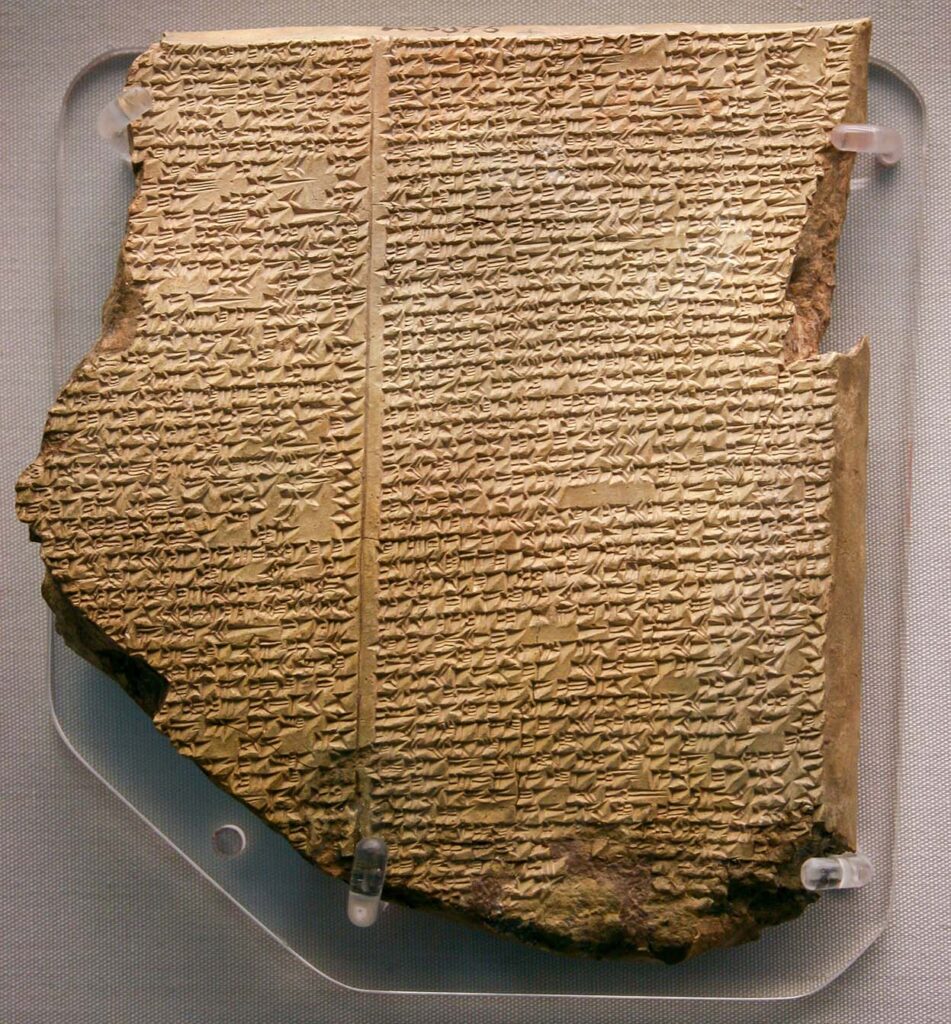
The British Museum’s catalogue entry for the tablet fragment known as K.3375 identifies it as a baked clay tablet inscribed with the Babylonian account of the Flood, the 11th Tablet of the Epic of Gilgamesh. The museum description notes that Ea revealed the plan to Uta-napishtim and instructed him to make a boat to save himself, his family, and animals. (British Museum)
The museum also catalogues tablet 1889,0426.236 as containing the story of Atrahasis, another Babylonian flood tradition. (research.usc.edu.au)
For modern readers, these tablets offer a useful distinction. They are not scientific reports, but they are closer to first-hand framing than many later retellings. They place the account in the mouth of a survivor figure, and they focus on actionable details: warning, construction, provisioning, survival, and aftermath.
Even if you treat the divine elements as theological language, the narrative structure resembles what disaster researchers recognize today: early warning, evacuation, sheltering, loss, and post-event meaning-making.
Controversy as a feature, not a bug: the Black Sea “deluge” debate
Some of the most discussed modern scholarship linking flood tradition to a specific regional mechanism involves the Black Sea. The popular version of the story goes like this: in the early Holocene, Mediterranean waters catastrophically breached into the Black Sea basin, rapidly flooding the shelf and displacing communities, potentially feeding flood myth traditions.
But the scientific record is not settled in that direction. A Woods Hole Oceanographic Institution paper by Liviu Giosan and colleagues, circulated as a rapid communication, describes the catastrophic flood proposal and then argues that stratigraphic and paleo-geomorphologic constraints from the Danube delta place the Black Sea level before marine reconnection at about 30 meters below present, not 80 meters or more. The authors write that, if a flood occurred at all, the sea-level increase and flooded area during reconnection were significantly smaller than previously proposed. (Woods Hole Oceanographic Institution)
On the broader critical side, Aksu and Hiscott’s 2022 review in Earth-Science Reviews argues that persistent Holocene outflow from the Black Sea to the eastern Mediterranean still contradicts the Noah’s Flood hypothesis, synthesizing evidence across 1997–2021. (ScienceDirect)
This is the correct scientific posture for myth-adjacent geology: cautious, proxy-driven, and willing to revise. The value of the Black Sea debate for readers is not a neat yes or no. The value is seeing how a culturally loaded idea gets tested in sediment cores, radiocarbon chronologies, and basin reconstructions.
And it also offers a sober interpretive reminder: a flood does not have to cover the world to become “world-ending” to the people living on its margins.
China’s Great Flood: legend meets a candidate mechanism
China’s Great Flood tradition is one of the world’s most influential “deluge narratives,” partly because it is tied to political legitimacy and the origin of dynastic authority through the figure of Yu the Great.
In 2016, a paper in Science presented evidence for a large outburst flood on the Yellow River, linked to an earthquake-induced landslide dam, and argued that the reconstructed flood could account for the Great Flood described in early Chinese texts, with implications for the chronology of the Xia dynasty.
The key word there is “could.” This is not a proof of the tradition in a literal sense. It is an example of what good myth-and-science scholarship looks like: propose a physically plausible mechanism, reconstruct the event with measurable evidence, then compare it to the narrative’s historical setting without claiming the narrative becomes a transcript.
China’s case also highlights something flood myths do beyond remembering water. They remember governance. Large flood control projects create administrative systems, labor organization, social stratification, and new moral narratives about who deserves to lead. In that sense, “the flood” can be a cultural hinge: a way to tell the story of why a society reorganized itself.
Many floods, many origins, one repeating feeling
At this point it becomes easier to talk about why flood stories echo across the world without overclaiming.
Flood traditions can converge for several reasons that do not require a single source.
Sometimes they converge because the hazard is universal. Humans settle near water, and water occasionally takes everything back.
Sometimes they converge because storytelling has common tools. Catastrophe makes for moral drama. It produces clean before-and-after boundaries. It explains why the world feels broken, and it offers a ritual reason for survival.
Sometimes they converge because climate history creates synchronized stress. When sea level rises rapidly across many coastlines, or when post-glacial landscapes are adjusting, many societies can experience “the same type of shock” in different places and times.
So yes, many cultures preserve flood traditions, and some of those traditions likely encode genuine environmental experiences. But similarity alone is not evidence of a single global flood, and it is not evidence of a shared narrative origin. The responsible approach is local: match story motifs to local hazards and local timelines, then scale up only when multiple lines of evidence justify it.
Why this matters now, not just then
Flood myths can feel antique, but they are surprisingly contemporary.
Modern climate science deals in projections, scenarios, and probability ranges. Myth deals in lived consequence. Myth reminds you that water does not merely “rise.” It reorganizes memory, economy, identity, and politics.
NOAA’s sea-level material emphasizes the long-term history of sea level and also the modern instrumental record showing ongoing rise. (National Ocean Service) The Smithsonian summary likewise notes that sea-level rise occurred in spurts and could be rapid in early postglacial intervals. (Smithsonian Ocean)
What flood traditions contribute, when handled carefully, is human-scale realism. They show what it looks like when a coastal map becomes obsolete, when a river becomes ungovernable, or when a society is forced into migration. That is not just ancient history. It is a present and future policy problem.
Claims taxonomy
Verified
Post–last ice age global sea level rose by about 120 meters, and credible institutional summaries describe early intervals of rapid rise. (cdn.oceanservice.noaa.gov)
The British Museum catalogues K.3375 as the flood tablet of Gilgamesh Tablet XI and describes Ea warning Uta-napishtim to build a boat, and it separately catalogues 1889,0426.236 as containing the Atrahasis flood story tradition. (British Museum)
Probable
Some oral traditions can preserve memories of coastal inundation over multi-millennial timescales, supported by Nunn and Reid’s peer-reviewed synthesis of Australian Aboriginal coastal inundation narratives. (Taylor & Francis Online)
Storegga tsunami impacts on North Sea coastlines are geologically attested and have been dated and modelled in peer-reviewed work, making tsunami a plausible mechanism for some sudden-surge flood traditions in affected regions. (White Rose Research Online)
Disputed
The scale and tempo of early Holocene Black Sea flooding remain contested; published work argues that, if a flood occurred at all, it was significantly smaller than catastrophic versions propose, while other researchers maintain stronger flood interpretations. (Woods Hole Oceanographic Institution)
The Younger Dryas Impact Hypothesis remains controversial in peer-reviewed literature, with a major review presenting “comprehensive refutation” and subsequent published replies and rebuttals continuing the dispute. (Astrophysics Data System)
Legend
Narratives asserting a literal global inundation covering all mountains function primarily as theological or cosmological statements in many traditions; current earth science more readily supports multiple regional catastrophes plus long-term sea-level change than a single global flood event in human times. (cdn.oceanservice.noaa.gov)
Speculation labels
Hypothesis
In some regions, flood myths preserve cultural memories of specific hazard types, including post-glacial coastal inundation, tsunami impact, and outburst floods. The plausibility increases when a tradition is geographically anchored and when independent geological reconstructions confirm comparable events in the same region. (Taylor & Francis Online)
Witness Interpretation
In several famous written flood narratives, survival knowledge arrives through a non-ordinary messenger (divine voice, ancestral being, or other agent). This is best treated as a narrative framing device unless a culture’s wider record provides independent reasons to read it differently. The presence of a “warning motif” in one tradition does not establish it as a universal global pattern. (British Museum)
Researcher Opinion
Flood myths are a valuable comparative dataset because extreme environmental stress amplifies “instruction narratives,” stories where decisive information appears to come from beyond normal human channels. This does not imply that floods were caused by UAP, nor that every warning figure should be read as an anomalous entity. It suggests a narrower, testable cultural question: under what conditions do societies externalize survival knowledge, and do those conditions correlate with other “contact-like” motifs in the same tradition’s broader archive?
References
Aksu, A. E., & Hiscott, R. N. (2022). Persistent Holocene outflow from the Black Sea to the eastern Mediterranean Sea still contradicts the Noah’s Flood Hypothesis: A review of 1997–2021 evidence and a regional paleoceanographic synthesis for the latest Pleistocene–Holocene. Earth-Science Reviews. https://doi.org/10.1016/j.earscirev.2022.103960 (ScienceDirect)
Bateman, M. D., Kinnaird, T. C., Hill, J., Ashurst, R. A., Mohan, J., Bateman, R. B. I., & Robinson, R. (2021). Detailing the impact of the Storegga Tsunami at Montrose, Scotland. Boreas. https://doi.org/10.1111/bor.12532 (White Rose Research Online)
British Museum. (n.d.). Tablet K.3375: Eleventh tablet of the Epic of Gilgamesh (Flood narrative). (British Museum)
British Museum. (n.d.). Tablet 1889,0426.236: Atrahasis flood story tablet. (research.usc.edu.au)
Giosan, L., Filip, F., & Constatinescu, S. (2009). Was the Black Sea catastrophically flooded in the early Holocene? (WHOI rapid communication PDF). (Woods Hole Oceanographic Institution)
NOAA National Ocean Service. (n.d.). Is Sea Level Rising? (cdn.oceanservice.noaa.gov)
Nunn, P. D., & Reid, N. J. (2016). Aboriginal memories of inundation of the Australian coast dating from more than 7000 years ago. Australian Geographer, 47(1), 11–47. https://doi.org/10.1080/00049182.2015.1077539 (Taylor & Francis Online)
Smithsonian Ocean. (n.d.). Sea level rise. (Smithsonian Ocean)
Wu, Q., et al. (2016). Outburst flood at 1920 BCE supports historicity of China’s Great Flood and the Xia dynasty. Science, 353(6299), 579–582. https://doi.org/10.1126/science.aaf0842
Holliday, V. T., et al. (2023). Comprehensive refutation of the Younger Dryas Impact Hypothesis (YDIH). Earth-Science Reviews. https://doi.org/10.1016/j.earscirev.2023.104502 (Astrophysics Data System)
Sweatman, M. B. (2024). Rejection of Holliday et al.’s alleged refutation of the Younger Dryas impact hypothesis. Earth-Science Reviews. (ScienceDirect)
Holliday, V. T., et al. (2024). Rebuttal of Sweatman, Powell, and West’s “Rejection of Holliday et al.’s alleged refutation of the Younger Dryas Impact Hypothesis”. Earth-Science Reviews. (ScienceDirect)
SEO keywords
flood myths, global flood traditions, deluge narratives, sea level rise 120 meters, postglacial sea level, geomythology, oral tradition sea level memory, Aboriginal inundation traditions, Australian Geographer Nunn Reid 2016, Gilgamesh flood tablet K.3375, Atrahasis flood story, Storegga tsunami Boreas 10.1111/bor.12532, Black Sea flood debate, Giosan Black Sea reconnection, Noah’s Flood hypothesis Earth-Science Reviews 10.1016/j.earscirev.2022.103960, Yu the Great flood, China Great Flood Science 2016 10.1126/science.aaf0842, catastrophic flooding case studies, ancient & mythological accounts, UAPedia flood myths