Paola Harris has spent much of her career listening to people whose stories rarely fit within the boundaries of ordinary journalism.
Her interview subjects have included military veterans, scientists, Catholic clergy, contact witnesses, alleged government insiders and researchers who believe humanity is already interacting with non-human intelligence. Some have described unusual objects. Others have reported telepathic communication, encounters with human-looking beings, apparent crash-retrieval operations or relationships extending across years.
The evidence supporting these accounts varies considerably. A documented military career may sit beside an unverified recollection. A witness may appear sincere while offering an interpretation that cannot be independently tested. A photograph may exist without a secure chain of custody. An alleged contact event may be rich in detail but absent from records made when it supposedly occurred.
Harris’s most defensible contribution is not that she has proved every account she has published. It is that she has recorded testimony that might otherwise have remained private, local or inaccessible to later researchers.
Her professional biographies state that she began studying extraterrestrial-related phenomena in 1979. Over the following decades, she developed a form of witness-centred journalism that treats personal testimony as historically important even when the event behind it remains unresolved.
That approach has made her an influential figure in experiencer research. It has also produced controversy. Critics argue that compassionate interviewing can drift into advocacy. Supporters answer that witnesses have often been dismissed before their claims received any serious examination.
Harris occupies the uneasy territory between those positions.
An Italian-American voice in UAP journalism
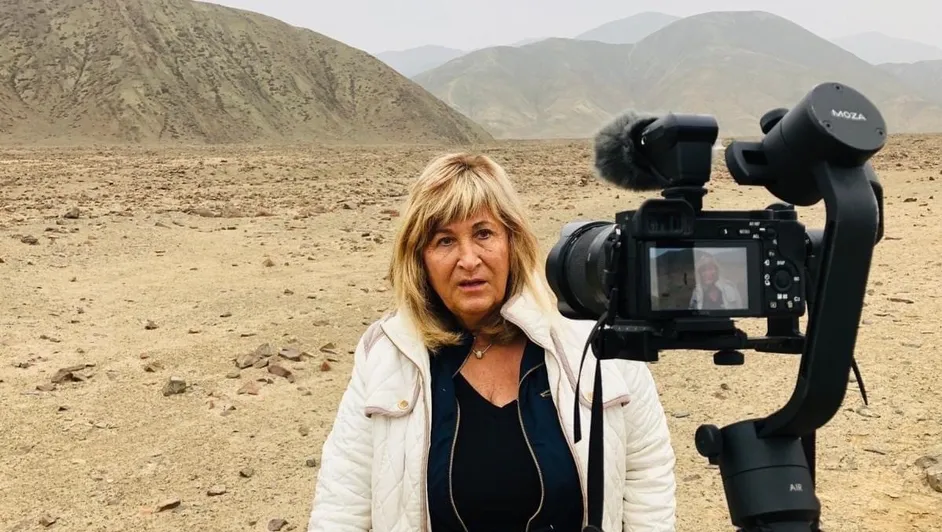
Paola Leopizzi Harris is publicly described, including in her professional biographies, as an Italian-American photojournalist, investigative reporter, author and conference organiser. Her biography says she has studied extraterrestrial-related phenomena since 1979 and has conducted interviews with prominent participants in UAP research and disclosure discussions.
Catalogue metadata for Connecting the Dots identifies her as “Harris, Paola Leopizzi, 1956–,” supporting 1956 as her reported birth year. Catalogue metadata is not equivalent to a civil record or independently researched biography, but it provides a reasonable bibliographical basis for the date.
Harris entered UAP research during a period of major transition.
Project Blue Book ended in 1969. The Condon Committee report had strengthened the institutional view that continued large-scale scientific investigation of UAP was unlikely to be productive. At the same time, researchers such as J. Allen Hynek and Jacques Vallée were challenging the assumption that every meaningful case could be reduced to a conventional aircraft, astronomical object or atmospheric event.
The subject was also expanding beyond reports of machines in the sky. By the late 1970s and 1980s, investigators were confronting testimony involving missing time, entities, telepathic impressions, altered states, recurring encounters and long-term changes in belief.
This created a new research problem. Radar returns and photographs could be examined technically. A witness who claimed communication through thought required a different form of inquiry.
Harris’s method begins with the person giving the account.
What an interview can and cannot establish
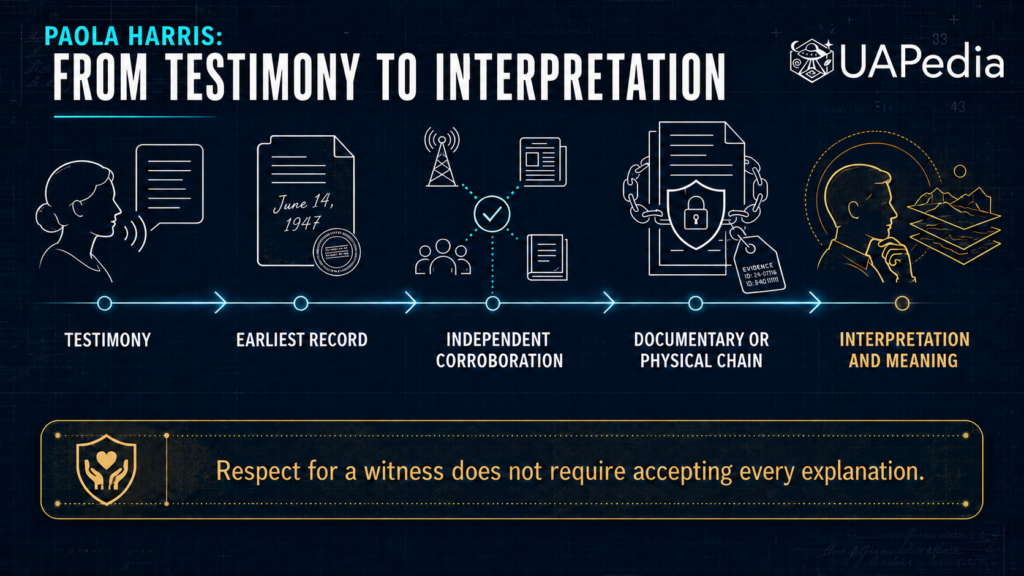
An interview does not prove that an extraordinary event occurred. It establishes that a person made a particular statement under identifiable circumstances.
That distinction is central to responsible experiencer research.
A witness may describe an event honestly while being mistaken about its cause. Memory can change over time, especially when an experience is repeatedly retold. Later reading, conversations with other experiencers and exposure to familiar UAP imagery may influence how an event is interpreted.
Emotional conviction can demonstrate that an experience had a profound effect. It does not, by itself, establish that the witness’s explanation is correct.
Testimony nevertheless remains a legitimate form of evidence. Historians, courts, accident investigators and journalists regularly depend on witnesses. The question is not whether testimony should be accepted or rejected as a whole. The question is how much weight it should carry in a particular case.
Testimony becomes stronger when it is recorded close to the event, remains consistent, includes details not publicly known and receives independent corroboration. It gains further weight when supported by photographs, documents, physical traces or sensor records.
It becomes weaker when major details emerge only decades later, when accounts change materially or when the witness has absorbed information from similar narratives.
Harris’s interviews are most useful when treated as preserved testimony. They document how witnesses described their experiences, what they believed those experiences meant and how those beliefs evolved.
NASA’s 2023 Unidentified Anomalous Phenomena Independent Study Team Report makes a similar distinction between the importance of reports and the limitations of unaided eyewitness evidence. It states that witness accounts can be compelling but are not reproducible and generally lack the information needed for definitive conclusions about UAP provenance. NASA therefore recommended standardised reporting, reliable metadata and scientifically calibrated observation.
Official report:
https://science.nasa.gov/wp-content/uploads/2023/09/uap-independent-study-team-final-report.pdf
AARO’s later work on narrative data addresses a related problem. UAP information is scattered across military records, civilian reporting systems, archival collections, interviews and social media. These sources differ greatly in structure and reliability, but they may still contain patterns worth examining.
The official title of the paper is 2025 UAP Workshop: Narrative Data, Infrastructures, and Analysis: Workshop Synthesis and Recommendations. It discusses fragmented reports, metadata, corroboration, integration of military and civilian information, and the cautious use of artificial intelligence.
Official paper:
https://www.aaro.mil/Portals/136/PDFs/Information%20Papers/2025_UAP_Workshop_Paper.pdf
Harris’s interview archive belongs within this wider evidentiary problem. It is not calibrated sensor data. It is narrative evidence requiring preservation, comparison and testing.
Connecting the Dots
Harris’s best-known early publication is Connecting the Dots: Making Sense of the UFO Phenomenon. The historical title uses “UFO” and should be reproduced exactly in bibliographical references.
The 2003 catalogue description states that the book contains 25 personal interviews with researchers and participants. Harris’s own description of the expanded 2008 edition refers to more than 30 interviews.
Google Books catalogue record:
https://books.google.com/books/about/Connecting_the_Dots.html?id=X_HDQgAACAAJ
Harris’s books page:
https://paolaharris.com/books
The difference is not necessarily contradictory. It reflects an expanded edition.
The title also captures Harris’s characteristic method. She places interviews beside one another and looks for recurring themes. These include military secrecy, alleged technological recovery, direct contact, spiritual transformation, telepathic communication and the possibility that consciousness plays a role in UAP encounters.
Pattern comparison can be valuable. Connections sometimes become visible only when accounts from different witnesses are examined together.
Similarity, however, does not automatically demonstrate a common cause.
Two witnesses may describe telepathy because they encountered the same form of intelligence. They may also use the term because telepathy is already deeply embedded in contact literature. A recurring motif is evidence of a pattern in testimony. It is not proof that every witness interacted with the same beings or mechanism.
Connecting the Dots is therefore best read as an oral history of a particular UAP research network. It preserves how influential participants described their work, beliefs and experiences at the beginning of the twenty-first century.
Publications and a widening idea of contact
Harris’s bibliography includes Exopolitics: All of the Above, UFOs: How Does One Speak to a Ball of Light?, Conversations with Colonel Corso and Trinity: The Best-Kept Secret, co-authored with Jacques Vallée.
The progression of these titles reflects an expanding research interest.
The traditional UAP question asks what an observed object was.
Harris increasingly asks who or what may be communicating and what contact would mean for human society.
That question is more ambitious and less easily tested. An object’s speed or direction may be estimated from reliable data. The intention of an alleged non-human intelligence is far more difficult to establish.
This difference places Harris primarily within contact and experiencer research rather than conventional aerospace analysis. She is less concerned with identifying a distant light than with understanding why some witnesses believe the light responded to thought.
Philip Corso and the reverse-engineering narrative
One of Harris’s most historically significant interview subjects was retired U.S. Army Lieutenant Colonel Philip J. Corso.
Publisher biographies state that Corso served in the United States Army from 1942 to 1963, reached the rank of lieutenant colonel, worked on President Dwight Eisenhower’s National Security Council staff and later served in Army Research and Development.
Publisher biography:
https://www.simonandschuster.com/authors/Philip-Corso/1246221
This source supports the broad outline of Corso’s career, but it is not an independent military personnel record. Simon & Schuster published The Day After Roswell and therefore has a commercial connection to Corso’s account. Exact postings and duties are better treated as publisher-reported biographical claims unless supported by service records, National Archives documents or other military documentation.
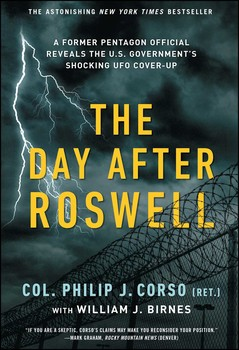
The available evidence nevertheless establishes that Corso had a genuine military career. It does not establish his later claims about recovered technology.
In The Day After Roswell, Corso alleged that material recovered from a non-human craft entered military custody and was later introduced into private research and industry. He associated the alleged material with fibre optics, integrated circuits and advanced materials.
No publicly available chain of custody demonstrates that these technologies originated in recovered non-human hardware. Their documented development involved numerous laboratories, scientists, industrial programmes and discoveries extending across decades.
Corso’s military background makes his testimony historically notable. It does not turn the testimony into verified evidence.
Harris’s professional biography states that she met and interviewed Corso in Roswell in 1997. She later published conversations and footage associated with him.
Harris biography:
https://paolaharris.com/biography
Corso-related material:
https://paolaharris.com/latest-news-paola-harris/3252
Her interviews allow researchers to compare Corso’s spoken descriptions with his published account and documented career.
The evidentiary picture remains mixed. Corso’s military service is supported. His alleged involvement with recovered non-human technology remains disputed.
AARO’s 2024 historical report states that it found no evidence that United States companies possessed off-world technology and no verified reverse-engineering programme of the type described in such allegations.
Official report:
https://www.aaro.mil/Portals/136/PDFs/AARO_Historical_Record_Report_Vol_1_2024.pdf
That conclusion is relevant but not absolute. An official review is shaped by its mandate, access, classification boundaries and available records. It should not be ignored, but neither should institutional status alone be treated as a guarantee of completeness.
Corrado Balducci and Catholic exotheology
Harris also interviewed Monsignor Corrado Balducci, an Italian Catholic theologian and cleric who had served in Vatican-related roles.
Balducci spoke publicly about the possibility of extraterrestrial life. His remarks are sometimes presented as though they constituted an official Vatican confirmation of non-human visitation. They did not.
No formal declaration from the Holy See has been identified endorsing his conclusions. The distinction that he spoke personally rather than institutionally follows from the absence of formal Vatican adoption of his statements.
Balducci’s position was essentially theological. He argued that intelligent life beyond Earth would not necessarily contradict Christian belief.
A Catholic Review discussion of Balducci and later Catholic engagement with extraterrestrial-life questions provides a more cautious institutional context:
https://catholicreview.org/ufos-extraterrestrial-life-explored-at-vatican-parish-event
Harris’s work also preserves interviews and discussions involving Balducci. Where possible, researchers should favour recordings or transcripts of his own words over later summaries.
The importance of Balducci lies not in proving contact, but in showing that extraterrestrial intelligence can be discussed within Catholic theology without automatically overturning doctrine.
His remarks open questions that reach beyond aerospace science. If non-human intelligence exists, how might religious traditions classify it? Would such beings be understood as biological creatures, spiritual entities, morally independent persons or something outside existing categories?
These questions cannot establish that contact has occurred. They demonstrate why UAP contact claims have implications for religion, philosophy and human identity.
The Italian Friendship case
A major area of Harris’s contact research concerns the Italian Friendship case, usually known as Amicizia.
The narrative developed from a network of Italian witnesses who claimed sustained interaction with human-looking non-human beings during the second half of the twentieth century. Reported elements include hidden facilities, requests for food and supplies, direct meetings, unusual communications and conflict between groups of entities.
These details come primarily from retrospective witness testimony, private collections and later publications. They have not been independently established through publicly accessible contemporaneous records.
A principal published source is Stefano Breccia’s Mass Contacts, which presents the Friendship narrative and associated witness material. The book is a near-primary source because Breccia described himself as connected to participants in the case, but it is not independent verification.
Breccia, S. (2009). Mass Contacts. AuthorHouse.
Harris has discussed Friendship material in interviews and presentations, treating it as a long-duration contact case rather than a brief sighting.
The distinction matters. The witnesses did not describe merely observing an object. They described participation in an ongoing relationship.
The case resembles older contactee narratives in which selected individuals meet benevolent or instructive visitors. It also echoes religious and folkloric traditions involving hidden teachers who appear human, reveal specialised knowledge and warn of moral, technological or ecological danger.
These parallels permit several interpretations.
They may indicate that similar intelligences have interacted with human societies across time. They may show that witnesses use familiar cultural patterns to describe anomalous experiences. They may also suggest that an external phenomenon and human symbolism interact during the encounter.
Harris generally favours interpretations in which at least part of the experience represents genuine contact.
The available public evidence does not currently verify that conclusion.
The Italian Friendship case should therefore be preserved as testimony, examined through original Italian sources and compared with other contact traditions. It should not be presented as established interaction with non-human beings.
Trinity and the limits of retrospective investigation
Harris’s most debated investigation concerns the alleged 1945 Trinity crash near San Antonio, New Mexico.
The principal witnesses, José Padilla and Remigio “Reme” Baca, said that they encountered an avocado-shaped craft on ranchland when they were children. Their later accounts included small occupants, unusual material and a military operation that allegedly removed the object.
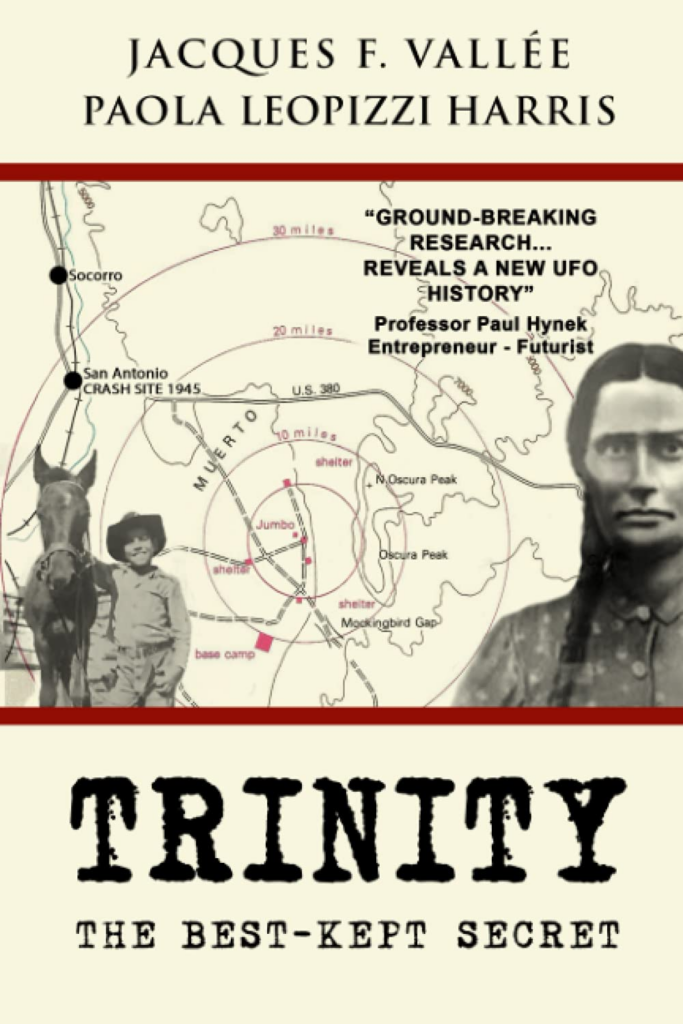
Harris interviewed the witnesses and brought the case to Jacques Vallée. Their joint investigation became Trinity: The Best-Kept Secret, published in 2021.
WorldCat record:
https://search.worldcat.org/title/1256820350
The timing made the story particularly provocative. The alleged event was placed only weeks after the first atomic bomb test and almost two years before Roswell.
If accurate, the case could suggest that anomalous intelligence displayed an early interest in nuclear weapons. That possibility remains a hypothesis, not an established implication.
Harris and Vallée presented witness recollections, site details and alleged material evidence as reasons for continued investigation.
The case also attracted detailed criticism.
Researcher Douglas Dean Johnson examined earlier interviews, biographical claims and historical records associated with the story. He argued that an earlier recorded account by Baca differed materially from the later narrative and that several supporting details did not survive documentary examination.
Johnson’s analysis:
https://douglasjohnson.ghost.io/crash-story-the-trinity-ufo-crash-hoax/
Johnson characterises the story as a hoax. That conclusion should be attributed to him rather than presented as an established fact. Demonstrating a hoax requires evidence of purposeful deception, not merely inconsistency or weak documentation.
WIRED reported that Vallée’s decision to work with Harris caused disagreement within the UAP research community.
WIRED profile:
https://www.wired.com/story/jacques-vallee-still-doesnt-know-what-ufos-are/
The Trinity case remains disputed because the public record contains major evidentiary gaps.
No authenticated military recovery document establishes the removal of a non-human craft. No publicly tested sample with a secure chain of custody demonstrates non-terrestrial manufacture. No known contemporaneous document records the crash as it was later described.
The witnesses’ testimony remains part of the historical record. The literal crash claim has not been verified.
Classifying Trinity as disputed is not a way of avoiding judgment. It is the conclusion that best reflects the current evidence.
Harris’s explanation of the contact phenomenon
Harris’s work becomes most distinctive when she attempts to explain the wider pattern behind the interviews.
Several themes recur across her publications. Witnesses describe humanity as observed rather than alone. Nuclear weapons appear as points of concern. Communication may occur through telepathy, dreams or imagery. Some reported beings look surprisingly human. Encounters may produce significant changes in spirituality, identity or environmental concern.
Harris often interprets these recurring themes as signs that contact is already developing outside formal institutions.
That interpretation is coherent within her work, but it must be separated from the underlying evidence. The recurrence of themes can be documented. Their cause remains uncertain.
One explanation is that witnesses are reporting interactions with one or more genuine non-human intelligences.
A second is that shared media, religious symbolism and UAP culture shape how ambiguous experiences are perceived and remembered.
A third combines both possibilities. An external anomaly may be present while human consciousness influences the form in which it is experienced and recalled.
This interaction model resembles theories developed by researchers who question whether UAP can be understood solely as conventional spacecraft.
Its weakness is that it can become difficult to falsify. Contradictions may be explained as effects of consciousness, symbolism or an intelligence controlling perception.
Consciousness-based explanations should therefore remain hypotheses until they produce clear, testable predictions.
StarworksUSA and contact culture
Harris operates and produces UAP-related conferences, interviews and educational events through StarworksUSA.
StarworksUSA profile:
https://starworksusa.com/presenters/paola-leopizzi-harris
The available presenter biography identifies her as a producer and central figure associated with the organisation. It does not, by itself, provide a complete legal or corporate history establishing the exact circumstances of its founding.
StarworksUSA events bring witnesses, researchers and members of the public into a shared interpretive environment. Participants may hear accounts similar to their own, acquire specialised terminology and connect private experiences with established cases.
Such communities can offer witnesses a setting in which they are heard without immediate ridicule.
They can also influence interpretation. Once a person becomes familiar with concepts such as downloads, hybrids, telepathic contact or missing time, an ambiguous memory may be reorganised around those ideas.
This does not demonstrate that the original experience was false. It means the social environment becomes part of the case history.
Claims that Harris’s activities have reduced stigma or moved experiencers from isolation to belonging are plausible interpretations. Their scale has not been established through controlled studies or comprehensive participant research.
Controversies and competing assessments
The most persistent criticism of Harris concerns the boundary between documentation and endorsement.
Her interviews are generally sympathetic. She gives witnesses space to explain what happened and what they believe it means. This may produce testimony that would not emerge in a hostile or narrowly structured interview.
It can also reduce adversarial testing.
A rigorous investigation should ask when the account was first recorded, whether earlier versions exist, which details are independent and whether the witness had prior exposure to similar stories. It should examine documentary gaps, conflicts of interest and conventional alternatives.
Harris’s public work often devotes more attention to the internal meaning of testimony than to formal attempts at falsification.
Supporters argue that conventional journalism has frequently failed UAP witnesses by beginning with ridicule or automatic dismissal. They see Harris’s method as a corrective.
Critics answer that respect for a witness does not require acceptance of the witness’s explanation.
Both observations are relevant. Harris’s interviews can preserve valuable testimony. That testimony still requires independent verification.
Her place in experiencer research
Harris represents a model of investigation in which the witness’s life after an event matters alongside the original observation.
An encounter may affect relationships, identity, career, religion and mental health. These consequences can be studied even when the event’s external cause remains unresolved.
This is particularly important in contact and abduction research. A witness may have no photograph, instrument reading or physical trace, yet still experience lasting fear, fascination or ontological shock.
Responsible research should not force that person into a choice between unquestioned belief and contemptuous rejection.
Investigators can recognise that an experience had profound consequences while remaining uncertain about what caused it.
Harris’s clearest contribution lies in listening, recording and placing testimony within a wider cultural history.
Future research can strengthen this archive through full transcripts, original recordings, precise dates, independent document searches and clearer separation between observation, memory, inference and interpretation.
Implications for future research
The career of Paola Leopizzi Harris reveals both the importance and the fragility of experiencer testimony.
Oral histories should be recorded before witnesses and investigators are lost. Original audio and video should be preserved. Transcripts should identify the interview date and disclose whether statements were edited.
Researchers should distinguish immediate recollection from later reconstruction. Material remembered before hypnosis should not be blended with details produced during regression. Direct observation should be separated from what the witness later inferred.
Physical evidence should be documented through a secure chain of custody. Alleged materials should be tested by independent laboratories using agreed methods. Negative or inconclusive findings should be published alongside positive results.
Official investigations and civilian archives should be compared rather than treated as mutually exclusive. Government systems may contain sensor information unavailable to private researchers. Civilian investigators may preserve witness histories that official agencies do not collect.
Most importantly, unresolved cases should remain unresolved.
Uncertainty is not a failure of research. It is often the most accurate description of the evidence.
Claims taxonomy
Verified
Paola Leopizzi Harris is publicly described in her professional biographies as an Italian-American photojournalist, investigative reporter, author and conference organiser.
Her biographies state that she began studying extraterrestrial-related phenomena in 1979.
Catalogue metadata records 1956 as her reported birth year.
She authored Connecting the Dots: Making Sense of the UFO Phenomenon and other books concerning UAP, contact and exopolitics.
The 2003 catalogue description of Connecting the Dots refers to 25 interviews, while Harris’s description of the expanded 2008 edition refers to more than 30.
She interviewed Philip J. Corso and published material concerning their conversations.
She co-authored Trinity: The Best-Kept Secret with Jacques Vallée.
She operates and produces UAP-related conferences and educational events through StarworksUSA.
Probable
Harris’s recorded interviews probably preserve the general beliefs and recollections expressed by her subjects at the time of recording.
Her international connections probably enabled some local or foreign-language testimony to reach a wider audience.
Her witness-centred method may have encouraged some experiencers to speak more openly, although the scale of that effect has not been systematically measured.
Disputed
The Trinity crash claim is disputed because of inconsistent accounts, retrospective testimony and the absence of conclusive physical or documentary evidence.
Corso’s claim that recovered non-human technology was transferred into industry remains disputed.
The Italian Friendship case remains disputed because it relies heavily on testimony, private collections and later publications.
The interpretation of repeated contact motifs as evidence of a common non-human source remains disputed.
Legend
Accounts of hidden communities of human-looking visitors, cosmic alliances and benevolent teachers have become part of modern UAP legend.
This classification concerns their cultural status. It does not automatically establish that every originating experience was false.
Misidentification
No single misidentification explains Harris’s complete archive. Individual sightings discussed in interviews may nevertheless involve aircraft, satellites, planets, balloons, atmospheric effects or perceptual error.
Hoax
There is no reliable evidence that any of Harris’s career investigations are based on deliberate deception.
Douglas Dean Johnson has characterised the Trinity account as a hoax. That remains an attributed researcher assessment rather than an established classification accepted across the field.
A hoax label should be applied only to a specific case when purposeful fabrication or misdirection can be demonstrated.
Speculation labels
Hypothesis
Some recurring patterns documented by Harris may represent contact with one or more forms of non-human intelligence.
A second hypothesis is that UAP contact involves interaction between an external anomaly and human consciousness, producing experiences containing both physical and symbolic elements.
A third hypothesis is that many similarities arise from shared culture, memory reconstruction, psychological expectation and contact-community influence.
No current model conclusively explains the full range of testimony Harris has collected.
Witness Interpretation
Participants in the Italian Friendship case interpreted their experiences as sustained interaction with human-looking non-human beings.
José Padilla and Reme Baca interpreted the alleged Trinity object as an anomalous craft containing non-human occupants and later removed by military personnel.
Philip Corso interpreted his alleged access to unusual material as evidence that recovered non-human technology entered military and industrial research.
These interpretations belong to the witnesses. They have not been independently verified as factual conclusions.
Researcher Opinion
Harris’s publications indicate that she regards contact with non-human intelligence as real and already developing through individual witnesses.
Some researchers consider her interviews valuable oral history but believe her conclusions extend beyond the available evidence.
The most evidence-weighted assessment is that her archive is historically significant while each underlying case must be evaluated according to its own corroboration, documentation and physical evidence.
References
All-domain Anomaly Resolution Office. (2024). Report on the historical record of U.S. government involvement with unidentified anomalous phenomena, Volume I. U.S. Department of Defense. https://www.aaro.mil/Portals/136/PDFs/AARO_Historical_Record_Report_Vol_1_2024.pdf
All-domain Anomaly Resolution Office. (2025). 2025 UAP workshop: Narrative data, infrastructures, and analysis: Workshop synthesis and recommendations. U.S. Department of Defense. https://www.aaro.mil/Portals/136/PDFs/Information%20Papers/2025_UAP_Workshop_Paper.pdf
Breccia, S. (2009). Mass contacts. AuthorHouse.
Corso, P. J., & Birnes, W. J. (1997). The day after Roswell. Pocket Books.
Harris, P. L. (2003). Connecting the dots: Making sense of the UFO phenomenon. Wild Flower Press.
Harris, P. L. (2009). Exopolitics: All of the above. AuthorHouse.
Harris, P. L. (2012). UFOs: How does one speak to a ball of light? AuthorHouse.
Harris, P. L. (n.d.). Biography. https://paolaharris.com/biography
Harris, P. L. (n.d.). Books. https://paolaharris.com/books
Internet Archive. (n.d.). Connecting the dots: Making sense of the UFO phenomenon. https://archive.org/details/connectingdotsma0000harr
Johnson, D. D. (2022). Crash story: The Trinity UFO crash hoax. Mirador. https://douglasjohnson.ghost.io/crash-story-the-trinity-ufo-crash-hoax/
National Aeronautics and Space Administration. (2023). Unidentified anomalous phenomena independent study team report. https://science.nasa.gov/wp-content/uploads/2023/09/uap-independent-study-team-final-report.pdf
Simon & Schuster. (n.d.). Philip Corso: Author biography. https://www.simonandschuster.com/authors/Philip-Corso/1246221
StarworksUSA. (n.d.). Paola Leopizzi Harris. https://starworksusa.com/presenters/paola-leopizzi-harris
Vallée, J. F., & Harris, P. L. (2021). Trinity: The best-kept secret. StarWorksUSA and Documatica Research.
WIRED. (2022). Jacques Vallée still doesn’t know what UFOs are. https://www.wired.com/story/jacques-vallee-still-doesnt-know-what-ufos-are/
WorldCat. (2021). Trinity: The best-kept secret. https://search.worldcat.org/title/1256820350
SEO keywords
Paola Leopizzi Harris, Paola Harris journalist, Paola Harris biography, UAP journalist, experiencer research, contact investigators, UAP contact testimony, StarworksUSA, Connecting the Dots Paola Harris, Exopolitics All of the Above, Trinity Best-Kept Secret, Jacques Vallée Paola Harris, Trinity UAP case, José Padilla, Reme Baca, Italian Friendship case, Amicizia contact case, Stefano Breccia Mass Contacts, Philip Corso interview, Corrado Balducci extraterrestrial life, Catholic exotheology, contact experiences, UAP oral history, experiencer testimony, non-human intelligence contact, consciousness and UAP, witness reliability, UAP disclosure journalism, UAP researchers