Grant Cameron began with an unusual light in the Manitoba sky. Decades later, his research asks a far more unsettling question: what if the witness is not simply observing the UAP phenomenon, but participating in it?
That question places Cameron within a distinctive branch of experiencer research. His work does not focus only on the apparent shape, speed or origin of objects. It also examines sudden insights, perceived telepathy, altered states, synchronicities, creative inspiration and the lasting changes reported by people after encounters.
For Cameron, the story of UAP is not merely a story about objects entering human airspace. It may also concern information entering human consciousness.
This idea remains unproven. It is also increasingly difficult to ignore as a research question. Across decades of testimony, some witnesses have reported much more than lights or structured craft. They describe impressions that feel communicated, an unusual certainty about what they have encountered, changes in personality and purpose, and experiences that continue long after the visible event has ended.
Cameron’s contribution has been to collect these accounts, compare their recurring features and argue that the interior life of the witness belongs inside the evidence file.
Unless otherwise stated, numerical descriptions of Cameron’s witness collections, personal experiences and publication output derive from Cameron’s own interviews or publication materials. These sources are useful for documenting what Cameron says he experienced, investigated or concluded, but they do not independently verify the anomalous causes he proposes.
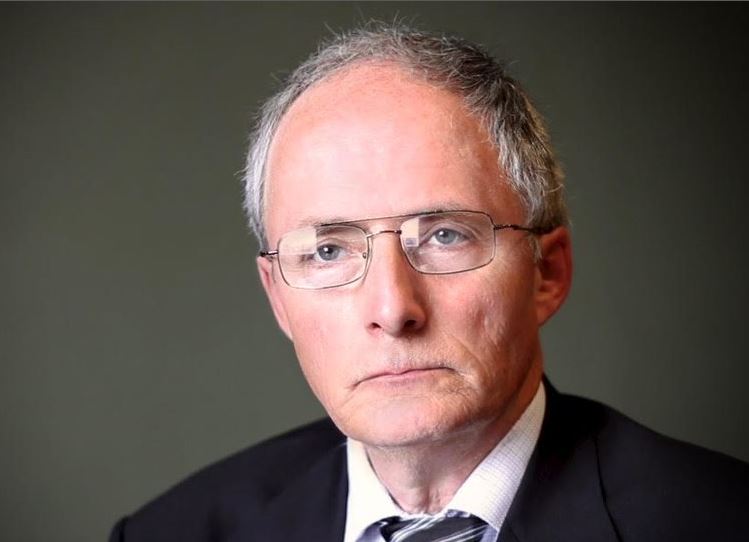
The Manitoba wave that started everything
During the 1975 Charlie Red Star wave, Cameron, then a university student, reported seeing the phenomenon repeatedly.
Southern Manitoba was experiencing an extended period of unusual aerial reports. Residents described red or orange lights appearing over the region, sometimes on successive nights. One recurring object became known locally as Charlie Red Star. Cameron later said he joined other observers in following the reports, organizing viewing trips and bringing people into the countryside to watch the sky.
Dundurn Press, the publisher of Cameron’s book Charlie Red Star, describes the episode as a major wave of sightings that lasted for well over a year. Its account identifies Cameron as a repeated witness who led viewing tours for other observers. The publisher also notes that journalists, photographers and local residents contributed testimony to the historical record (Cameron, 2017).
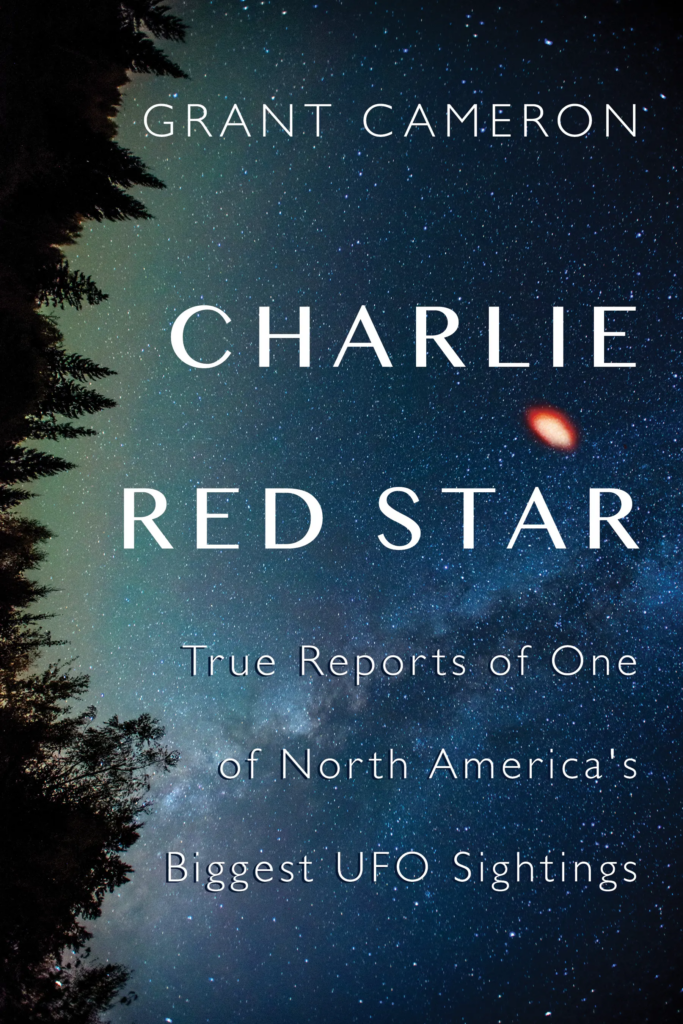
The broad historical outline of a regional reporting wave and Cameron’s subsequent involvement is documented. A wave occurred. Cameron became publicly associated with it as a witness and later as a chronicler. Numerous residents reported unusual lights, and the episode entered Canadian UAP history.
What caused the sightings is much less certain.
Cameron has explored possible associations with military and nuclear activity south of the Canadian border. Such associations remain speculative unless an identifiable operation can be linked directly to a particular observation. A suggestive location, military rumor or chronological overlap does not establish causation.
Nor should every report grouped under the name Charlie Red Star be assumed to describe the same object. During a long regional wave, separate observations may involve different causes. Some may eventually prove conventional. Others may remain unexplained because the original information is incomplete.
The evidentiary strength of Charlie Red Star lies in the repetition of reports and the number of people who became involved. Its weakness is the absence of a modern, calibrated sensor package capable of establishing distance, altitude, velocity, physical dimensions and flight path.
For Cameron, however, the wave was important for another reason. It showed that a UAP event can transform a community of observers. People changed their evening routines, drove into the countryside, exchanged reports and began watching the sky as though it might respond.
The phenomenon became more than a distant light. It became a relationship between an aerial stimulus, a landscape, a group of witnesses and their growing expectations.
From government records to the mind of the witness
Cameron spent much of his early research career examining political history, archival records and government interest in UAP. His projects explored Canadian reporting systems, presidential knowledge, intelligence-linked witnesses and the gradual public release of information.
That archival work had a firm historical foundation.
Canada operated several official or semi-official UAP-related initiatives, including Project Magnet and Project Second Storey. Responsibility for receiving reports later passed to the National Research Council. The NRC continued collecting reports until 1995, after which the records were transferred to Library and Archives Canada.
The Sky Canada report estimates that the surviving government collection contains approximately 15,000 pages, of which about 9,500 had been digitized. It also describes a fragmented reporting environment in which information was received by different organizations, recorded inconsistently and rarely integrated into a unified scientific system (Office of the Chief Science Advisor, 2025, pp. 24–26).
These records demonstrate institutional activity. They show that Canadian authorities received reports, discussed cases and preserved documentation. They do not prove that officials identified the source of Charlie Red Star or any other particular event.
This distinction is central to Cameron’s work. Government records are reliable evidence of what an agency received, recorded, funded or communicated. They are not automatically complete accounts of what occurred. Official files can contain errors, unresolved interpretations, missing records and institutional assumptions. They can also document genuine uncertainty.
Cameron gradually concluded that government archives were only one part of the puzzle. They might reveal how institutions managed UAP information, but they did not fully explain what witnesses experienced.
His attention therefore moved from the management of the mystery to the nature of the encounter itself.
The 2012 “download”
Cameron identifies 2012 as a turning point.
In a 2025 interview, he said he was listening to researcher Colin Andrews at an event in Nevada when an idea arrived with unusual force and clarity. Cameron described the experience as a “download.” The insight, as he understood it, was that consciousness was not a peripheral feature of the UAP phenomenon. It was central to it (Cameron, 2025a).
This was Cameron’s personal account of a sudden realization. It was not a controlled test and does not establish that information entered his mind from an external intelligence.
The experience is nevertheless relevant to his intellectual history. From that point onward, his research increasingly concentrated on experiencers, altered states, apparent telepathy, intuitive information and the possibility that UAP interaction involves both physical and mental components.
Cameron stated in the same interview that he had produced approximately 22 books and 300 podcast episodes. Those totals are best understood as his own account of his output rather than an independently audited bibliography. His wider body of work is substantial in any case, spanning books, interviews, lectures and long-form discussions with witnesses.
The “download” also illustrates one of the central problems in consciousness research. People frequently distinguish ordinary thought from information that seems to arrive fully formed. They may experience it as foreign, unusually coherent or accompanied by powerful certainty.
That phenomenology can be documented. Its source is harder to determine.
A sudden insight may arise from subconscious integration, memory, intuition, dissociation, creative association or an altered cognitive state. Cameron’s hypothesis allows for another possibility, namely information acquired through a non-ordinary interaction. At present, no method reliably distinguishes among these causes solely from the witness’s feeling of certainty.
What Cameron means by consciousness
Calling Cameron a consciousness researcher requires some precision. He is not a neuroscientist directing a laboratory program, and his work should not be confused with clinical brain research.
His method is independent, comparative and testimony-centered. He interviews experiencers, studies archival material, follows repeated motifs and considers whether apparently different anomalous experiences might be related.
In Cameron’s framework, consciousness is more than wakefulness or private awareness. It may function as an interface between the witness and the phenomenon.
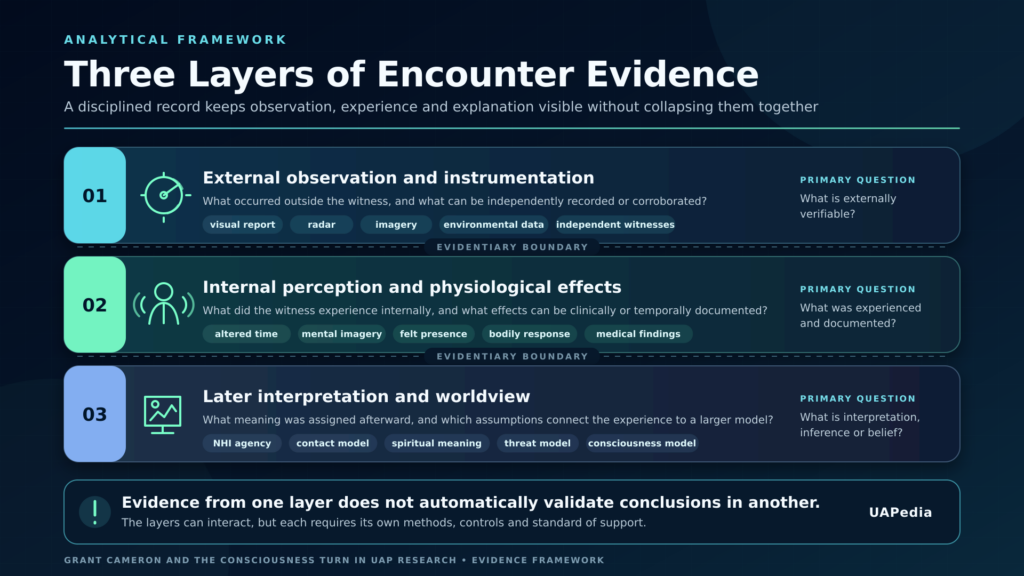
A UAP encounter, viewed this way, can contain three intertwined layers. There may be an external event, such as a light, structured object or apparent entity. There may also be an internal event, including altered time, bodily sensations, sudden imagery, perceived telepathy or an unexplained sense of knowing. Finally, there is the witness’s later interpretation of what happened.
Traditional case investigation tends to privilege the first layer. Researchers measure direction, duration, shape and motion while treating psychological effects as secondary consequences.
Cameron argues that this division may remove the very feature that makes some encounters unusual. The mental and physical aspects, he suggests, may form one interactive event.
His book Contact Modalities, written with Desta Barnabe, places UAP contact alongside meditation, dreams, remote viewing, channeling, hypnosis, psychedelic states and other altered or focused conditions (Cameron & Barnabe, 2020). The central idea is not simply that these experiences feel unusual. It is that they may represent different routes into the same underlying territory.
That is a broad hypothesis, not an established classification.
Meditation, sleep paralysis, psychedelic experiences, dreams and luminous aerial observations can resemble one another at the level of emotion, imagery or meaning while having entirely different causes. Similarity does not prove a shared mechanism.
Cameron’s strength is his willingness to compare the categories. His methodological danger is the temptation to treat recurring language or symbolism as evidence that every category originates from one source.
Case study: Charlie Red Star as a social encounter
Charlie Red Star remains Cameron’s foundational case because it began as an apparently external event.
Observers reported lights in a defined geographical region. Cameron says he saw the phenomenon repeatedly. Journalists and local witnesses contributed accounts. The reports were not originally framed as dreams, meditation experiences or private visions.
Yet the longer the wave continued, the more it changed the behavior of the witnesses. People gathered, compared observations and developed expectations about where and when the phenomenon might appear.
That transformation makes the case valuable to consciousness research even without assuming that consciousness caused the sightings.
A UAP wave is partly an aerial event and partly a human network. Witnesses influence where others look. Media reports shape anticipation. Familiar descriptions affect later vocabulary. Repeated observation can improve recognition, but it can also create expectation effects.
An adequate investigation must therefore preserve both sides of the case. It should ask what appeared in the sky and how the community’s perception evolved around it.
Cameron’s later consciousness model can be read as an extension of that lesson. The witness is never a passive camera. Attention, memory, culture and expectation are always present.
The unresolved issue is whether those factors merely shape the interpretation of an external event or sometimes participate in the event itself.
Case study: the people who say they piloted craft
One of Cameron’s most unusual research collections involves experiencers who report that they were allowed to operate an advanced craft.
Cameron has stated that the investigation began after a woman told him she had piloted such a vehicle. He initially found the claim difficult to accept. He later said he identified more than 50 people with broadly similar accounts and interviewed more than three dozen of them.
These figures come primarily from Cameron’s own statements and publication material. They document the scale he assigns to his collection, but they have not been independently audited.
The accounts reportedly contain recurring elements. Some witnesses describe a vehicle controlled by thought rather than mechanical instruments. Others speak of being taught rather than tested. Some report an immediate familiarity with the craft or a feeling that they already understood how it worked.
The appearance of a recurring motif is noteworthy. It does not, by itself, establish that witnesses physically operated non-human vehicles.
The independence of the reports matters enormously. Researchers would need to know whether witnesses had read similar books, attended the same conferences, listened to Cameron’s interviews or encountered the motif through online communities. Interview questions would need to be preserved so that later reviewers could identify prompting or suggestions.
The strongest conclusion presently available is that the sky-pilot motif exists within experiencer testimony.
Its cause remains unresolved.
Literal participation in an external craft is one possibility asserted by some witnesses. Other possibilities include immersive altered states, dream experiences, symbolic narratives, screen-like memories, hypnotic influence or culturally shared imagery. More than one cause may be operating across the collection.
A proper comparative study would preserve the original language of each witness, establish when each account was first recorded and measure how much prior exposure the individual had to similar narratives.
The FREE experiencer survey
The large experiencer survey associated with the Dr. Edgar Mitchell Foundation for Research into Extraterrestrial and Extraordinary Experiences offers useful context for Cameron’s witness-centered approach.
The published study analyzed responses from 3,256 self-identified contact experiencers. Participants completed extensive questionnaires concerning physical events, non-physical experiences, perceived telepathy, entities, life changes and emotional consequences (Hernandez et al., 2018).
Among respondents answering the relevant evaluative questions, a majority characterized their experiences or resulting life changes positively. Other respondents described fear, distress or harmful consequences.
The survey is important because it captures the range of experiences people associate with contact. It shows that the reported phenomenon often extends beyond the classic image of a physical abduction.
It was, however, a self-selected experiencer survey. The respondents were not drawn randomly from the general population. Its findings cannot establish how common these experiences are across society. Nor can questionnaire responses independently confirm the presence of NHI.
The study documents reports, interpretations and consequences. It does not determine the ultimate cause of the experiences.
That distinction does not make the survey unimportant. Large collections can reveal patterns that deserve controlled study. They can identify recurring effects, language and emotional outcomes. They can also help clinicians and investigators understand that experiencers do not form a single psychological category.
Case study: Chris Bledsoe and meaning in music
Cameron’s work with the testimony of North Carolina experiencer Chris Bledsoe demonstrates how he follows an encounter beyond the original sighting.
Bledsoe reports that a 2007 event near the Cape Fear River involved luminous spheres, missing time and an apparent interaction that felt responsive to thought. Other people in the group reportedly observed unusual lights, while members of Bledsoe’s family later described additional events.
The presence of additional reported witnesses potentially increases evidentiary value, although their accounts require individual documentation and independence analysis. Publicly available evidence does not provide a calibrated sensor reconstruction capable of establishing the distance, size or origin of the reported objects.
Cameron later said that Bledsoe conveyed a message attributed to beings he called the Guardians. According to Cameron’s publication account, the message suggested that meaning could be found in music.
Cameron followed that idea into research on musicians who reported UAP sightings, dreams, unusual inspiration or contact-like experiences. The investigation contributed to his book Tuned In, which explores the possibility that creative inspiration can function as a contact modality (Cameron, 2017b).
The documented elements are clear. Bledsoe reported a message, and Cameron reorganized part of his research around it.
The identity and existence of the alleged communicators remain unverified. The suggestion that an external intelligence intentionally communicates through music is a witness interpretation and researcher hypothesis.
Still, the broader research question is legitimate. Experiencers frequently describe meaning arriving indirectly, through dreams, lyrics, coincidences, images or sudden insight. Such claims can be investigated without assuming in advance that every coincidence was arranged.
Specific information should be recorded before an outcome occurs. Predictions should be timestamped. Independent analysts should assess whether the information is unusual, accurate and unavailable through ordinary means.
The more specific and prospective the information, the stronger the test.
Mount Shasta and initiated contact
Cameron has also participated in gatherings intended to invite contact.
His publication material describes events at Mount Shasta in which groups used meditation, focused intention and practices associated with contact traditions. Participants later reported lights, communications and unusual subjective experiences.
These events occupy a difficult space between field investigation and ritual.
They offer a potential scientific advantage because an intentional-contact claim can be tested prospectively. Researchers can identify a location, time and expected event before an observation period begins.
They also create serious confounding factors. Participants often arrive expecting an extraordinary experience. Group members can influence one another’s attention. Satellites, stars, aircraft and atmospheric effects may acquire greater significance in an emotionally charged setting.
A light appearing after meditation does not establish that meditation caused the light.
The most productive response is not to dismiss such events or declare them successful on testimony alone. It is to improve their design.
Predictions can be recorded and sealed in advance. Multiple cameras can be synchronized and positioned far enough apart to permit triangulation. Observers who do not know what is expected can be included. Satellite, astronomical and air-traffic data can be checked. Nights without apparent results should be reported alongside successful nights.
Cameron’s participation in such events marks an important change in his role. He is no longer only documenting what others say happened. He is entering the practice as a participant-observer.
That can produce insight, but it also increases the need for independent verification.
Psilocybin, revelation and the question of source
Cameron’s exploration of altered states eventually included recorded psilocybin sessions, which he discussed in Breakthrough.
His publication material describes a series of experiences informed, at least in part, by protocols used in university psychedelic research.
Modern clinical studies show that psilocybin can produce experiences perceived as mystical, deeply meaningful and personally transformative. The influential Johns Hopkins research led by Roland Griffiths found that participants could continue to regard a controlled session as one of the most significant experiences of their lives (Griffiths et al., 2006).
Those findings help explain why a person may experience a psychedelic state as revelatory. They do not establish that the content originates from an external intelligence.
A privately documented session is not equivalent to a clinical trial. It lacks randomization, placebo controls, blinded assessment and independent replication. Its psychological value can be genuine while its apparent source remains unknown.
This distinction is especially important because altered states can carry risks. Clinical psychedelic research includes participant screening, preparation, controlled dosing, supervision and follow-up. Cameron’s accounts should not be interpreted as guidance for unsupervised drug use.
A scientifically credible program examining psychedelics and UAP experiences would require legal approval, medical safeguards, informed consent and independent ethical oversight.
The deeper question remains open. Do altered states merely generate contact-like content from within the mind, or can they sometimes increase access to information that is not ordinarily available?
At present, the evidence does not resolve that question.
Trauma and anomalous sensitivity
Cameron has suggested that trauma may alter ordinary perception and increase sensitivity to anomalous experiences. He has sometimes described trauma as “ripping the veil.”
This idea should be treated as researcher opinion rather than established neurobiology.
Trauma can affect memory, attention, dissociation, threat processing and the assignment of significance. It can make experiences feel fragmented, unusually vivid or disconnected from ordinary time. These known effects may explain some features of contact narratives.
They do not demonstrate access to an external intelligence.
The subject deserves careful study because many experiencers report earlier trauma, encounter-related distress or profound psychological change. Yet researchers must avoid assuming that trauma either invalidates a witness or grants unusual perception.
Both conclusions exceed the evidence.
A trauma-informed approach should prioritize non-leading interviews, psychological safety, privacy and referral to appropriate clinical care when needed. It should not force a witness into either a pathological or supernatural interpretation.
What official studies contribute
No major official UAP study has validated Cameron’s consciousness model.
That is not the same as proving it false. Official studies have generally examined data collection, aviation safety, reporting systems and unresolved observations rather than mind-UAP interaction.
The Sky Canada Project, published in June 2025, focused on how Canada receives and manages public UAP reports. It did not attempt to determine the origin of UAP or verify particular contact claims. Its conclusions concerned fragmented reporting, inconsistent follow-up and the need for clearer procedures (Office of the Chief Science Advisor, 2025).
NASA’s 2023 independent study similarly focused on how better UAP data could be collected and evaluated. NASA’s continually updated FAQ page, last updated May 8, 2026, states that the agency has found no credible evidence of extraterrestrial life and that there is no evidence that UAP are extraterrestrial. NASA also emphasizes that the limited number of high-quality observations makes firm scientific conclusions difficult (National Aeronautics and Space Administration, 2023, 2026).
NASA’s position documents the agency’s current evidentiary judgment. It does not demonstrate that every unresolved observation has a conventional explanation.
Government-sponsored anomalous-cognition research is more directly relevant to Cameron’s interests.
Programs conducted at SRI and SAIC examined whether participants could describe distant or hidden targets under conditions intended to prevent ordinary access to the information. In the commissioned 1995 review, statistician Jessica Utts concluded that the results supported anomalous cognition under the examined experimental conditions. Psychologist Ray Hyman accepted that the statistical effects required scrutiny but disputed whether the evidence established a replicable paranormal mechanism. He also cautioned against assuming that statistically similar outcomes across different protocols represented one common phenomenon (Hyman, 1995; Utts, 1995).
The disagreement is more useful than a simplified verdict.
The program shows that anomalous cognition was considered testable and received sustained official attention. It does not establish that UAP communicates telepathically, that Cameron’s “download” had an external source or that remote viewing proved dependable enough for routine operational use.
Official research therefore leaves Cameron’s central hypothesis open but unsupported.
Psychology does not erase the witness
Experiencer research often becomes trapped between two extreme positions. One treats every extraordinary account as literal. The other assumes that any psychological factor makes the witness unreliable.
Neither approach is adequate.
A person can be sincere and mistaken about the cause. A person can also describe a genuine external event through incomplete memory, cultural language or an altered state. Emotional intensity does not prove external reality, but it does not prove fabrication either.
Susan Clancy, Richard McNally and colleagues studied people reporting recovered memories of alien abduction. Their research found that this group showed greater susceptibility to false recall and recognition than control participants (Clancy et al., 2002).
The finding applies to the studied population. It does not demonstrate that every contact memory is false.
A related study found measurable physiological responses when participants listened to scripts based on their reported abduction experiences. Heart rate, skin conductance and facial muscle activity showed that the memories carried significant emotional force (McNally et al., 2004).
Those reactions demonstrate that an experience can be psychologically and physically embodied. They do not establish what originally caused it.
This distinction is where Cameron’s witness-centered approach has value. Experiencers should not be regarded as defective measuring devices whose internal lives are irrelevant. Their testimony can preserve sequence, sensory detail, emotional consequence and recurring motifs.
Respect does not require automatic agreement.
Investigators can take witnesses seriously while examining memory, suggestion, cultural exposure and alternative explanations. In practice, this means recording testimony before introducing specialized vocabulary, avoiding leading questions and separating the original account from later interpretation.
Publications as an intellectual map
Cameron’s publications chart the development of his ideas.
Charlie Red Star preserves the case that began his involvement. Managing Magic examines secrecy, political authority and the possibility of controlled public acclimatization. Tuned In explores creativity and anomalous inspiration. Contact Modalities attempts to connect numerous pathways into non-ordinary experience. Sky Pilots focuses on reports of experiencers operating craft.
Later books expand into manifestations, altered states and disclosure. Beyond Managing Magic 2: Landing the Plane, published in 2025, returns to government secrecy through Cameron’s consciousness-centered framework.
Read together, the books form an intellectual autobiography.
Cameron did not abandon physical UAP cases. He placed them inside a larger proposed ecology that includes witnesses, institutions, altered states, symbolism, creativity and spiritual transformation.
That synthesis is both the attraction and the controversy of his work.
The major controversies
The first controversy concerns convergence.
Cameron often regards recurring patterns across independent testimonies as evidence that witnesses are approaching a common underlying reality. This can be persuasive when accounts are specific, genuinely independent and recorded before witnesses encounter one another.
It becomes less persuasive when people share the same media environment, attend the same conferences or adopt the language of influential researchers.
The second controversy concerns certainty.
Experiencers often say that information did not feel like an ordinary thought. They simply knew it. This sense of certainty is an important feature to document, but it does not independently verify the content.
The third controversy concerns quantum physics.
Cameron has suggested that quantum theory is moving toward a consciousness-first understanding of reality. Some interpretations of quantum mechanics do raise difficult questions about observation, measurement and information.
No accepted quantum theory currently demonstrates that human intention can summon UAP, produce telepathic contact or operate an advanced vehicle.
Quantum terminology can inspire research questions. It cannot substitute for a mechanism or experiment.
The fourth controversy concerns Managing Magic.
Cameron proposes that UAP information may be released gradually to acclimatize the public. Historical secrecy, selective disclosure, contradictory messaging and government influence over public narratives are well documented in many national-security contexts.
A single, unified acclimatization program is harder to establish.
Government institutions are not one mind. Agencies, contractors, elected officials, military offices, journalists and private researchers can pursue competing goals. Apparent coordination may sometimes emerge from institutional conflict rather than central design.
Cameron goes further by suggesting that the intelligence behind the phenomenon may also influence the pace of disclosure. That remains researcher opinion.
The fifth controversy is the investigator effect.
Because Cameron participates in altered-state and contact practices, his own expectations may influence what he notices, records and emphasizes.
This does not automatically invalidate his research. Participant-observation is an accepted method in fields such as anthropology. It does require reflexivity, transparent records and independent analysis.
Cameron’s impact on experiencer research
Cameron has been a prominent contributor to consciousness-centered and experiencer-oriented UAP discussion.
His most significant contribution may be his insistence that an encounter does not necessarily end when the object disappears.
For many witnesses, the aftermath becomes a larger story. They report changes in worldview, heightened intuition, recurring dreams, creative impulses, synchronicities, ecological concern and a sense of connection with a wider intelligence.
These changes do not prove the witness’s explanation. They are still part of the event’s human impact.
Cameron helped create a language for comparing such reports. His use of “contact modalities” brought together practices and experiences that had often been studied separately.
The framework raises useful questions. Are some forms of contact spontaneous while others are cultivated? Do particular mental states precede reports? Are there measurable physiological changes during apparent interaction? Which features recur across cultures, and which depend on local religious or technological imagery?
Cameron has also encouraged experiencers to record their stories. This archival impulse is valuable. Future researchers cannot examine testimony that was never preserved.
His prominence does not establish that his explanation is correct. It means he has helped define a research territory that more controlled studies may eventually explore.
Implications of the consciousness hypothesis
If consciousness plays an active role in some UAP encounters, researchers would need to rethink how evidence is collected.
The witness would become part of the instrument package.
Optical, infrared, radar and electromagnetic observations could be synchronized with heart rate, sleep state, attention, electroencephalography and time-stamped subjective reports.
The aim would not be to replace physical evidence with feelings. It would be to test whether reported moments of interaction correlate with measurable external or physiological changes.
Intentional-contact experiments could be preregistered. Participants could submit specific predictions before observation periods. Independent analysts could compare those predictions with sensor records. Control nights could be included, and failed sessions could be reported as carefully as apparent successes.
Experiencer interviews could also become more rigorous without becoming hostile. Researchers could preserve the witness’s language, distinguish contemporaneous notes from later recollection and document prior exposure to similar narratives.
If external anomalies repeatedly correlated with defined mental states under controlled conditions, Cameron’s hypothesis would gain support.
If no such relationship appeared, the research would still improve understanding of attention, expectation, memory, group experience and personal transformation.
Either outcome would be valuable.
A question worth testing
Grant Cameron is strongest as a collector of testimony, a historian of UAP discourse and a generator of unconventional research questions.
He is less persuasive when thematic convergence, personal certainty or quantum analogy is treated as evidence of mechanism.
Yet the question at the center of his work remains difficult to dismiss.
What if consciousness is not merely watching the phenomenon?
Answering that question requires more than belief and more than rejection. It requires transparent records, prospective experiments, independent replication and a willingness to study the human witness without reducing every encounter to either literal contact or psychological error.
Cameron began with lights over Manitoba. His later work suggests that the most important frontier may not be the distance between a witness and an object.
It may be the boundary between perception and participation.
Claims taxonomy
Verified
Grant Cameron has publicly documented his involvement in UAP research since the 1975 Charlie Red Star wave. He has published books and interviews concerning Canadian UAP history, government secrecy, experiencer testimony and consciousness.
A significant wave of aerial reports occurred in southern Manitoba in 1975. Canada also maintained historical UAP reporting and investigative activities through Project Magnet, Project Second Storey and the National Research Council.
The FREE Foundation conducted a large self-selected survey of people identifying as contact experiencers. Government-sponsored anomalous-cognition research was conducted at SRI and SAIC.
These findings verify that reports were made, records were created and research programs occurred. They do not verify every proposed explanation.
Probable
Cameron has been a prominent contributor to consciousness-centered and experiencer-oriented UAP discussion.
Recurring motifs such as perceived telepathy, altered time, sudden information and personal transformation are sufficiently widespread within testimony to justify systematic investigation.
Their recurrence as reported experiences is probable. A single external cause has not been established.
Disputed
The claim that consciousness is the primary mechanism underlying UAP remains disputed.
Accounts of experiencers literally operating advanced craft, receiving externally sourced downloads, communicating with named non-human beings or initiating contact through meditation have not been independently demonstrated to a scientific standard.
Cameron’s managed-acclimatization model and his view that NHI may influence disclosure are also disputed.
Legend
Named beings, Guardians, portals and spiritually framed contact narratives may be classified as contemporary contact legends when they are transmitted mainly through testimony and community retelling without independent physical corroboration.
This evidentiary label concerns transmission and corroboration. It does not make a judgment about the truthfulness or mental health of the witness.
Speculation labels
Evidence
Cameron’s involvement in the Charlie Red Star wave, his publications, his interviews and his collection of experiencer testimony are documented.
The Sky Canada report, NASA’s UAP study materials, the FREE experiencer survey and government-sponsored anomalous-cognition research are also documented.
Witness Interpretation
Claims involving telepathic communication, craft operation, named entities, responsive lights, portals or guidance through music represent meanings assigned by witnesses to their experiences.
These interpretations should be recorded accurately while remaining separate from verified external events.
Researcher Opinion
Cameron’s proposals that UAP disclosure is gradually managed, that NHI may influence the disclosure process, that trauma can increase anomalous sensitivity and that contact messages form a coordinated program are researcher opinions.
Hypothesis
The central hypothesis is that some UAP events interact with human consciousness in ways that produce correlated external, cognitive and physiological effects.
A related hypothesis is that focused intention or altered states may influence the timing or character of reported encounters.
Both hypotheses require controlled, preregistered and independently replicated research.
Impact speculation
The scientific and social impact would be considerable if consciousness-linked effects were demonstrated alongside external sensor anomalies.
Such findings could affect neuroscience, physics, communication theory, clinical practice and the study of intelligence.
Even without confirmation of NHI, Cameron’s material may contribute to research on transformative experience, memory, anomalous belief, creativity and experiencer welfare.
References
Cameron, G. (2017a). Charlie Red Star: True reports of one of North America’s biggest UAP sightings. Dundurn Press. https://www.dundurn.com/books_/t22117/a9781459737808-charlie-red-star
Cameron, G. (2017b). Tuned In: The paranormal world of music. It’s All Connected Publishing. https://itsallconnected.weebly.com/books.html
Cameron, G. (2017c). Managing Magic: The government’s UAP disclosure plan. It’s All Connected Publishing. https://itsallconnected.weebly.com/books.html
Cameron, G., & Barnabe, D. (2020). Contact Modalities: The keys to the universe. It’s All Connected Publishing. https://itsallconnected.weebly.com/books.html
Cameron, G. (2022). Sky Pilots. It’s All Connected Publishing. https://itsallconnected.weebly.com/books.html
Cameron, G. (2025a, March 7). UAP, consciousness and the paranormal: A deep dive with Grant Cameron [Podcast interview]. Haunted History Chronicles. https://www.podpage.com/haunted-history-chronicles/ufos-consciousness-and-the-paranormal-a-deep-dive-with-grant-cameron/
Cameron, G. (2025b). Beyond Managing Magic 2: Landing the Plane. It’s All Connected Publishing. https://itsallconnected.weebly.com/books.html
Clancy, S. A., McNally, R. J., Schacter, D. L., Lenzenweger, M. F., & Pitman, R. K. (2002). Memory distortion in people reporting abduction by aliens. Journal of Abnormal Psychology, 111(3), 455–461. https://doi.org/10.1037/0021-843X.111.3.455
Government of Canada, Office of the Chief Science Advisor. (2025, June). Management of public reporting of unidentified aerial phenomena in Canada: Report of the Sky Canada Project. https://science.gc.ca/site/science/sites/default/files/documents/sky-canada-report.pdf
Griffiths, R. R., Richards, W. A., McCann, U., & Jesse, R. (2006). Psilocybin can occasion mystical-type experiences having substantial and sustained personal meaning and spiritual significance. Psychopharmacology, 187, 268–283. https://doi.org/10.1007/s00213-006-0457-5
Hernandez, R., Davis, R., Scalpone, R., & Schild, R. (2018). A study on reported contact with non-human intelligence associated with unidentified aerial phenomena. Journal of Scientific Exploration, 32(2). https://journalofscientificexploration.org/index.php/jse/article/view/1344
Hyman, R. (1995). Evaluation of a program on anomalous mental phenomena. American Institutes for Research. https://nsarchive2.gwu.edu/NSAEBB/NSAEBB438/docs/doc_57.pdf
McNally, R. J., Lasko, N. B., Clancy, S. A., Macklin, M. L., Pitman, R. K., & Orr, S. P. (2004). Psychophysiological responding during script-driven imagery in people reporting abduction by space aliens. Psychological Science, 15(7), 493–497. https://doi.org/10.1111/j.0956-7976.2004.00707.x
National Aeronautics and Space Administration. (2023). UAP Independent Study Report. https://science.nasa.gov/uap/
National Aeronautics and Space Administration. (2026, May 8). UAP frequently asked questions. https://science.nasa.gov/uap/faqs/
Utts, J. (1995). An assessment of the evidence for psychic functioning. American Institutes for Research. https://www.ics.uci.edu/~jutts/air.pdf
SEO keywords
Grant Cameron, Grant Cameron consciousness researcher, UAP consciousness, experiencer research, Charlie Red Star, Contact Modalities, UAP contact experiences, UAP sky pilots, Chris Bledsoe, Mount Shasta contact, UAP and psilocybin, anomalous cognition, UAP testimony, non-human intelligence, UAP disclosure, mind-UAP interaction, Canadian UAP history, consciousness research, experiencer investigators, UAPedia