
Thomas E. Bullard entered UAP research through an unusual door.
He was not a military intelligence analyst, aerospace engineer, psychiatrist, or radar specialist. He was trained as a folklorist, someone who studies how extraordinary experiences become narratives, how those narratives travel, and how communities negotiate the uncertain boundary between history, belief, memory, and legend.
That background could easily have led Bullard to treat abduction reports as nothing more than cultural inventions. Instead, he approached them as a complicated body of testimony whose recurring features demanded explanation.
When hundreds of people describe forced transport, immobilization, examinations, telepathic communication, missing time, and return, what exactly is repeating? Is it an external procedure? A human psychological experience? A culturally transmitted narrative pattern? An interaction between anomalous events and reconstructive memory? Or are several different phenomena being grouped under the single label of abduction?
Bullard did not settle those questions. His achievement was to make them more precise.
Through archival work, comparative analysis, and close attention to investigator influence, he helped transform abduction research from a collection of dramatic personal stories into a field capable of examining patterns across cases. His work neither verifies the physical reality of every reported encounter nor reduces the witnesses to passive carriers of folklore. It occupies the more difficult territory between those positions.
That is why Bullard remains one of the most important and intellectually independent figures in experiencer research.
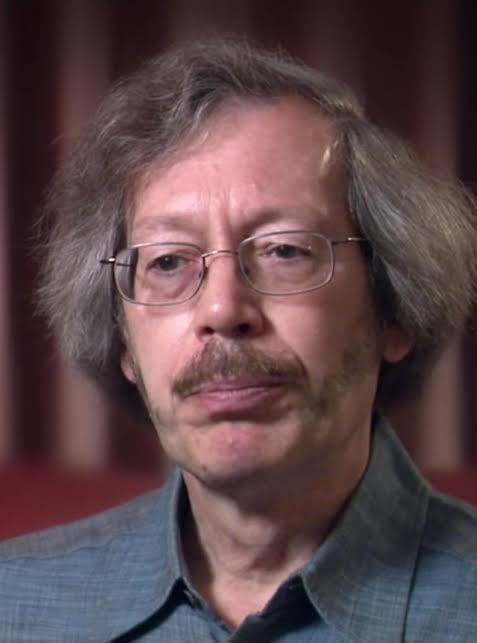
The folklorist behind the files
Thomas E. Bullard studied at the University of North Carolina before earning a doctorate in folklore from Indiana University in 1982. His dissertation concerned UAP reports, and his early research included extensive newspaper searches for accounts of the American mystery-airship wave of 1896 and 1897 (Center for UFO Studies, n.d.).
Bullard later became a board member of both the Center for UFO Studies and the Fund for UFO Research. The University Press of Kansas identifies him as the author of UFO Abductions: The Measure of a Mystery, The Sympathetic Ear: Investigators as Variables in UFO Abduction Reports, and The Myth and Mystery of UFOs (University Press of Kansas, n.d.). The historical term “UFO” is retained only where it forms part of a publication’s official title.

Before turning his attention to abduction, Bullard investigated the American mystery-airship wave of 1896 and 1897. These newspaper reports described strange aerial machines appearing years before practical powered flight. Witnesses spoke of lights, propellers, wings, cabins, ropes, occupants, and mechanical structures that resembled the technological imagination of the nineteenth century.
The results were gathered in The Airship File, a privately compiled research manuscript completed in 1982. The work collected historical newspaper and periodical accounts concerning phantom airships and other unusual aerial reports, particularly those published before Kenneth Arnold’s 1947 sighting (Bullard, 1982; Center for UFO Studies, n.d.).
The reports presented Bullard with a problem that would follow him throughout his career. Extraordinary experiences are communicated through familiar language. A witness may encounter something genuinely unusual while describing it through the machines, religious ideas, symbols, and stories available within that witness’s culture.
That does not mean the experience was invented. It means that no testimony arrives without interpretation.
The mystery-airship research showed Bullard that anomalous reports could contain two layers at once. One layer consisted of the event as remembered. The second consisted of the cultural vocabulary used to make the event intelligible.
When Bullard later examined abduction accounts, he found the same tension operating at a more intimate level.
Folklore is not a synonym for fiction
The word “folklore” is often misunderstood outside academic study. In everyday conversation it can imply that a story is false, childish, or imaginary. Folklorists use the term much more carefully.
A legend, for example, is generally a narrative presented as possibly true. It may concern a named person, a known place, a remembered event, or an experience that challenges conventional categories. A legend can preserve accurate information, introduce distortions, carry collective beliefs, or combine all three.
A folklorist therefore asks questions that differ from those asked by a physicist or police investigator. How is the account structured? Which details appeared in the earliest version? Which emerged after repeated interviews? What language does the witness use? Which motifs recur across unrelated cases? What influence did books, films, investigators, hypnosis, religion, or support groups have on later recollection?
Bullard’s approach was not to declare that abduction accounts were false because they resembled older supernatural narratives. Nor did he conclude that recurring patterns proved the presence of non-human visitors.
He treated the pattern itself as evidence requiring explanation.
His 1989 article, “UFO Abduction Reports: The Supernatural Kidnap Narrative Returns in Technological Guise,” appeared in the Journal of American Folklore, volume 102, issue 404, pages 147–170. Its publication established the work as a scholarly contribution to folklore research. It did not represent scientific verification of the physical causes proposed by experiencers or investigators. The article evaluated the reports as narrative, testimonial, and cultural material (Bullard, 1989a, pp. 147–170).
That distinction remains essential. Academic analysis can establish that a body of testimony exists, that it has recognizable characteristics, and that it deserves serious study. It cannot, through publication alone, verify the identity of the reported beings or the physical origin of the experience.
Building the abduction corpus
During the 1980s, Bullard undertook one of the first large comparative examinations of abduction reports.
The results appeared in the two-volume UFO Abductions: The Measure of a Mystery, published by the Fund for UFO Research in 1987. The first volume presented the comparative analysis, while the second catalogued the cases and source materials. Bibliographic records list the first volume at approximately 402 pages (Bullard, 1987).
Bullard described the research project as containing about 300 reports of abductions or abduction-like events. The published catalogue used 270 numbered entries, some of which contained more than one case, witness, or narrative component. The difference therefore reflects a counting method rather than a substantive contradiction (Bullard, 1987; Bullard, 1989b, pp. 3–5).
This qualification matters because abduction databases are not naturally uniform. One event may involve several witnesses. A single witness may describe more than one event. The same account may appear in an investigator’s notes, a magazine article, a book, and a later interview. Counting each document as an independent case would inflate the total, while combining all related testimony into one entry could conceal meaningful differences.
Bullard was also working before searchable online archives. He had to gather accounts from books, journals, newspapers, organizational files, correspondence, private reports, and investigator records. The available documentation ranged from contemporaneous interviews to stories published years after the alleged event.
The sample was never a random cross-section of humanity. It was a collection of reports that had reached UAP investigators, publishers, or research organizations. This introduced selection effects from the beginning. People whose experiences matched known abduction motifs may have been more likely to report them. Investigators may have favored detailed or dramatic cases. Publishers may have selected accounts likely to attract readers.
The geographical distribution was similarly uneven. North American reports dominated the available corpus, with important material from South America, Britain, and Australia. Large regions of Asia, Africa, and the Soviet sphere were poorly represented in the English-language sources accessible to Bullard.
For that reason, Bullard’s pattern should not be described as a fully demonstrated universal human sequence. It was a recurring structure found within the substantial but culturally and geographically limited body of reports available to him.
Even with those limitations, the corpus revealed something important. The more developed narratives were not arranged randomly.
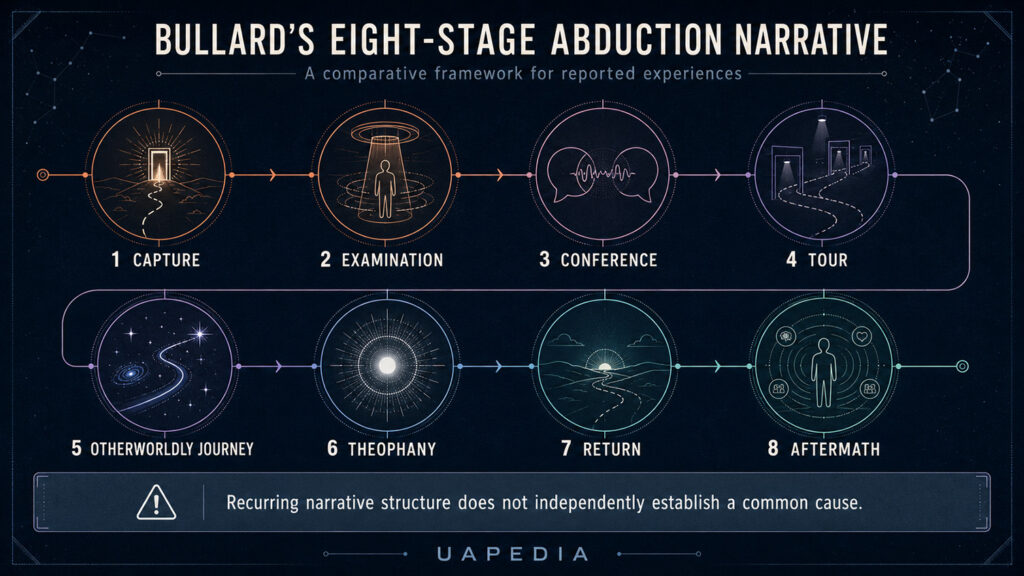
The eight-part narrative sequence
Bullard identified eight broad episodes that could appear within an abduction account: capture, examination, conference, tour, otherworldly journey, theophany, return, and aftermath.
He did not claim that every witness passed through all eight stages. The categories were tools for comparing narrative organization, not a rigid script that every event had to follow.
Capture describes the interruption of ordinary activity and the loss of control that follows. The witness may be driving, sleeping, fishing, walking, hunting, or working when a light, object, sound, presence, or bodily sensation intrudes. Movement may become difficult or impossible. The witness may describe levitation, escort by entities, transport through a doorway, or an abrupt transition into an unfamiliar environment.
Examination includes reported medical or technical procedures. Experiencers describe tables, instruments, lights, skin sampling, eye procedures, reproductive interventions, neurological effects, or the collection of biological material.
Conference refers to communication between the experiencer and the reported beings. Communication is frequently described as telepathic, although spoken dialogue also appears. The content may involve reassurance, warnings, explanations, questions, instructions, environmental imagery, or statements about human development.
A tour may involve being shown additional rooms, machinery, windows, occupants, maps, or other parts of the apparent environment.
An otherworldly journey includes accounts of being transported away from Earth, shown unusual landscapes, or taken through a sequence that the witness interprets as travel through space or another realm.
Theophany describes an encounter with an overwhelming, numinous, or spiritually authoritative presence. Bullard borrowed a term associated with manifestations of the divine because some experiencers described episodes that exceeded the usual image of a medical examination. They reported unity, terror, revelation, transformation, or contact with an intelligence perceived as having authority over life, death, nature, or destiny.
Return covers the witness’s restoration to an ordinary location, frequently near the point where the experience began.
Aftermath includes the physical, psychological, social, and interpretive consequences. These may involve missing time, recurring dreams, anxiety, bodily marks, altered beliefs, heightened interest in anomalous phenomena, fear of recurrence, or a lasting sense that reality has become less predictable.
In the subset containing more than capture and return, Bullard found that 163 of 193 reports conformed broadly to the proposed sequence (Bullard, 1989a, p. 153).
These numbers should be read as results from Bullard’s coding of a selected historical corpus, not as independent confirmation of an external procedure. The significance lies in organization. The reports did not merely share isolated images. Many appeared to move through a comparable narrative progression.
Yet the recurring sequence does not identify the cause. Sleep paralysis also has recurring stages. So do rituals, dreams, traumatic memories, initiation narratives, medical procedures, near-death experiences, and culturally patterned visions.
The sequence narrows the investigation. It does not complete it.
Betty and Barney Hill: the case that shaped a field
The Betty and Barney Hill experience became the most influential North American abduction account.
On the night of September 19, 1961, the Hills were driving through New Hampshire when they observed a light that appeared to follow or approach their vehicle. They later became concerned about an unexplained interval in the journey, emotional distress, unusual areas on the vehicle, and memories that seemed incomplete.
Betty subsequently experienced vivid dreams. During separate hypnotic sessions conducted by psychiatrist Benjamin Simon, both Hills described being stopped, taken aboard an object, subjected to examinations, and returned (Fuller, 1966).
The case contributed several motifs that would later become familiar: missing time, medical procedures, telepathic or unusual communication, small humanoid figures, and memory recovered or expanded under hypnosis.
Bullard treated the case as historically pivotal, but its evidence must be separated into layers.
The initial sighting, the journey, the couple’s distress, the reported time discrepancy, and Betty’s early dreams belong to one evidentiary layer. The more detailed onboard narratives emerged later, much of them during hypnosis. Those layers should not be treated as though they possess identical reliability.
The University of New Hampshire preserves the Betty and Barney Hill Papers. The collection includes correspondence, journals, manuscripts, newspaper material, photographs, slides, and audiovisual records. These sources allow researchers to trace the development of the account and examine primary documentation rather than relying entirely on later retellings. The archive verifies the existence and history of the testimony. It does not establish that the Hills’ interpretation of the experience was physically correct (University of New Hampshire Library, n.d.).
The Hill case also illustrates the double effect of cultural influence. Once the account became widely known through books, television, lectures, and popular discussion, later witnesses could have absorbed its imagery. At the same time, publicity may have given language to people who believed they had undergone similar events but had never known how to describe them.
An increase in reports after publicity may therefore indicate imitation, recognition, permission to disclose, or some combination of all three.
Antônio Villas-Boas and the pre-Hill problem
The reported 1957 experience of Antônio Villas-Boas is important because it preceded the public prominence of the Hill case.
Villas-Boas, a Brazilian farmer, stated that he saw a luminous object while working at night. He described being seized by small beings, taken into a craft, subjected to procedures, exposed to a gas or vapor, and placed in a room with a human-looking female figure. He interpreted the encounter as reproductive in purpose (Lorenzen & Lorenzen, 1967; Bullard, 1987).
The report included forced capture, enclosure, bodily examination, biological sampling, sexual content, and return. These motifs would later appear in other abduction accounts, but the Villas-Boas narrative was not identical to the standard North American form.
Its timing complicates any claim that all developed abduction reports were copied directly from the Hill story. It does not remove the possibility of influence from science fiction, religious tradition, local folklore, earlier UAP reports, interviewer expectations, or retrospective editing.
The case illustrates why chronological priority is important but not conclusive. A motif appearing before a famous publication weakens one narrow copying explanation. It does not prove that the event happened exactly as interpreted.
For Bullard, Villas-Boas demonstrated the mixture of ancient and modern imagery found throughout the corpus. Supernatural kidnapping, sexual contact with non-human beings, bodily testing, and return from another realm have older cultural parallels. The metallic craft, technical procedures, protective clothing, and biological framing belong more clearly to the technological age.
The narrative may be culturally structured without being culturally invented.
Pascagoula and the evidence of apparent sincerity
On October 11, 1973, Charles Hickson and Calvin Parker reported an encounter near Pascagoula, Mississippi. They told local authorities that a hovering object appeared while they were fishing and that unusual beings took them aboard, examined them, and released them.
Unlike many cases reconstructed years later, the incident was reported to law enforcement on the night it allegedly occurred.
During the police interview, officers left Hickson and Parker alone in a room while a recorder continued operating. The men were reportedly unaware that their conversation was still being captured. The recording preserved expressions of fear, uncertainty, and concern about whether anyone would believe them.
The University of Southern Mississippi’s special-collections exhibition discusses the continuing recording and its value for understanding the witnesses’ state of mind. The exhibition page is not itself the original police recording and should not be confused with it. It provides archival context for the underlying material and related oral-history records (University of Southern Mississippi Libraries, 2014).
The private conversation is frequently treated as proof of the encounter. A more careful interpretation is that it supports apparent sincerity and distress at that moment. It weighs against a simple scenario in which the men were calmly performing a rehearsed deception for police.
It does not independently establish the identity of the reported beings, the nature of the object, or the physical cause of the experience.
Sincerity and causal accuracy are separate questions. A witness can be honest and mistaken. A person can accurately describe an experience while misunderstanding its cause. A witness can also encounter an external anomaly while interpreting it through incomplete concepts.
Bullard’s framework keeps these possibilities separate.
Travis Walton, Andreasson, and the expansion of the pattern
The 1975 Travis Walton case added a different kind of evidentiary structure.
Walton disappeared after coworkers reported seeing him approach a luminous object in an Arizona forest. His companions supplied testimony regarding the initial event, while Walton alone described the later interior experience (Walton, 1978; Bullard, 1987).
This creates an evidentiary division. The reported aerial object, Walton’s approach, and his disappearance involved multiple witnesses. The onboard narrative depended primarily on Walton’s personal testimony.
The Andreasson affair introduced an even more visionary dimension. Betty Andreasson Luca described beings, examinations, journeys, symbolic scenes, and contact with an overwhelming presence. Raymond Fowler documented the case in The Andreasson Affair and later related volumes (Fowler, 1979).
Whitley Strieber’s accounts, beginning with those described in Communion, further complicated the boundaries among bodily intrusion, dream, altered consciousness, trauma, spirituality, memory, and external encounter (Strieber, 1987).
Such cases do not fit comfortably into a simple model of biological sampling by extraterrestrial visitors. Their symbolic and visionary features resemble religious experience, fairy traditions, shamanic journeys, initiation narratives, sleep phenomena, and near-death experiences.
That resemblance does not prove they share the same cause. It shows that the experiences occupy overlapping human categories.
Bullard’s category of theophany was especially useful here. Some experiencers were not merely reporting an unwanted examination. They believed they had encountered an intelligence connected with human destiny, ecological crisis, spiritual transformation, or the foundations of reality itself.
Whether that meaning came from an external intelligence, the witness’s own interpretive framework, an altered state, or the later interviewing process remains unresolved.
The investigator as a variable
One of Bullard’s most important contributions was his decision to study not only experiencers, but also the people interviewing them.
Abduction reports are sometimes discussed as though the only participants are the witness and the reported beings. In practice, investigators affect what becomes part of the record.
They decide which questions to ask, what details deserve follow-up, which memories seem significant, and how ambiguous statements should be classified. An investigator interested in reproductive themes may pursue medical and sexual material. One focused on spiritual transformation may explore visionary content. Another concerned with physical evidence may concentrate on marks, vehicle effects, locations, and timelines.
This influence need not be dishonest or deliberate. Ordinary conversation is interactive. Witnesses search for language, test interpretations, respond to expectations, and incorporate concepts that appear to make sense of an unfamiliar experience.
Bullard addressed this problem directly in The Sympathetic Ear: Investigators as Variables in UFO Abduction Reports, published by the Fund for UFO Research in 1995. The title captured his central insight: a sympathetic listener may help a distressed witness speak, but the listener may also become part of the narrative-production process (Bullard, 1995).
Bullard also contributed several papers to the privately organized Abduction Study Conference held on the Massachusetts Institute of Technology campus from June 13 to 17, 1992. The event brought together researchers, clinicians, investigators, and experiencers. Its location at MIT did not mean that MIT institutionally endorsed the conference or its conclusions. The proceedings were later published as Alien Discussions: Proceedings of the Abduction Study Conference Held at MIT (Center for UFO Studies, n.d.; Indiana University Libraries, n.d.; Pritchard et al., 1994).
Bullard’s investigator-focused work remains highly relevant because the finished case report is never raw memory. It is a product of perception, recall, questioning, editing, interpretation, and publication.
Hypnosis and the reconstruction of memory
Regression hypnosis became one of the most controversial practices in abduction investigation.
Many experiencers reported missing time, fragmentary memories, recurring dreams, unexplained fear, or physical sensations without a coherent sequence. Investigators used hypnosis in the hope of recovering information that witnesses could not access consciously.
The problem is that hypnosis can increase the amount of material a person reports without reliably increasing its accuracy. It can also intensify confidence in memories that are incomplete, distorted, suggested, or confabulated.
Bullard addressed this problem in “Hypnosis and UFO Abductions: A Troubled Relationship,” published in the Journal of UFO Studies in 1989. He explicitly rejected the idea that hypnosis functioned as an infallible truth serum. He recognized that suggestion, interviewer expectations, fantasy, and reconstructive memory could affect the resulting narratives (Bullard, 1989b, pp. 3–40).
At the same time, Bullard argued that the major traits of abduction reports occurred in both hypnotically recovered and consciously remembered accounts. He therefore resisted the claim that hypnosis alone had created the entire pattern.
This is a narrower argument than a defense of hypnotic accuracy. Similarities between conscious and hypnosis-derived reports may indicate that hypnosis is not the sole source of the motifs. They do not establish that the details recovered under hypnosis are historically or physically correct.
Alvin Lawson and colleagues offered a major challenge by hypnotizing volunteers and prompting them to imagine UAP encounters. Participants generated elaborate stories containing motifs resembling reported abductions.
The experiment demonstrated that suggestion and imagination can produce abduction-like narratives. Bullard objected that the prompts were leading, the sample was small, and the encounter structure was partly supplied by the experimenters. He also argued that the frequency and arrangement of motifs differed from his case corpus (Bullard, 1989b).
Both points can be true. Suggested subjects can create convincing encounter narratives, and that experiment does not prove that every reported encounter arose through the same process.
Psychological research and the experiencer
Later psychological studies added important evidence without providing a universal explanation.
Spanos and colleagues did not find evidence that intense UAP experiences were generally explained by broad psychopathology or exceptional fantasy proneness. They also identified associations with unusual sensory and sleep-related experiences (Spanos et al., 1993, pp. 624–632).
Susan Clancy, Richard McNally, Daniel Schacter, and colleagues studied participants who reported recovered or repressed memories of abduction. On certain laboratory tasks, those participants showed greater false recall and false recognition than control subjects. The result supports caution when evaluating memories reconstructed after hypnosis, therapy, suggestion, or prolonged reflection (Clancy et al., 2002, pp. 455–461).
It does not demonstrate that every experiencer has a false memory. Nor does it automatically explain conscious recollection, contemporaneous reporting, multiple witnesses, environmental anomalies, or independently documented events.
McNally and colleagues also found strong psychophysiological responses when experiencers listened to scripts describing their reported encounters. Their bodies reacted as though the memories carried serious emotional significance (McNally et al., 2004, pp. 493–497).
Physiological arousal establishes the reality of emotional response. It does not independently establish the external cause of the memory.
Taken together, the research supports a mature position. Experiencers should not be presumed dishonest, unintelligent, or mentally ill. Their distress, conviction, and life disruption may be genuine. Memory is nevertheless reconstructive, and methods that intensify imagery can also intensify error.
A stable core and a changing cultural shell
Bullard did not deny that media and culture influence abduction accounts. His question was more specific: what exactly changes under cultural influence, and what remains comparatively stable?
He proposed that many reports contain a recurring experiential core involving loss of control, capture, examination, communication, return, and aftermath. Around that core, more variable material appears, including uniforms, symbols, planets, spiritual missions, environmental warnings, hybrid programs, cosmic histories, and predictions.
This model offers a useful distinction, but it should not be mistaken for proof of an external mechanism.
A stable core could reflect a recurring external encounter. It could also reflect sleep paralysis, trauma-related processes, dissociation, neurological events, medical fears, cultural scripts, or the influence of investigators using similar methods.
The apparent stability may also result partly from the way cases were selected and coded. Reports that resemble the recognized abduction pattern are more likely to enter an abduction archive. Ambiguous experiences may be interpreted according to existing categories. Investigators may unconsciously organize fragmented material into a familiar sequence.
Bullard’s model therefore remains a research framework rather than a verified description of what objectively occurs.
Its value lies in making the competing explanations testable.
The major controversies
Bullard’s work faces several continuing challenges.
The first is sample selection. His corpus consisted largely of reports that reached UAP investigators and publications. It was not a random population sample. Highly detailed and culturally recognizable cases may have been overrepresented.
The second is source dependence. Two reports appearing in different books are not necessarily independent. Witnesses may have read earlier accounts, attended the same conferences, joined the same support groups, consulted the same investigators, or encountered the same media.
The third is coding judgment. Deciding whether a passage represents an examination, conference, tour, or theophany requires interpretation. Modern replication would benefit from a published coding manual, multiple independent coders, measurements of agreement, and clear separation of consciously recalled information from hypnosis-derived material.
The fourth is memory contamination. A narrative may evolve through dreams, repeated interviews, therapy, support-group discussions, reading, and personal reflection.
The fifth is ontological ambiguity. Narrative regularity does not determine whether the underlying cause is physical, psychological, neurological, cultural, spiritual, or mixed.
Bullard also faced criticism from more literal abduction researchers. Some interpreted recurrent examinations, reproductive procedures, and hybrid accounts as evidence of a coordinated external program. Bullard regarded such conclusions as exceeding what narrative comparison alone could establish.
Conversely, reductionist critics argued that folklore, suggestion, sleep phenomena, and false memory adequately explained the field. Bullard considered those factors important but insufficient to account confidently for every report.
He remained between the camps, open to a genuine anomaly while resisting premature certainty about its origin.
What official studies can establish
Official UAP programs provide historical context, but most were not designed to investigate intimate abduction testimony.
The United States Air Force’s Project Blue Book collected 12,618 reports before the program ended in 1969. According to the National Archives, 701 remained categorized as unidentified. The Air Force publicly concluded that the reports it investigated showed no national-security threat, no evidence of technology beyond known scientific knowledge, and no proof that unidentified cases represented extraterrestrial vehicles (National Archives and Records Administration, n.d.).
These conclusions arose from an aerial-sighting investigation. They were not the result of a controlled study of the later abduction corpus assembled by Bullard.
A radar return, pilot observation, bedroom experience, hypnotic narrative, physical mark, and religious vision are different categories of evidence. They require different investigative methods.
NASA’s 2023 independent UAP study focused on data quality, reporting systems, sensors, scientific methodology, and strategies for obtaining better observations. NASA stated that the report was not a review or assessment of previous UAP incidents. Its findings therefore neither verified nor refuted Bullard’s abduction cases (NASA, 2023).
The report did reinforce a problem central to Bullard’s work: extraordinary experiences are often documented through incomplete, inconsistent, or nonstandardized records.
Official studies should therefore be treated as sources with defined mandates and limitations. They do not possess automatic authority over testimony they did not investigate. At the same time, the existence of officially unresolved aerial reports does not verify a specific abduction claim.
Bullard’s major publications
Bullard’s influence developed through a sequence of studies rather than a single definitive work.
The Airship File established his archival approach to historical aerial mysteries.
UFO Abductions: The Measure of a Mystery created the large comparative corpus and introduced a systematic framework for examining abduction narratives.
“UFO Abduction Reports: The Supernatural Kidnap Narrative Returns in Technological Guise” brought the subject into a major folklore journal and compared modern encounter accounts with older supernatural-kidnapping traditions.
“Hypnosis and UFO Abductions: A Troubled Relationship” examined the strengths and dangers of hypnotically recovered testimony.
The Sympathetic Ear treated investigators themselves as variables capable of influencing the shape of reports.
Bullard later contributed to the scholarly collection UFOs and Abductions: Challenging the Borders of Knowledge, published by the University Press of Kansas in 2000.
In 2010, the same press published The Myth and Mystery of UFOs, Bullard’s broad synthesis of UAP history, folklore, belief, evidence, and cultural interpretation. The book examined the UAP phenomenon as a major modern mythmaking process while leaving open the possibility that cultural narratives had formed around a genuine unresolved anomaly.
That balance made Bullard difficult to classify. He was too attentive to culture for strict literalists and too open to anomalous externality for strict reductionists.
The difficulty is part of his importance.
What Bullard changed
Before Bullard’s comparative work, abduction research often revolved around individual dramatic cases. A witness was believed or disbelieved. An investigator defended a favored interpretation. A critic concentrated on the weakest detail.
Bullard changed the unit of analysis.
The subject was no longer only the individual witness. It was the corpus, including its patterns, absences, variations, sources, investigators, and cultural history.
This shift made several advances possible. Researchers could compare how often a motif appeared rather than relying on memorable examples. They could examine sequence rather than isolated imagery. They could identify geographical limitations. They could compare conscious recollections with hypnosis-derived accounts. They could ask whether particular investigators repeatedly produced distinctive kinds of narratives.
Most importantly, Bullard exposed two symmetrical errors.
The first is the assumption that a sincere witness must be describing the cause of an event accurately. Sincerity does not guarantee causal interpretation.
The second is the assumption that culturally structured testimony must be false. Every human report, including an accurate report, passes through perception, memory, language, expectation, and social context.
An experience can be culturally mediated and still involve a real anomaly.
Implications for modern experiencer research
A modern research program informed by Bullard would begin by separating sources and stages of memory.
Investigators should document what was consciously remembered before hypnosis, therapy, group discussion, extensive reading, or repeated interviewing. Dreams, bodily sensations, recovered images, and later interpretations should also be recorded, but stored as distinct layers rather than blended into a single seamless narrative.
Interviews should be recorded in full wherever consent permits. Questions should avoid supplying entities, procedures, motives, or locations that the witness has not mentioned. Participants in multiple-witness cases should be interviewed separately before comparing accounts.
Researchers should document the witness’s prior exposure to abduction books, documentaries, online communities, support groups, and investigators. Sleep history, medication, neurological symptoms, trauma, stress, and unusual sensory experiences should be handled sensitively but not ignored.
Physical claims require ordinary evidentiary controls. Bodily marks, alleged implants, environmental traces, electromagnetic readings, damaged vegetation, or vehicle effects need photographs, timestamps, comparison samples, medical documentation, calibrated instruments, chain of custody, and independent analysis.
An unexplained result should remain unexplained. It should not automatically be converted into evidence of non-human origin.
The most useful next step would be a transparent database preserving both phenomenology and provenance. Every claimed detail should carry information about when it was first reported, whether it was conscious or recovered, which questions preceded it, which investigator recorded it, and what media exposure occurred beforehand.
Bullard’s eight-part model could then be tested using blinded coding, statistical analysis, and genuinely cross-cultural data.
Such research might reveal that “abduction” does not describe one phenomenon. Some cases may involve sleep paralysis. Others may involve trauma, dissociation, neurological events, false memory, spiritual experience, deliberate deception, or conventional misidentification. A smaller subset may include external anomalies that remain unresolved after those explanations are examined.
A heterogeneous collection can contain explained cases, weak cases, culturally shaped cases, and genuinely anomalous cases at the same time.
The question Bullard left behind
Bullard did not prove who or what is responsible for reported abduction experiences.
He left researchers with a better question.
What kind of reality produces testimony that is repetitive yet variable, technological yet mythic, bodily yet visionary, intimate yet cosmic?
A purely cultural explanation must still address conscious reports, multiple-witness episodes, contemporaneous distress, and occasional physical claims.
A purely physical interpretation must account for dreamlike transitions, symbolic imagery, memory reconstruction, investigator effects, and parallels with older supernatural traditions.
The strongest eventual model may need to cross boundaries that conventional research often keeps separate. It may require folklore, anthropology, cognitive science, religious studies, medicine, history, sensor analysis, and careful witness-centered investigation.
Bullard’s most lasting contribution was methodological restraint. He demonstrated that researchers can take experiencers seriously without converting every interpretation into established fact. He also showed that cultural influence can be investigated without reducing the witness to a cultural artifact.
For a field frequently divided between certainty and dismissal, that remains a quietly radical position.
Claims taxonomy
Verified
Bullard’s authorship of the cited publications, his comparative analysis of abduction reports, his eight-part narrative framework, and his research into hypnosis and investigator influence are documented.
The existence of the Hill archive, Pascagoula archival records, Project Blue Book documentation, NASA’s UAP study, and the cited psychological studies is also verified.
“Verified” in this context confirms publications, records, documented testimony, and institutional materials. It does not verify the physical reality of alleged abductions.
Probable
It is probable that a recurring narrative structure exists within Bullard’s assembled corpus.
It is also probable that many experiencers sincerely believed they had undergone extraordinary events and experienced genuine emotional or social consequences.
Media exposure, investigator expectations, interview methods, memory reconstruction, and cultural vocabulary probably influenced at least some reports. The degree of influence is unlikely to be identical in every case.
Disputed
The physical externality of abduction experiences remains disputed.
Also disputed are the reliability of hypnosis-derived memories, the independence of repeated motifs, the significance of bodily marks, the interpretation of missing time, and claims involving reproductive or hybridization programs.
Bullard’s stable-core proposal remains a useful research model rather than a verified mechanism.
Legend
Historical accounts of fairy kidnapping, spirit journeys, demonic visitation, divine encounter, supernatural transport, and shamanic initiation belong to legend, religious narrative, and traditional belief systems.
Comparison with modern abduction reports can reveal structural similarities. It cannot establish that the historical and modern accounts share the same cause.
The classification “Legend” identifies a cultural narrative category. It does not mean that a witness deliberately fabricated an experience.
Misidentification
An individual report may be classified as a misidentification when evidence demonstrates that its principal features arose from a conventional source, sleep-related state, astronomical object, aircraft, medical event, environmental condition, or another identifiable cause.
The diversity of Bullard’s corpus does not support applying one demonstrated explanation to every case.
Hoax
Some abduction reports may involve deliberate invention, alteration, performance, or financial motivation.
Bullard included reports of mixed or uncertain reliability because his purpose was to compare narrative content as well as case quality.
There is no evidentiary basis for classifying Bullard’s research, all experiencers, or the entire abduction corpus as a hoax. That classification should be reserved for cases in which intentional deception is established.
Speculation labels
Evidence
Bullard’s publications, comparative research project, narrative categories, examination of hypnosis, and analysis of investigator influence are documented.
The Hill archive, Pascagoula archival materials, Bullard’s published works, Project Blue Book records, NASA’s 2023 report, and peer-reviewed psychological studies are identifiable sources.
These records establish that witnesses reported extraordinary experiences, that some displayed substantial distress, that narrative regularities appear within Bullard’s corpus, and that memory and interviewer effects are legitimate methodological concerns.
They do not establish one cause for all reported abductions.
Witness Interpretation
Claims involving non-human visitors, spacecraft interiors, telepathic communication, medical procedures, reproductive programs, hybrid beings, environmental warnings, spiritual missions, other planets, or future catastrophes are interpretations reported by experiencers.
Such testimony should be preserved accurately and respectfully. Unless supported by independent evidence, it should not be presented as verified information about the origin, biology, technology, or intentions of the reported agents.
Researcher Opinion
Bullard proposed that abduction reports may contain a comparatively stable experiential structure surrounded by culturally variable interpretation.
Some researchers regard recurring medical and reproductive motifs as evidence of an organized external program. Psychological researchers have emphasized suggestion, sleep phenomena, false-memory susceptibility, cultural expectation, and reconstructive memory.
Each position addresses part of the evidence. None has been demonstrated as a complete explanation for every reported case.
Hypothesis
The external-agent hypothesis proposes that some experiencers interact with an intelligence capable of affecting perception, movement, memory, or physical surroundings.
The neurocognitive hypothesis proposes that sleep paralysis, dissociation, trauma, neurological events, altered states, expectation, or reconstructive memory produce many reports.
The cultural-memory hypothesis proposes that traditional supernatural narratives, modern media, and investigator frameworks supply a shared grammar through which ambiguous experiences are interpreted.
The mixed-interface hypothesis proposes that an external anomaly interacts with human consciousness and is subsequently shaped by physiology, memory, culture, and investigation.
These remain hypotheses. Available evidence does not verify any one of them as a universal explanation.
References
Bullard, T. E. (1982). The Airship File: A collection of texts concerning phantom airships and other UFOs, gathered from newspapers and periodicals mostly during the hundred years prior to Kenneth Arnold’s sighting. Privately compiled manuscript.
Bullard, T. E. (1987). UFO abductions: The measure of a mystery (Vols. 1–2). Fund for UFO Research. Google Books catalogue record
Bullard, T. E. (1989a). UFO abduction reports: The supernatural kidnap narrative returns in technological guise. The Journal of American Folklore, 102(404), 147–170. Article copy
Bullard, T. E. (1989b). Hypnosis and UFO abductions: A troubled relationship. Journal of UFO Studies, 1, 3–40. Center for UFO Studies journal issue
Bullard, T. E. (1995). The sympathetic ear: Investigators as variables in UFO abduction reports. Fund for UFO Research.
Bullard, T. E. (2000). UFO abduction reports: The supernatural kidnap narrative returns in technological guise. In D. M. Jacobs (Ed.), UFOs and abductions: Challenging the borders of knowledge (pp. 141–175). University Press of Kansas.
Bullard, T. E. (2010). The myth and mystery of UFOs. University Press of Kansas. University Press of Kansas
Center for UFO Studies. (n.d.). Thomas Eddie Bullard. CUFOS biographical profile
Clancy, S. A., McNally, R. J., Schacter, D. L., Lenzenweger, M. F., & Pitman, R. K. (2002). Memory distortion in people reporting abduction by aliens. Journal of Abnormal Psychology, 111(3), 455–461. PubMed record
Fowler, R. E. (1979). The Andreasson affair. Prentice-Hall.
Fuller, J. G. (1966). The interrupted journey: Two lost hours aboard a flying saucer. Dial Press.
Indiana University Libraries. (n.d.). Alien discussions: Proceedings of the Abduction Study Conference. IUCAT catalogue record
Lorenzen, C. E., & Lorenzen, J. (1967). Flying saucer occupants. Signet.
McNally, R. J., Lasko, N. B., Clancy, S. A., Macklin, M. L., Pitman, R. K., & Orr, S. P. (2004). Psychophysiological responding during script-driven imagery in people reporting abduction by space aliens. Psychological Science, 15(7), 493–497. PubMed record
National Aeronautics and Space Administration. (2023). UAP Independent Study Team report. NASA report announcement
National Archives and Records Administration. (n.d.). Project Blue Book: Unidentified flying objects. National Archives
Pritchard, A., Pritchard, D. E., Mack, J. E., Kasey, P., & Yapp, C. (Eds.). (1994). Alien discussions: Proceedings of the Abduction Study Conference held at MIT. North Cambridge Press.
Spanos, N. P., Cross, P. A., Dickson, K., & DuBreuil, S. C. (1993). Close encounters: An examination of UFO experiences. Journal of Abnormal Psychology, 102(4), 624–632. PubMed record
Strieber, W. (1987). Communion: A true story. William Morrow.
University of New Hampshire Library. (n.d.). Using the Betty & Barney Hill Collection. Retrieved July 19, 2026, from University of New Hampshire Library
University of Southern Mississippi Libraries. (2014). Sermon about Pascagoula alien abduction. Special Collections exhibition
University Press of Kansas. (n.d.). Thomas E. Bullard. Author profile
Walton, T. (1978). The Walton experience. Berkley.
Suggested UAPedia internal crosslinks
Readers exploring Bullard’s methods may continue with Cross-cultural Abduction Comparisons, Missing Time in UAP Studies, and CE-1 to CE-5: Contact Protocols and Typologies.
The cases discussed here connect with The Betty and Barney Hill Abduction, Antônio Villas-Boas Case, Parker–Hickson: Contacts After Pascagoula, and The Greys: Origins and Reported Characteristics.
SEO keywords
Thomas E. Bullard, Thomas Bullard folklorist, UAP abduction research, experiencer research, abduction narrative patterns, The Measure of a Mystery, The Myth and Mystery of UFOs, The Sympathetic Ear, Betty and Barney Hill, Pascagoula abduction, Antônio Villas-Boas, Travis Walton, Betty Andreasson, Whitley Strieber, UAP hypnosis, regression hypnosis, missing time, abduction folklore, UAP witness testimony, experiencer investigators, contact and abduction experiences, UAP case studies, folklore and UAP, investigator influence, abduction claims taxonomy