Barbara Bartholic entered abduction research through the part of the story that conventional investigations often left behind.
The unusual light had disappeared. The road journey was over. The witness had returned home. Yet something remained unresolved: an hour that could not be accounted for, an unsettling dream shared across a family, a bodily mark without an obvious history, a child describing strange visitors, or an adult who felt that an intimate part of life had been altered without consent.
From Tulsa, Oklahoma, Bartholic became an influential and controversial figure within a major strand of late twentieth-century abduction research. She interviewed experiencers, practiced regression hypnosis, collaborated with writers including Karla Turner, and developed a model in which anomalous contact was not confined to a dramatic encounter with an object or entity. In her interpretation, the phenomenon could affect memory, relationships, health, spirituality, sexuality, identity and the witness’s understanding of reality itself.
That approach gave frightened and socially isolated people a vocabulary for experiences they believed mainstream institutions would not hear. It also generated serious methodological difficulties. Once apparently ordinary memories could be reclassified as deliberately manufactured “screen memories,” and once many forms of personal disruption could be interpreted as hidden interference, the theory became difficult to test and harder to disprove.
Bartholic’s legacy is therefore not simple. She was a compassionate listener, a persistent field investigator and an important transmitter of experiencer testimony. She was also a researcher whose later conclusions often extended far beyond what the publicly available evidence could demonstrate.
Her career occupies an important place in the history of abduction research because it exposes the field’s central dilemma. How can investigators take extraordinary testimony seriously without turning interpretation into fact? How can they protect witnesses without making a case impossible to audit? And how can they explore the possibility of a genuinely anomalous intelligence without allowing the hypothesis to absorb every contradiction?
A life formed outside conventional research
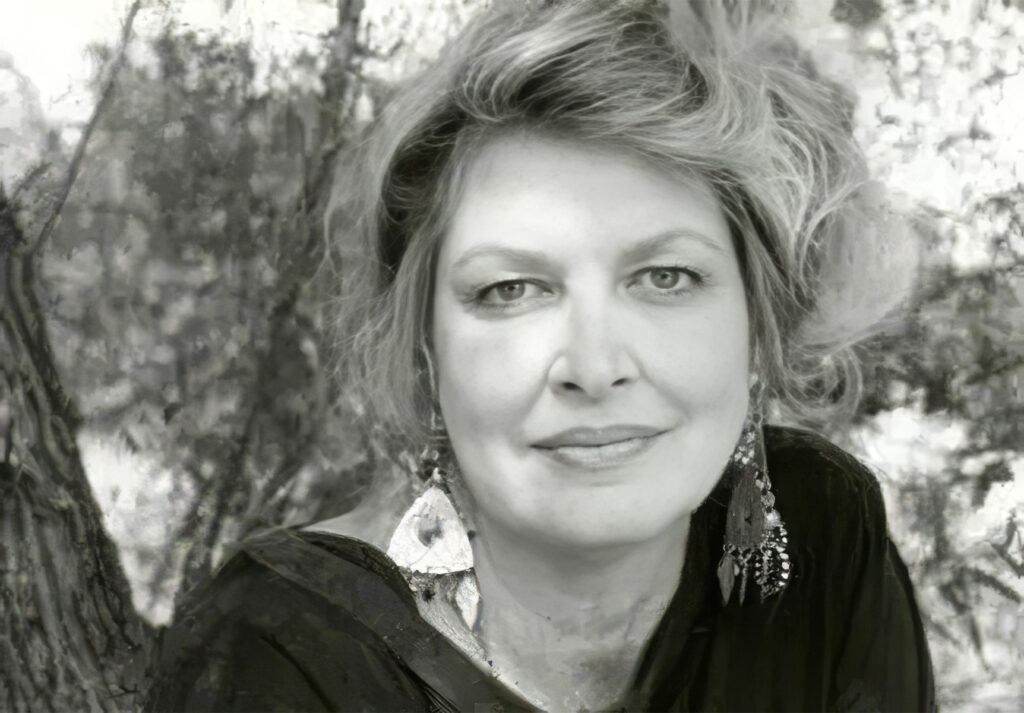
Barbara Simon Bartholic was born on February 3, 1939, and died on November 10, 2010, at the age of 71. Contemporary and memorial accounts describe her death as following a stroke. Before becoming known as an abduction investigator, she worked as a model in Los Angeles and New York, painted, participated in Tulsa’s arts community, operated galleries with her husband Bob, and hosted a local arts program called Arts Arena. One of the galleries was known as the Barking Dog. (Gary Kelley’s Add’Vantage Funeral Service; Tulsa World)
Her artistic background may have encouraged close attention to imagery, symbolism and emotional tone. Whether it also increased susceptibility to pattern overinterpretation is an editorial inference, not a documented psychological assessment of Bartholic.
That distinction matters because Bartholic did not approach experiencers primarily as an academic scientist or licensed psychiatrist. She entered the field as a highly engaged independent investigator. Her method was personal, intuitive and immersive. Supporters experienced this as empathy and unusual sensitivity. Critics could view the same qualities as potential sources of confirmation bias, especially when symbolic correspondences were treated as evidence of an external intelligence.
In her memoir, Barbara: The Story of a UFO Investigator, Bartholic described hosting regular meetings at her home, showing recordings and inviting speakers interested in UAP, anomalous contact and hypnosis. She stated that she learned hypnosis from Curtis Reeves, whom she described as an experienced hypnotherapist who had lectured medical audiences, and that she initially practiced under his supervision. These claims appear in the memoir’s discussion of her early hypnosis training. No publicly accessible training syllabus, professional certification record or standardized interview protocol was located during this review. (Digital scan of Bartholic and Fielding’s memoir)
This does not mean such records never existed. It means that independent editors and researchers currently lack a publicly available documentary trail sufficient to evaluate the scope and rigor of her training.
The problem is not unique to Bartholic. Experiencer research has often developed outside universities, hospitals and government programs because witnesses feared ridicule, professional repercussions or psychiatric labeling. Independent investigators filled a genuine social and investigative vacuum. Yet this freedom from institutions also meant freedom from many of the safeguards used in clinical research, forensic interviewing and human-subject studies.
Bartholic’s work combined two goals that can pull in different directions. She wanted to help distressed people understand what had happened to them, and she wanted to determine the external cause of their experiences. A supportive conversation may appropriately validate fear, confusion and suffering. An evidentiary interview, however, must avoid supplying explanations, rewarding preferred answers or transforming uncertainty into certainty.
Jacques Vallée and the control-system connection
Bartholic’s association with Jacques Vallée is one of the better-supported elements of her research history, although some later accounts describe the relationship more expansively than the accessible record permits.
In her memoir, Bartholic said the association began in the late 1970s amid reports of cattle mutilations and UAP activity in Arkansas and Oklahoma. She portrayed Vallée as both mentor and investigative associate, crediting him with teaching her to follow evidentiary details and examine a witness’s broader circumstances.
Vallée’s published journals independently establish genuine investigative contact. In his journal material, he identified Bartholic as one of the correspondents who supplied information about cases. In an October 1981 entry concerning Tulsa, he referred to her as a friend engaged in field research and described accompanying her while gathering information on recent incidents. (Jacques Vallée, Forbidden Science 3)
This evidence supports sustained cooperation. It does not, by itself, establish a formally defined employment relationship or prove every later claim that the two worked as an organized investigative team for exactly seven years.
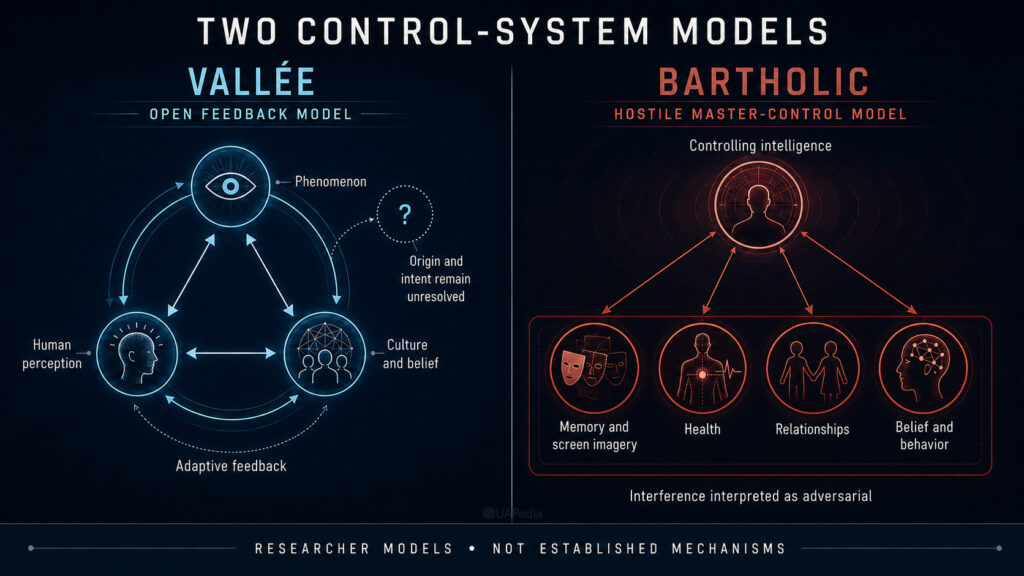
The deeper connection was theoretical. Vallée’s control-system model proposed that UAP might operate through feedback, adapting to human expectations and influencing culture, belief and behavior. The framework did not require the phenomenon to be extraterrestrial, uniformly hostile or governed by one intelligence. It was a way of asking how the phenomenon behaves across time, not a final declaration of who or what controls it.
Bartholic eventually developed a more literal and adversarial version. In later interviews, she described a “master control system” capable of manipulating memory, intimate relationships, addiction, health, belief and social conflict. These were Bartholic’s conclusions. They were not controlled findings, and they should not be attributed to Vallée merely because both researchers used the language of control. (Eve Lorgen’s interview archive)
The difference is fundamental. Vallée generally used the control-system idea to preserve uncertainty about the phenomenon’s origin and mechanism. Bartholic increasingly used it to unify distressing experiences under a hostile explanatory framework.
The change from reassurance to warning
Bartholic did not always interpret contact as hostile.
In her memoir, she recalled initially reassuring experiencers that the entities they described were probably benevolent despite fear, discomfort and apparent intrusion. She presented the visitors as different and perhaps unsettling, but ultimately purposeful or constructive.
She identified a meeting in 1988 as a major turning point. According to her account, a young physician from Dallas challenged her confidence in benevolent contact and described experiences that appeared coercive and harmful. Bartholic later portrayed the exchange as the moment when her earlier reassurance began to feel irresponsible. The episode appears in the memoir’s section describing her shift toward a hostile-control interpretation, but no separate transcript or contemporaneous record of the meeting was located in publicly accessible sources during this review. (Bartholic & Fielding, memoir)
After this change, Bartholic’s central investigative question shifted. She no longer asked only what a witness remembered. She increasingly asked whether the remembered scene was itself a deception.
A witness might recall an animal, a religious figure, a military setting, a medical environment, an ordinary interruption in a journey or a dreamlike visitor. Bartholic treated some such images as masks covering more disturbing events. In her terminology, these could be “screen memories.”
There is a legitimate observational issue beneath this concept. Human perception is incomplete, and memory is reconstructive. Witnesses often interpret unfamiliar stimuli through familiar categories. A person may describe an anomalous light as a helicopter because “helicopter” is the nearest available concept.
The methodological problem begins when the investigator assumes that a conventional memory was intentionally implanted. If the witness remembers an animal, the animal may be called a screen. If the witness does not remember an entity, the absence may be interpreted as evidence of suppression. If testimony changes under hypnosis, the new account may be treated as deeper truth. Under those conditions, contradictory evidence can be absorbed as another layer of concealment.
Karla Turner and the family case
Karla Turner’s Into the Fringe provides the clearest first-person account of Bartholic’s importance to an experiencer family.
Turner wrote that she and her husband, identified by the pseudonym Casey, met Bartholic at a MUFON meeting in June 1988. Turner described arriving skeptical, listening to Bartholic discuss Oklahoma sightings and abduction reports, and speaking with her privately afterward. In the book’s acknowledgments and opening case narrative, she called Bartholic the family’s greatest ally in attempting to understand what they believed had happened. (Karla Turner, Into the Fringe)
The Turner account did not consist solely of hypnotic material. It included conscious memories, reports of missing time, dreams, bodily marks, family conversations and statements from relatives and acquaintances. This wider testimony gave the case more depth than an account produced in one regression session.
In one episode, Casey’s father reportedly confirmed that a childhood journey recalled during hypnosis had actually taken place. Details concerning Casey’s approximate age, the location and a delayed return were said to match parts of the regression narrative.
This is meaningful corroboration of the trip and its surrounding circumstances. It is not independent corroboration of every extraordinary event described during the session.
That distinction is essential in testimonial research. Confirmation of an identifiable journey, location or delay increases confidence that the recalled narrative is connected to a real event. It does not automatically confirm non-human entities, medical procedures, telepathic communication or physical transport.
The Turner case also shows why Bartholic became so important to experiencers. She did not withdraw when the testimony became strange. She gave the family a framework, language and sustained attention. Turner’s gratitude appears sincere and emphatic.
Bartholic was not, however, a neutral recorder outside the developing narrative. Her assumptions shaped the questions asked and the meanings attached to dreams, bodily marks, relationship difficulties and memory gaps. This may have helped reveal patterns that narrower investigators ignored. It may also have encouraged unrelated events to be organized around one cause.
The case is therefore best understood as substantial testimony with partial circumstantial corroboration, but without public evidence sufficient to verify its most extraordinary claims.
Ted Rice and Masquerade of Angels
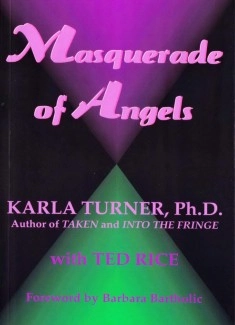
Bartholic’s work with Ted Rice became the foundation for Masquerade of Angels, published in 1994 by Karla Turner and Rice, with a foreword by Bartholic.
The book presents a lifelong history of psychic experiences, alleged contact, religious imagery, missing memories and perceived manipulation. In the introduction, Turner stated that she and Bartholic interviewed nearly 30 people who had first-hand knowledge of Rice’s experiences or had participated in related events. She also reported that several underwent hypnosis and that signed affidavits from principal participants were retained. (Karla Turner & Ted Rice, Masquerade of Angels)
This is more substantial than a narrative resting on one isolated witness. It suggests an effort to widen the evidentiary field around Rice’s testimony.
The published form nevertheless creates an audit problem. Many names were changed, and Turner explained that some characters were composites created to protect identities and simplify presentation. No publicly accessible copy of the complete interview archive, signed affidavits or unedited regression recordings was located during this review.
The absence of public access does not mean the materials never existed. It means independent reviewers cannot currently determine which statements were made before hypnosis, which witnesses were interviewed separately, how contradictions were handled, or whether narrative similarities appeared before or after group discussion.
Privacy is not a minor concern. Experiencers have faced social, professional and family consequences after disclosing anomalous events. Pseudonyms may be ethically necessary. Yet privacy and verification create competing obligations. A rigorous archive must protect identities while still allowing qualified reviewers to examine source chronology, interviewer prompts and unedited testimony.
Masquerade of Angels also shows how Bartholic’s model expanded from encounters into an interpretation of an entire life. Rice’s relationships, occupations, dreams, religious experiences and personal crises were presented as parts of a long program of external direction.
This approach can reveal long-term patterns. It can also transform ordinary complexity into apparent evidence of control. Most lives contain coincidences, emotional crises, recurring themes and decisions that seem meaningful in retrospect. The investigator must demonstrate why an anomalous explanation accounts for those events better than trauma, chance, personality, cultural influence, spirituality or ordinary human conflict.
Amy and the layers of evidence
A case identified as “Amy” in Turner’s Taken illustrates how an abduction narrative can develop through several evidentiary layers.
The first layer was conscious recollection. Amy reportedly remembered observing unusual objects, alerting a neighbor, walking behind an apartment building and later watching the objects depart. She believed there was a discontinuity in the sequence. She also held conflicting memories concerning whether she had retrieved a telescope or binoculars. Turner wrote that the telescope remained packed and that Amy did not own binoculars. These details appear in the chapter devoted to Amy’s account. (Karla Turner, Taken)
That contradiction establishes a memory problem. It does not establish the cause.
Possible explanations include ordinary confusion, mistaken sequencing, dream contamination, a dissociative episode, an altered state, later reconstruction or deliberate interference by an external agent. Turner and Bartholic favored the final possibility.
The second layer consisted of dreams and impressions involving entities. The third emerged during two regression sessions conducted by Bartholic in 1992. Under hypnosis, Amy described childhood contact, threats, telepathic communication and lessons concerning belief and conformity.
The fourth layer was interpretive. The regression scenes were organized as evidence that an intelligence had influenced Amy’s memory and psychological development over many years.
These layers should not be treated as evidentially equivalent. The conscious sighting and the demonstrable inconsistency concerning the optical device are the strongest elements because they preceded the regression interpretation. Dream material may be psychologically significant, but its external referent is uncertain. Hypnosis-derived scenes remain exploratory unless they produce specific information that can later be independently verified. The theory of deliberate memory control is an inference constructed from the earlier layers.
This does not imply dishonesty. A witness can be sincere, distressed and uncertain about the cause. Sincerity, physiological response and external verification answer different questions.
The three nurses
In a later interview, Bartholic described three psychiatric nurses who allegedly became disoriented and physically distressed after stopping at a remote store during a journey in New Mexico. She said that separate regression sessions produced similar descriptions of an underground facility and non-human beings. The nurses reportedly feared that disclosure to their employers could lead to professional consequences or psychiatric judgment. The account appears in Eve Lorgen’s archived interview with Bartholic under the discussion of the New Mexico nurses. (Eve Lorgen archive)
As publicly described, the case contains potentially important elements: multiple participants, an identifiable journey, physical symptoms and reportedly comparable narratives.
The available account lacks the material required for independent evaluation. No publicly accessible copy of the witnesses’ names, contemporaneous medical records, route documentation, store identification, full interview recordings or pre-regression statements was located during this review.
Similarity between hypnotic narratives can be meaningful, but only when independence is demonstrated. Shared discussion, knowledge of the investigator’s theories, common cultural images, suggestive prompts and later retelling can all increase apparent agreement.
The nurses’ fear of professional stigma remains plausible as a social reality. It helps explain why many experiencer accounts remain private. It does not verify the underground-facility interpretation, but it is part of the environment in which such cases are reported and investigated.
The Oklahoma driver’s letter
Bartholic’s memoir reproduced an anonymous letter from an Oklahoma woman who described an encounter while driving with her four-year-old son.
The woman reported seeing a highly reflective object, experiencing severe steering-wheel vibration, stopping on a dirt road, becoming unable to move, hearing activity in nearby trees and watching the vehicle’s engine fail as figures approached. The letter appears in the later case-document section of the memoir. (Bartholic & Fielding, memoir, p. 160 in the digital scan)
Within Bartholic’s archive, the account is important because it was presented as conscious recollection rather than imagery first produced in hypnosis. It also included an external object, possible vehicle interference, paralysis, sound and the presence of a second person.
Its anonymity prevents meaningful public verification. Researchers cannot inspect the vehicle, locate the road, interview the child, compare weather and traffic conditions or determine what information the writer had encountered before contacting Bartholic.
The account remains first-hand testimony with potentially significant features. It is not a resolved or independently verified case.
Hypnosis and the problem of certainty
No issue defines Bartholic’s legacy more clearly than regression hypnosis.
Bartholic appears to have regarded hypnosis as both investigative and therapeutic. She believed that accessing concealed experiences could help reduce fear, confusion, addiction and psychological distress. Eve Lorgen later remembered her as attentive to emotional processing and repeatedly concerned with how an experience made the witness feel. (Eve Lorgen, “Tribute to Barbara Bartholic”)
That witness-centered care should be distinguished from the evidentiary status of memories generated under hypnosis.
A National Institute of Justice review found no demonstration that hypnotized witnesses are more accurate than non-hypnotized witnesses. It warned that hypnosis can contribute to pseudomemories a person may be unable to distinguish from original recollection. It also noted that hypnosis can increase confidence and make testimony appear more convincing without increasing accuracy. The review allowed for limited investigative use under strict safeguards but rejected hypnosis as a truth-detection mechanism. (National Institute of Justice, Forensic Use of Hypnosis)
This does not mean every statement made under hypnosis is false. It means vividness and confidence do not authenticate a memory.
A genuine fragment, an inference, a dream image, a cultural expectation and an interviewer’s suggestion can become combined into one coherent and emotionally powerful scene. That scene may feel more real after hypnosis even when its historical accuracy has not improved.
Laboratory studies involving people reporting abduction memories reinforce the need for caution.
A 2002 study found that participants reporting recovered or repressed memories of alien abduction showed greater false recall and false recognition in a word-list paradigm than control participants. The groups did not differ in correct recall or correct recognition. The result was a group-level association in an experimental task. It did not establish that every abduction account was false, nor did it determine the cause of any individual experience. (Clancy et al., 2002)
A 2008 British study examined 19 people reporting alien-contact experiences and compared them with matched controls. The experiencer group scored higher on measures including dissociation, absorption, paranormal belief and experience, self-reported psychic ability, hallucination tendency and reported sleep-paralysis incidence. Fantasy proneness was also elevated in some analyses, although that result was less robust than several of the other reported differences. The study did not find a significant difference between the groups in false-memory susceptibility on the measure used. Its small sample and mixed findings do not justify using these variables as a diagnostic profile. (French et al., 2008)
Another experiment measured heart rate, skin conductance and facial-muscle activity while people reporting abduction experiences listened to scripts describing their memories. Their physiological responses resembled reactions to other stressful autobiographical material and were stronger than those of controls hearing the same scripts. The study demonstrated that belief in a traumatic anomalous event can be accompanied by measurable stress responses. It did not identify the external cause of the reported memory. (McNally et al., 2004)
Taken together, this research supports a disciplined position. Experiencers should not be mocked, dismissed or presumed dishonest. Their distress may be serious and physiologically measurable. Hypnosis-derived detail, however, should not be presented as verified history unless supported by independent evidence.
A checklist broad enough to find almost anyone
Bartholic’s memoir included a self-assessment checklist intended to help readers identify possible histories of contact.
Its indicators ranged from remembered beings and missing time to psychic experiences, recurring nightmares, obsessive relationships, miscarriage, hysterectomy, kidney problems and generalized unease. (Bartholic & Fielding, memoir, p. 170 in the digital scan)
The checklist demonstrates how far her theory had expanded.
Many of the listed experiences are common in the general population and have numerous medical, psychological and social explanations. Miscarriage, surgery, kidney disease, sleep disturbance, anxiety and difficult relationships cannot function as meaningful contact indicators without comparison against ordinary base rates.
A broad checklist can also create a self-confirming path. A reader begins with common but troubling life events, learns that they may signify contact, seeks regression, and then interprets ambiguous imagery through that expectation. The resulting narrative may appear to validate the framework that initiated the search.
A reliable screening instrument would require defined variables, control groups, known prevalence rates, blinded scoring and measurement of false positives. Bartholic’s published checklist did not meet those standards. It is best treated as a historical representation of her developing theory rather than a diagnostic tool.
Publications and influence
Bartholic’s principal book was Barbara: The Story of a UFO Investigator, as told to Peggy Fielding. The first edition appeared in 2003, with a revised edition dated 2004. The work is part memoir, part case archive and part theoretical statement. It combines biography, witness narratives, personal anomalous experiences, field investigation and Bartholic’s increasingly expansive interpretation of control. (Digital scan)
Her influence also travelled through Karla Turner’s books. Into the Fringe, Taken and Masquerade of Angels brought Bartholic’s methods and interpretations to a much larger readership.
She later influenced Eve Lorgen’s investigation of alleged external manipulation in intimate relationships. A 1999 article in the MUFON UFO Journal described Lorgen and Bartholic as compiling cases for a proposed co-authored work called The Love Bite. The eventual book appeared under Lorgen’s name, but the article documents Bartholic’s formative involvement in the project’s case framework. (MUFON UFO Journal, January 1999)
Bartholic helped move abduction research beyond the isolated model of an examination aboard a craft. She argued that researchers should study the witness’s whole life, including childhood memories, family patterns, dreams, sexuality, health, belief changes, synchronicities and relationships.
This expansion opened legitimate questions. Do reports cluster within families? Do experiencers undergo long-term psychological or spiritual change? Are dreams and altered states part of the event, consequences of it, or independent experiences later woven into the narrative?
The difficulty lies in causal attribution. A whole-life approach can recover context, but it can also absorb nearly every major event into one explanatory system.
Controversies and competing interpretations
The main controversy surrounding Bartholic is not whether she cared about witnesses. Turner, Lorgen and others described her as compassionate, committed and unusually willing to remain present with people reporting disturbing experiences.
The controversy concerns what she believed her methods established.
Bartholic’s later master-control theory attributed a wide range of outcomes to non-human interference, including illness, addiction, romantic disruption, altered memory, spiritual deception and broader conflict. The publicly accessible record does not contain controlled comparisons, independently verified causal mechanisms or physical evidence sufficient to establish claims on that scale.
Her screen-memory concept is similarly difficult to test in its strongest form. A witness can certainly misperceive an unfamiliar event or represent it symbolically. That does not establish that an external intelligence manufactured the memory. When every contradiction is treated as evidence of concealment, the theory becomes self-protecting.
Interviewer influence is another concern. By the later stage of her career, Bartholic expected layered deception and hostile manipulation. Even subtle wording can shape hypnotic imagery. Asking what lies “behind” a remembered scene tells the witness that the scene may be incomplete.
The archival record is also limited. Bartholic and her collaborators referred to large case collections, signed statements and repeated patterns. Much of the original material is not publicly accessible. Published books are edited narratives and cannot substitute for full recordings, dated notes and independent review.
Some biographical claims remain uncertain. Retrospective reports have stated that Bartholic consulted on Close Encounters of the Third Kind. A publicly accessible production credit, contract, studio memorandum or named filmmaker testimony confirming a formal consultancy was not located during this review. The claim should remain unverified rather than being presented as either established or disproven. (UFO Digest retrospective)
Later claims that hostile forces caused illnesses, accidents or deaths associated with Bartholic and Karla Turner are also unsupported by publicly verifiable medical or forensic evidence. Bartholic’s death was reported following a stroke. Turner died from cancer. Interpretations of external orchestration belong to later researcher or witness belief, not established causation.
Bartholic’s enduring impact
Bartholic’s most defensible contribution was not proof of a master control system. It was her insistence that the witness still matters after the object disappears.
She treated psychological aftermath, family dynamics, recurring dreams, bodily experiences and changes in worldview as relevant data. Modern experiencer research increasingly recognizes that an event’s consequences can be studied even when its ultimate cause remains unresolved.
A clinician does not need to certify non-human contact to recognize anxiety, disrupted sleep, intrusive imagery, trauma symptoms, ontological shock or social isolation. An investigator does not need to accept every interpretation to treat the witness with dignity.
Bartholic also challenged an assumption common in some contact narratives: that greater intelligence or technological sophistication implies moral benevolence. Her warning remains philosophically sound. Intelligence, power and ethical conduct are separate qualities.
Her error was converting a caution into an all-encompassing causal model. A theory capable of explaining illness, addiction, dreams, romance, conflict, memory and spiritual belief risks explaining too much. When almost any outcome can be fitted into the model, the model loses predictive value.
Implications for future experiencer research
A stronger research program could preserve Bartholic’s attention to the whole person while replacing her least reliable methods.
The conscious account should be recorded before hypnosis, group discussion or exposure to extensive case literature. Investigators should create a dated baseline distinguishing direct memory, inference, dream content and uncertainty.
Questions should remain open. “What happened next?” is safer than “What did the beings do next?” The second question introduces an entity before the witness has done so.
Hypnosis, when used, should be framed as exploratory imagery rather than verified recovery. Sessions should be recorded in full, including preparation, induction, prompts and post-session interpretation. Emotional care and factual investigation should ideally be performed by different professionals.
Corroboration must remain specific. Confirmation that a journey took place does not confirm every event recalled during it. A bodily mark should be photographed with a scale and date and, where appropriate, medically examined. Vehicle effects should be compared with maintenance records. Multiple witnesses should be interviewed separately before exchanging details.
Researchers also need control groups and ordinary base rates. How often do people without contact beliefs report missing time, entity dreams, sleep paralysis, unexplained bruising or relationship disruption? Without that comparison, common experiences may appear unusually diagnostic.
The archive should survive the investigator. De-identified transcripts, consent documents, original audio, coding criteria and evidence logs should be deposited with qualified repositories under controlled access. Witness privacy can be protected without making independent review impossible.
Bartholic recognized that the phenomenon might operate through ambiguity, consciousness and memory. A phenomenon of that kind requires unusually disciplined methods.
Claims taxonomy
Verified
Barbara Simon Bartholic lived from February 3, 1939, to November 10, 2010. She participated in Tulsa’s arts community and later became known as an independent investigator of UAP and alleged abduction experiences.
Jacques Vallée’s published journals confirm that she supplied him with case information and that the two participated in field activity in Oklahoma.
Her authorship of Barbara: The Story of a UFO Investigator, her foreword to Masquerade of Angels, and her documented involvement with Karla Turner, Ted Rice and Eve Lorgen are also verified.
These facts establish her activity and influence. They do not verify every case interpretation.
Probable
Bartholic provided substantial emotional and investigative support to many experiencers. Turner’s acknowledgment, Lorgen’s tribute and Bartholic’s repeated presence in case literature make this highly probable.
It is also probable that many witnesses she interviewed were sincere and experienced genuine distress, confusion or personal transformation. Sincerity and impact do not determine the external cause.
Disputed
The historical accuracy of extraordinary memories recovered under Bartholic’s hypnosis is disputed.
Her claims concerning engineered screen memories, hostile relationship manipulation, underground facilities and a master system directing personal and social outcomes remain disputed.
The precise formal scope of her partnership with Vallée is also disputed. Investigative cooperation is documented, but some later descriptions exceed the independently accessible record.
The claim that Bartholic formally consulted on Close Encounters of the Third Kind is an unverified biographical assertion. Retrospective sources repeat it, but no publicly accessible production record, contract, studio memorandum or named filmmaker confirmation was located during this review.
Legend
Stories concerning duplicate versions of Bartholic appearing aboard craft, hidden agencies retaliating against her, or anomalous forces arranging researchers’ deaths belong to later experiencer lore unless supported by new evidence.
Misidentification
No specific major case reviewed in this article has been conclusively re-attributed to a conventional cause. Sleep paralysis, hypnagogic imagery, neurological events, dissociation, trauma responses, dream-reality confusion and ordinary memory error remain possible explanations for individual reports and should be evaluated case by case.
Speculation labels
Hypothesis
Some reported abduction experiences may involve an external anomalous trigger interacting with perception, altered consciousness and memory. Under this hypothesis, neither a purely physical transport model nor a purely psychological model fully captures the event. Bartholic’s cases contain testimony compatible with such an interaction, but they do not establish its mechanism.
A second hypothesis is that recurring UAP motifs behave like an adaptive feedback system, responding to cultural expectations while producing subjective and, in some cases, reported physical effects. This resembles Vallée’s open control-system framework more closely than Bartholic’s later claim of a unified hostile command structure.
Witness Interpretation
Descriptions of Greys, reptilian entities, underground facilities, telepathic warnings, implanted scenes and manipulated relationships are interpretations reported by experiencers. Many emerged through dreams, altered states or hypnosis.
These accounts should be documented accurately because recurring testimony may reveal meaningful patterns. They should not automatically be presented as independently verified beings, locations or operations.
Researcher Opinion
Bartholic’s master-control model, her belief that apparently positive contact often concealed exploitation, and her attribution of illness, addiction and relationship disruption to non-human interference were researcher opinions based on her interpretation of case patterns.
Her belief that regression hypnosis could penetrate externally engineered screen memories was also a methodological opinion. Current forensic and memory research does not support treating hypnosis as a reliable truth-recovery method.
References
Bartholic, B., & Fielding, P. (2003; revised 2004). Barbara: The Story of a UFO Investigator. AWOC.COM. ISBN 0-9707507-7-3. https://www.yumpu.com/en/document/view/36090580/barbara-the-story-of-a-ufo-investigator-exopolitics-hongkong/1
Clancy, S. A., McNally, R. J., Schacter, D. L., Lenzenweger, M. F., & Pitman, R. K. (2002). Memory distortion in people reporting abduction by aliens. Journal of Abnormal Psychology, 111(3), 455–461. https://doi.org/10.1037/0021-843X.111.3.455
French, C. C., Santomauro, J., Hamilton, V., Fox, R., & Thalbourne, M. A. (2008). Psychological aspects of the alien contact experience. Cortex, 44(10), 1387–1395. https://doi.org/10.1016/j.cortex.2007.11.011
Gary Kelley’s Add’Vantage Funeral Service. (2010). Barbara Simon Bartholic obituary. https://www.garykelleyafs.com/obituaries/Barbara-Simon-Bartholic?obId=44196908
Lorgen, E. F. (1999). The Love Bite: Alleged human bonding dramas, relationship manipulations and love obsessions. MUFON UFO Journal, 369, 9–10. https://iapsop.com/archive/materials/mufon_ufo_journal/mufon_ufo_journal_n369_jan_1999.pdf
Lorgen, E. F. (n.d.). Barbara Bartholic. Eve Lorgen. Accessed July 19, 2026. https://evelorgen.com/wp/articles/alien-abduction/barbara-bartholic/
Lorgen, E. F. (2010). Tribute to Barbara Bartholic. Eve Lorgen. https://evelorgen.com/wp/articles/miscellaneous/tribute-to-barbara-bartholic/
McNally, R. J., Lasko, N. B., Clancy, S. A., Macklin, M. L., Pitman, R. K., & Orr, S. P. (2004). Psychophysiological responding during script-driven imagery in people reporting abduction by space aliens. Psychological Science, 15(7), 493–497. https://doi.org/10.1111/j.0956-7976.2004.00707.x
NASA. (2023). UAP Independent Study Team Report. National Aeronautics and Space Administration. https://science.nasa.gov/wp-content/uploads/2023/09/uap-independent-study-team-final-report.pdf
Orne, M. T., Dinges, D. F., & Orne, E. C. (1984). Forensic Use of Hypnosis. National Institute of Justice. https://nij.ojp.gov/library/publications/forensic-use-hypnosis
Tulsa World. (2010, November). UFO investigator Barbara Bartholic dies at age 71. https://tulsaworld.com/news/local/article_13e1558e-f894-5177-81a2-d866e027a90d.html
Turner, K. (1992). Into the Fringe. Berkley Books. ISBN 0-425-13510-1. https://archive.org/stream/IntoTheFringeByDrKarlaTurner/Into%20The%20Fringe%20by%20Dr%20Karla%20Turner_djvu.txt
Turner, K. (1994). Taken: Inside the Alien-Human Abduction Agenda. Kelt Works. ISBN 0-9640899-0-4. https://pearl-hifi.com/06_Lit_Archive/14_Books_Tech_Papers/Turner_Karla/Taken.pdf
Turner, K., & Rice, T. (1994). Masquerade of Angels. Kelt Works. ISBN 0-9640899-1-2. https://archive.org/stream/masqueradeofangelsbykarlaturner/Masquerade%20of%20Angels%20by%20Karla%20Turner_djvu.txt
UFO Digest. (2010). UFO investigator Barbara Bartholic dead at 71. https://www.ufodigest.com/article/ufo-investigator-barbara-bartholic-dead-at-71/
Vallée, J. (2017). Forbidden Science 3: On the Trail of Hidden Truths: The Journals of Jacques Vallée, 1980–1989. Anomalist Books. ISBN 978-1-938398-78-0. https://www.anomalistbooks.com/book.cfm?id=96
Vallée, J. (2017). Forbidden Science 3: On the Trail of Hidden Truths: The Journals of Jacques Vallée, 1980–1989 [Searchable digital copy]. https://dokumen.pub/forbidden-science-3-on-the-trail-of-hidden-truths-the-journals-of-jacques-vallee-1980-1989-1938398785-9781938398780.html
SEO keywords
Barbara Bartholic, Barbara Bartholic biography, Barbara Bartholic abduction investigator, UAP abduction research, experiencer research, Karla Turner Barbara Bartholic, Ted Rice Masquerade of Angels, Jacques Vallée control system, UAP hypnosis controversy, regression hypnosis, screen memories, master control system hypothesis, anomalous contact testimony, missing time research, experiencer psychological effects, non-human intelligence contact, UAP witness reliability, abduction case studies, Contact and Abduction Experiences, UAPedia Barbara Bartholic