For most of history, people seeking contact with extraordinary beings did not simply wait for something to appear. They travelled to sacred places, fasted, prayed, slept in sanctuaries, repeated chants, entered trance, watched the heavens, consulted dreams, and gathered in communities organised around the possibility of communication.
Today, a contact group may meet beyond the glare of a city. Participants check the sky, settle into meditation, visualise Earth from above, mentally extend an invitation, and then watch for unusual lights. Phones and cameras replace sacred tablets, satellite trackers replace astronomical almanacs, and the hoped-for intelligence is described as non-human rather than angelic or divine.
The setting is modern, but parts of the procedure are familiar.
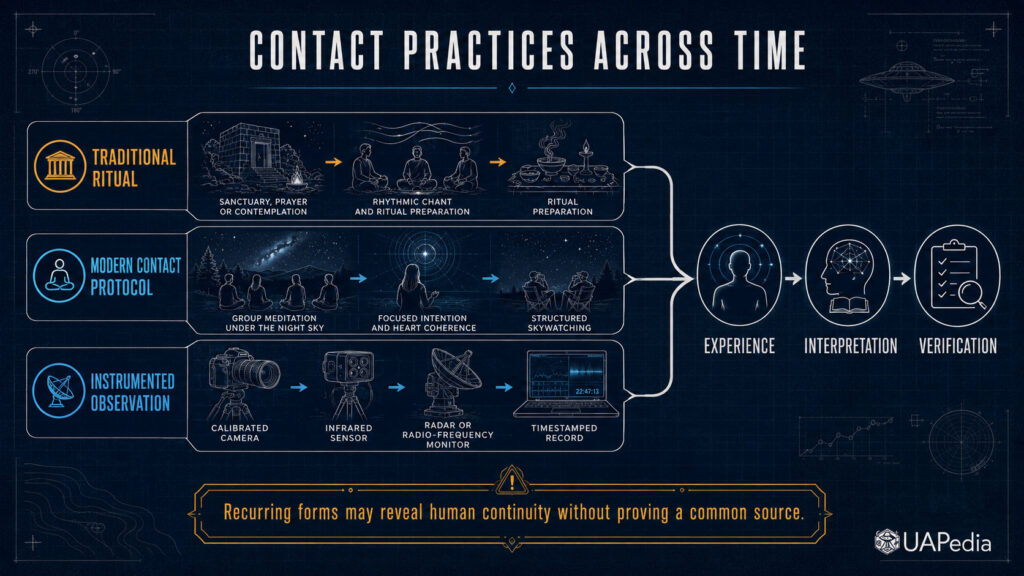
Across many periods and cultures, practices intended to facilitate communication with unseen or extraordinary beings display recurring structural features. These include withdrawal from ordinary activity, preparation of the body, focused attention, invocation, a perceived response, interpretation, and communication of the experience to others.
That resemblance does not demonstrate an uninterrupted tradition linking ancient sanctuaries, prophetic religion, spiritualism, twentieth-century contactees, and present-day initiated-contact groups. Direct historical transmission can sometimes be shown, particularly where later movements openly borrow from spiritualism, Theosophy, Eastern meditation, occult literature, or earlier contactee organisations. In other cases, similar practices may have developed independently because human beings share comparable cognitive, social, and sensory capacities.
History therefore gives us recurring patterns, not proof of a single lineage or source.
The same caution applies to the identity of the reported communicator. An experience may be understood as contact with a god, spirit, angel, ancestor, celestial teacher, extraterrestrial visitor, interdimensional entity, or non-human intelligence. Each label belongs partly to the witness’s cultural world.
A responsible explanation must preserve both sides of the record. The experience may have been vivid, sincere, transformative, shared, or accompanied by an unusual observation. The witness’s explanation of its source remains a separate claim.
Contact practice is a method, not a verdict
A contact practice can be defined as an intentional procedure through which a person or group attempts to receive communication from an unseen, extraordinary, or unidentified intelligence.
This definition does not decide in advance whether the perceived intelligence is external, psychological, spiritual, symbolic, technological, or unknown. It describes what participants are attempting to do.
The resulting evidence generally falls into three overlapping classes.
Subjective evidence includes dreams, visions, internally heard words, bodily sensations, impressions of presence, unusual imagery, and perceived telepathic communication. Intersubjective evidence arises when several people report corresponding observations or experiences, especially when their accounts are recorded separately before discussion. Instrumented evidence includes photographs, video, radar, infrared recordings, electromagnetic measurements, astronomical data, acoustic recordings, or other information preserved outside human memory.
Subjective evidence should not be dismissed merely because it is subjective. Most testimony, including testimony accepted in courts and historical research, begins with a person’s perception and recollection. The credibility of a witness can be assessed through proximity, opportunity to observe, consistency, independence, contemporaneous documentation, corroboration, motive, expertise, and the presence or absence of contradictory evidence.
Yet credible testimony does not automatically verify the witness’s interpretation. A trustworthy person may accurately report seeing a light, hearing a voice, or experiencing a presence while remaining mistaken or uncertain about its cause.
That distinction is particularly important in contact practices, where the first measuring instrument is the participant.
The ancient sanctuary as an analytical comparison
One of the clearest ancient examples of deliberately cultivated encounter is found in the healing sanctuaries of Asclepius.
At Epidaurus and other Asclepian centres, supplicants sought healing through a process that could include purification, offerings, prayer, dietary preparation, and ritual sleep. The visitor would sleep in a sanctuary area associated with incubation, hoping that Asclepius would appear in a dream or vision and provide healing, diagnosis, or instructions.
Fourth-century BCE inscriptions from Epidaurus preserve accounts of apparent cures attributed to the god. They describe dreams in which Asclepius touches a patient, removes an object, performs an operation, or instructs the person to complete an action after waking. These texts are devotional inscriptions assembled within the sanctuary’s religious culture. They are not clinical records produced under independent observation. They verify that such stories were recorded and displayed, not that every reported healing occurred exactly as narrated. [1]
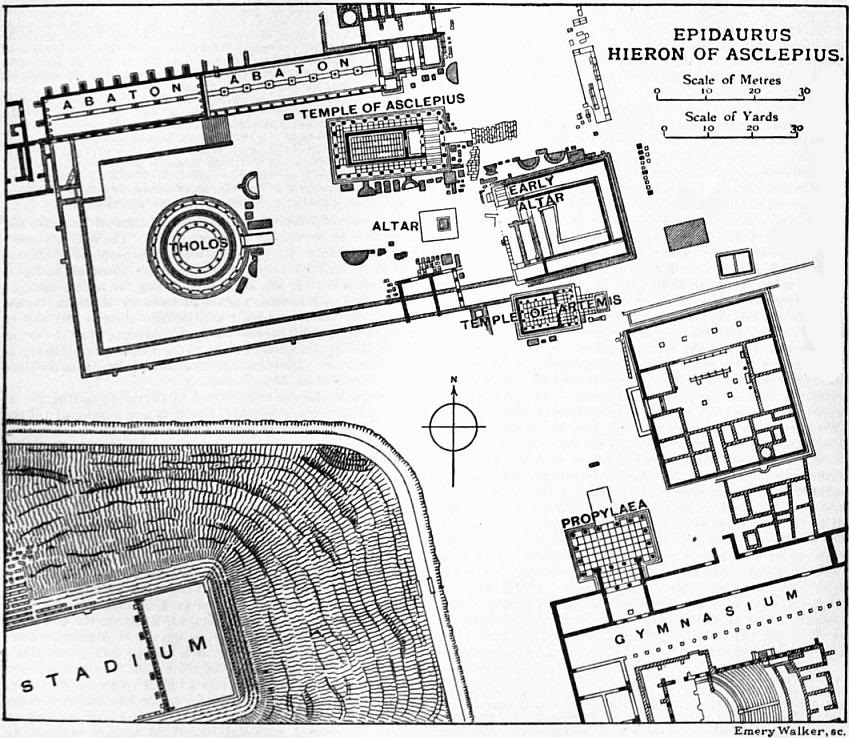
The phrase “contact laboratory” can be useful as a modern analogy, but it was not an ancient description of the sanctuary. Epidaurus was simultaneously a religious institution, healing centre, pilgrimage destination, performance space, and repository of sacred testimony.
Aelius Aristides provides a more personal record. In the second century CE, the Greek orator composed the works now known as the Sacred Tales, describing numerous dreams and perceived interventions attributed to Asclepius. Scholarly analysis identifies approximately 130 dream narratives in the work. Aristides recorded instructions involving bathing, diet, exercise, medicine, travel, public speaking, and religious conduct. [2]
His testimony shows how cultivated encounters could become an ongoing relationship. He prepared himself, slept, received what he considered guidance, acted upon it, observed the consequences, and returned for further instruction.
That pattern resembles aspects of modern contact practice, but resemblance does not establish descent. Modern groups may use meditation, mental imagery, repeated sessions, dream journals, and interpretation of subsequent events. The comparison is structural. It does not prove that ancient Greek worshippers and contemporary UAP experiencers were contacting the same kind of intelligence.
Sacred texts as maps of extraordinary encounter
Religious texts contain many descriptions of communication across the perceived boundary between humanity and a greater reality. These passages are sometimes reinterpreted through modern technological language, but their original literary and theological settings must remain visible.
The opening chapter of Ezekiel describes open heavens, fire, radiance, living beings, immense sound, intersecting wheels, and a throne-like form above them. Modern readers have sometimes interpreted the wheels as components of a vehicle. That is a modern hypothesis placed upon an ancient prophetic text. Within Ezekiel, the vision concerns divine presence, prophetic commissioning, priestly symbolism, exile, and sovereignty. The description is part of the testimony. A technological identification is not. [3]
The Qur’an’s account of the Prophet Muhammad’s Night Journey describes a sacred passage from the sanctuary in Mecca to the farthest sanctuary. Later Islamic traditions elaborate an ascent through heavenly realms, encounters with earlier prophets, and the reception of religious instruction. The narrative’s primary significance is theological. Treating it solely as a report of advanced transportation would remove it from the religious framework through which it was transmitted and understood. [4]
In chapter 11 of the Bhagavad Gita, Arjuna receives a special form of vision through which he beholds Krishna’s universal form. The experience is marked by radiance, multiplicity, immensity, awe, and fear. It is not presented as an observation of an aerial craft. It does, however, illustrate an enduring motif in extraordinary-contact narratives: the witness believes ordinary perception has been temporarily altered so that a concealed order of reality can be seen. [5]
These examples are not interchangeable. Ezekiel’s vision, the Islamic Miʿrāj, and Arjuna’s revelation belong to different traditions, genres, languages, and theological systems.
The useful comparison lies in what might be called the grammar of encounter. A boundary opens. Perception changes. A presence manifests. Information or authority is communicated. The witness experiences fear, awe, obligation, healing, or transformation. The event is then narrated through the concepts available to that witness and community.
A medieval Christian visionary might describe an angel. A nineteenth-century medium might describe a spirit communicator. A 1950s contactee might describe a visitor from Venus. A contemporary experiencer might use the term non-human intelligence.
These reports may have different causes. They may also involve culturally different descriptions of phenomena that share certain features. The evidence does not yet permit a universal conclusion.
Trance, rhythm, training, and the sensed presence
Many contact practices change attention before attempting communication.
Chanting, repetitive prayer, drumming, breath regulation, isolation, darkness, fasting, contemplation, prolonged wakefulness, and meditation can affect perception, memory, bodily awareness, and the sense of agency. This does not mean that every experience produced under those conditions is false or meaningless. It means that the method alters the observer.
A 2021 high-density EEG study compared experienced shamanic practitioners with controls during rest, drumming, and music. The practitioners reported substantial alterations in consciousness, while the researchers observed changes involving gamma activity, connectivity, neural-signal diversity, and criticality. Some measured changes correlated with reported visual alterations and complex imagery. The study demonstrated measurable neurophysiological changes during shamanic practice. It did not test whether practitioners were communicating with independently existing beings. [6]
Cross-cultural research led by anthropologist Tanya Luhrmann has similarly examined how people report sensing gods and spirits. The research found that such experiences vary with cultural ideas about the mind, personal absorption, training, and expectations concerning whether thoughts and presences can cross the boundary between minds. [7]
These findings support the conclusion that culture and training influence the form and recognition of extraordinary experience. They do not establish that every presence is generated internally.
The distinction resembles the problem of a receiver. Understanding the receiver’s circuitry does not, by itself, establish whether a transmission is external. Yet the existence of a receiver-like experience also does not prove that an outside transmitter is present.
The scientific question is whether contact practices ever produce information or physical effects that cannot be adequately explained by perception, expectation, memory, ordinary environmental events, social influence, or known technology.
Case study: Fátima and a predicted public event
The 1917 events at Fátima are among the most consequential religious-contact cases of the modern era.
Three Portuguese children, Lúcia dos Santos and her cousins Francisco and Jacinta Marto, reported repeated encounters with a luminous female presence whom they understood within Catholic tradition. The encounters were associated with prayer, particular dates, a rural location, messages, and a promise that a public manifestation would occur in October. [8]
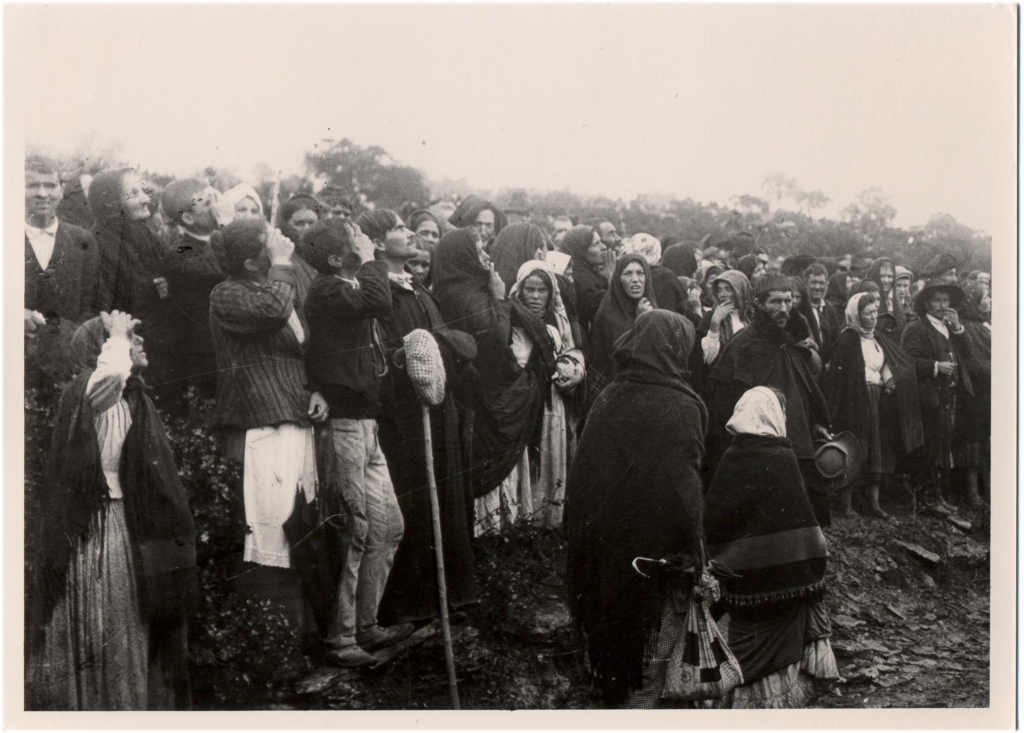
On 13 October 1917, a large crowd gathered at the Cova da Iria after rain. Those present included believers, sceptical observers, journalists, clergy, local residents, and people who had travelled because they expected something unusual to occur.
This feature makes Fátima especially relevant to the history of contact practices. It was not merely a private vision reported after the event. The children’s prediction helped create a scheduled mass gathering at which participants watched for a sign.
Contemporary journalist Avelino de Almeida published an account in the Lisbon newspaper O Século on 15 October 1917 under the headline “Coisas Espantosas! Como o Sol Bailou ao Meio-Dia em Fátima.” Almeida described people looking toward an apparently softened solar disc and reporting trembling, movement, and unusual visual effects. His report also records the crowd’s emotional response and the striking diversity of individual reactions. [9]
Surviving accounts are not uniform. Witnesses described differing colours, motions, religious imagery, and degrees of visibility. Some people reported seeing nothing extraordinary. Almeida’s report is especially valuable because it was published two days after the gathering, but it remains a journalistic account rather than an instrumented scientific record.
In 1930, Bishop José Alves Correia da Silva declared the children’s visions at the Cova da Iria “worthy of belief.” The ruling authorised Catholic devotion and reflected an ecclesiastical assessment. It was not a scientific determination that the astronomical Sun had moved or that an unidentified physical object had been present. [10]
Several explanations remain under discussion.
A physiological interpretation holds that prolonged observation of a bright or partly obscured Sun could produce retinal adaptation, coloured afterimages, apparent movement, and looming effects. Physicist Auguste Meessen developed such an explanation while treating the witnesses’ visual experiences as sincere perceptions rather than inventions. [11]
Philippe Dalleur later examined photographs, shadow directions, weather information, and collected testimony, including reports attributed to observers outside the immediate crowd. He proposed that a local luminous source distinct from the astronomical Sun could account for parts of the record. This is a non-consensus researcher interpretation. It depends upon disputed readings of photographs and testimony assembled from sources of unequal proximity and date. Claims involving distant observations, rapidly drying clothing, or the direction of illumination should therefore not be treated as carrying the same evidentiary weight as contemporary press reports. [12]
A Catholic interpretation understands the occurrence as a sign connected with the children’s Marian encounters. A UAP hypothesis asks whether an unidentified luminous phenomenon could have been embedded within a religiously interpreted event. A sociopsychological explanation emphasises prediction, expectation, communication within the crowd, intense attention, political conditions, and the perceptual effects of looking toward the Sun.
The historical gathering, the children’s testimony, press coverage, ecclesiastical inquiry, and subsequent devotional impact are documented. The physical cause of the reported visual phenomena remains disputed.
Fátima also carries a direct safety lesson. Looking at the Sun can cause retinal injury, even when it appears dimmed by cloud or atmospheric conditions. Published medical reports have documented solar retinopathy following religious sun-gazing. No contemporary contact practice should involve looking directly at the Sun. [13]
The case also demonstrates why prediction is evidentially complicated. An announced event can intensify expectation and suggestion. It can also bring many observers to a place at a specified time. Prediction becomes scientifically useful only when observations are recorded independently and when instruments, controls, and precise timing are established in advance.
Spiritual telegraphy and the cosmic receiver
Modern contact language was influenced not only by religion, but also by communication technology.
The telegraph, telephone, and wireless radio made invisible transmission part of daily life. A message could travel over great distances without a visible messenger. Information could fill the surrounding environment while remaining inaccessible until a suitable receiver was tuned to it.
Spiritualists adopted these metaphors. Mediums were described as instruments, receivers, batteries, operators, and channels. Inventors and experimenters attempted to construct devices that might detect communication from the dead. Historian Richard Noakes has documented proposals and experiments involving “psychic telegraphs” in Britain and the United States during the early twentieth century. [14]
This did not eliminate religious thinking. It supplied religious and occult communication with a technological vocabulary.
Prayer traditionally moved toward a divine realm. Wireless signals moved through space. Revelation could now be imagined as reception, trance as tuning, and the medium as an operator.
Later contactee movements developed within this conceptual environment. Their celestial communicators often behaved like religious teachers while speaking through the language of advanced science, radio, spacecraft, energy, and cosmic civilisation.
The sacred did not disappear from these accounts. It was partly translated into the imagery of modern communications and aerospace technology.
Case study: George Adamski and the moral visitors
George Adamski became one of the best-known contactees of the early flying-saucer era.
In Flying Saucers Have Landed, published with Desmond Leslie in 1953, Adamski described an encounter with a humanlike visitor whom he associated with Venus. In Inside the Space Ships, published by Abelard-Schuman in 1955, he expanded his narrative to include alleged journeys, additional beings, and teachings concerning peace, spirituality, nuclear danger, and humanity’s future. [15][16]
Adamski’s claims remain deeply contested. His photographs, witness arrangements, planetary descriptions, and later narrative details have been criticised, and the public evidence does not independently establish that he met visitors from another planet.
His historical importance is nevertheless substantial.
Adamski’s visitors combined technical superiority with moral authority. They arrived from the heavens, warned humanity about destructive conduct, presented themselves as members of a more advanced order, and treated technological development without spiritual maturity as dangerous.
This can be interpreted as a prophetic structure translated into post-war aerospace language. The atomic bomb provided an apocalyptic horizon. Space travel supplied the imagery of transcendence. The contactee became an intermediary between humanity and a supposedly wiser cosmic community.
That is an analytical reading, not proof that Adamski consciously adapted ancient prophecy or that his account had a religious origin, but there are evidences that he visited Tibet for spiritual initiation.
Several possibilities remain. Adamski may have interpreted ambiguous experiences through a developing cosmic spirituality. Parts of the account may have involved deliberate construction or performance. Sincere conviction and commercial activity may also have coexisted. The surviving evidence does not justify applying one classification automatically to every component of his story.
Case study: George Van Tassel and the desert temple
George Van Tassel brought together meditation, claimed communication, aerospace experience, religious imagery, and experimental architecture.
His 1952 publication I Rode a Flying Saucer presented messages that he attributed to beings from space. At Giant Rock in California’s Mojave Desert, he organised meditation and channeling meetings. He later claimed that an occupant of a spacecraft awakened him, brought him aboard, and communicated information relating to cellular rejuvenation.
Van Tassel attempted to embody those claims in the Integratron, a domed wooden structure associated in his writings and promotional material with rejuvenation, electrostatic energy, time research, Nikola Tesla, Georges Lakhovsky, and biblical architecture. The existence and construction of the building are documented. Its claimed rejuvenating and time-related functions were not scientifically demonstrated. [17]
Giant Rock also became a gathering place for the wider contactee movement. Annual conventions brought together speakers, experiencers, spiritual seekers, families, journalists, photographers, and visitors interested in unusual aerial phenomena. LIFE photographer Ralph Crane documented the 1957 convention. [18]
Attendance estimates vary considerably. A Smithsonian account states that attendance was thought to have exceeded 1,000, while a Google Arts & Culture presentation associated with the LIFE photographs reports that participation exceeded 10,000 at the convention’s height. Those figures are retrospective estimates and are not accompanied by complete registration or ticket records. They should not be treated as precise counts. [18][19]
The conventions transformed contact from an isolated personal claim into a communal activity. Participants heard testimony, exchanged publications, watched the sky, attended lectures, and returned to a location believed to be unusually receptive.
Giant Rock can therefore be analysed as a modern sacred landscape. Its authority grew from a founding encounter claim, repeated gatherings, charismatic leadership, publications, community memory, and the expectation that the site itself increased the chance of contact.
Van Tassel’s communications are unverified. His publications, conventions, organisation, and building are documented. Whatever caused his reported experiences, those experiences produced lasting cultural and architectural consequences.
What CE-5 originally meant, and how it changed
The terminology of initiated contact requires careful historical treatment.
Astronomer J. Allen Hynek introduced a close-encounter classification in The UFO Experience, first published in 1972. Close encounters of the first kind involved observations at relatively close range without reported physical effects. The second kind included physical effects, and the third kind included reported occupants or entities. Hynek’s categories classified reports. They were not instructions for producing an encounter. [20]
Later writers expanded encounter classification, but the additional categories were never universally standardised.
Jacques Vallée developed a multidimensional system that combined event classes with numbered effect levels. His classes included anomalous observations, manoeuvres, fly-bys, and close encounters. At level five, the reported consequences differed by class. AN5 included cases associated with injury, death, unexplained wounds, or permanent healing. MA5 and FB5 involved manoeuvre or fly-by cases associated with permanent injury or death. CE5 referred to close encounters followed by permanent psychological injury or death. [21]
This system differs significantly from the later CSETI use of CE-5 for deliberate human-initiated communication.
Steven Greer and the Center for the Study of Extraterrestrial Intelligence, founded in 1990, popularised CE-5 as intentional contact initiated by human participants. A reproduced copy of the spring 1995 CSETI Working Group Handbook defines CE-5 as “human-initiated contact or interaction with Extraterrestrial Intelligence or beings.” The definition appears in the handbook’s introductory classification material, before the working-group instructions and field procedures. [22]
The surviving online copy is a third-party reproduction rather than a copy hosted by CSETI or an academic archive. Rice University’s Brenda Denzler Ufology Collection confirms the preservation of CSETI and Steven Greer material dating from 1995 to 2002, although the public catalogue description does not independently identify every document contained within that folder. [23]
Greer later described the approach in Extraterrestrial Contact: The Evidence and Implications, published in 1999. [24]
In CSETI usage, participants attempt communication through meditation, coherent mental intention, visualisation, tones, light signals, and organised field observation. The term is now strongly associated with Greer’s approach, but it was not part of Hynek’s original classification.
For clarity, “human-initiated contact” is often a better descriptive term than CE-5 unless the particular classification system is stated.
Modern initiated-contact practice
A contemporary session may begin with preparation of the observation site, identification of visible planets and expected satellite traffic, meditation, group synchronisation, visualisation, and a directed mental invitation. Participants may then watch for lights, record subjective impressions, and compare experiences afterward.
Some report lights appearing soon after an invitation, changing direction, flashing in apparent response, or recurring in later dreams and synchronicities. These are witness reports and interpretations. A temporal sequence alone does not establish causation.
Aircraft, satellites, tumbling rocket bodies, planets, drones, balloons, meteors, atmospheric effects, autokinesis, camera processing, and sensor artefacts can all produce observations that appear responsive or anomalous. Heightened expectation may also increase the likelihood that an ambiguous event is interpreted as communication.
Identifying ordinary causes in some sessions does not demonstrate that every case has a conventional explanation. It does show why intentional-contact claims require controls.
As of 26 July 2026, no substantial body of publicly available, independently replicated, peer-reviewed research has demonstrated that directed human intention causes UAP to appear. The published record consists mainly of testimony, group accounts, photographs, videos, personal narratives, privately circulated manuals, documentary media, and limited instrument data collected under varying conditions.
The literature check supporting that statement used targeted searches conducted on 26 July 2026 across Google Scholar-indexed results, PubMed, Crossref-discoverable records, general academic search results, and searches of UAP, consciousness, anomalous cognition, and parapsychology literature. Search combinations included “human-initiated UAP contact,” “CE-5 peer reviewed,” “directed intention UAP,” “meditation UAP appearance,” “human initiated contact experience,” and related terminology. Searches excluded unrelated results concerning China’s Chang’e-5 lunar mission, which frequently appears under the abbreviation CE-5.
The editorial research archive should preserve the search date, exact strings, databases and interfaces searched, language limits, result counts, inclusion criteria, exclusion criteria, and potentially relevant studies rejected because they were uncontrolled, unpublished, or not independently replicated.
A literature-absence statement cannot prove that no relevant publication exists in any language or inaccessible archive. It means that no substantial replicated peer-reviewed evidence was identified through the stated search process.
The absence of established proof does not make the question untestable. It makes experimental design decisive.
Remote viewing and disagreement over anomalous cognition
Remote viewing is not the same as UAP contact, but official evaluation of remote-viewing research offers a useful comparison.
In 1995, the American Institutes for Research evaluated research and operational material associated with the United States government’s remote-viewing programme. Statistician Jessica Utts and psychologist Ray Hyman disagreed over the interpretation of laboratory results.
Utts argued that the statistical evidence supported the existence of anomalous functioning. Hyman accepted that statistical deviations required explanation but disputed whether the evidence established a paranormal process, citing methodological concerns and the need for more independent replication.
The AIR overview reached a narrower operational conclusion. It found that remote viewing had not produced sufficiently reliable, specific, and actionable information to justify continued use as an intelligence tool. The report stated that operational information had not been used to guide intelligence operations and described much of the material as vague, inconsistent, and dependent on subjective interpretation. [26]
The evaluation should not be summarised as unanimous scientific confirmation or as proof that the laboratory results were meaningless. It documented a disagreement over statistical interpretation alongside a more negative assessment of practical intelligence value.
The lesson for UAP contact research is direct. A statistical anomaly does not automatically reveal its cause. A laboratory effect does not guarantee operational usefulness. Apparent successes must be tested across independent teams, methods, judges, targets, and locations.
Religious institutions and discernment
Religious institutions have developed another form of contact evaluation.
The Dicastery for the Doctrine of the Faith issued revised Norms for Proceeding in the Discernment of Alleged Supernatural Phenomena on 17 May 2024. The document calls for prompt collection of testimony and documentation and considers doctrinal concerns, possible fabrication, psychological factors, manipulation, financial interests, abuse, and the use of alleged mystical authority to control other people. [27]
The revised framework generally avoids a definitive institutional declaration that an event is supernatural. Instead, authorities may permit, monitor, discourage, or prohibit associated devotion while judging the pastoral consequences and evidence available.
This is not a scientific UAP protocol. It nevertheless addresses issues that scientific instrumentation alone cannot resolve.
A contact claim can be evaluated partly through its consequences. Does the leader welcome independent examination? Are claims changed whenever a prediction fails? Are participants encouraged to abandon medical care? Is money extracted through fear or promises of privileged access? Does the group protect personal autonomy, or does it demand obedience?
Contact research requires both instrument discipline and awareness of power. NASA’s emphasis on calibration and metadata can be combined with institutional safeguards against coercion, exploitation, and charismatic abuse.
Three explanatory models
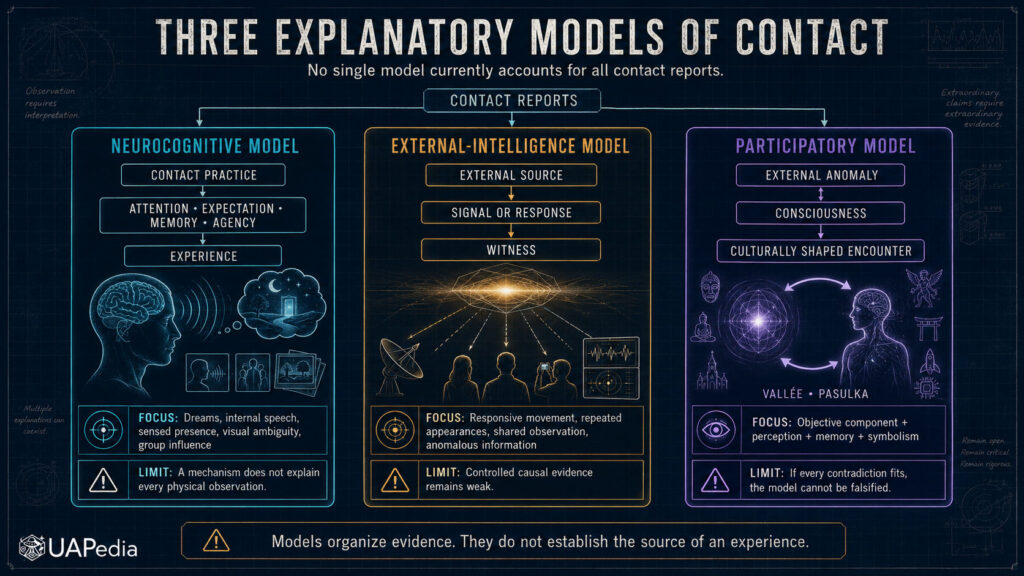
No single model currently accounts for all contact reports.
The neurocognitive model
This model proposes that contact practices alter attention, expectation, arousal, sensory processing, memory, and the sense of agency. Dreams, internal speech, sensed presences, dissociation, visual ambiguity, and group influence can produce convincing experiences without an external communicator.
Research on trance, meditation, absorption, and culturally trained perception supports parts of this explanation. Its limitation is that demonstrating a neurocognitive mechanism does not necessarily explain every associated physical observation.
The external-intelligence model
This model proposes that at least some practices attract or communicate with an external intelligence. Possible candidates include extraterrestrial, interdimensional, cryptoterrestrial, artificial, post-human, spiritual, or presently unclassified forms of intelligence.
The model gives particular weight to reports of responsive movement, repeated appearances, shared observations, or information that witnesses believe they could not otherwise have known.
Its principal weakness is the lack of controlled, causally persuasive evidence. Unless the hypothesis produces predictions that can fail, an elusive intelligence can be invoked to explain both apparent success and absence of results.
The participatory model
The participatory model proposes that an external anomaly and human consciousness jointly shape the perceived encounter. The event may have an objective component while its visible form, emotional tone, memory, and symbolism are influenced by the witness and culture.
Jacques Vallée’s control-system hypothesis is often discussed in this territory. Vallée has compared modern reports with folklore and religious traditions and proposed that recurring phenomena may influence individuals and societies while adapting to cultural expectations. This remains a researcher opinion and is difficult to falsify. [28]
Diana Walsh Pasulka has examined how contemporary UAP culture can develop pilgrimage sites, conversion experiences, secrecy traditions, sacred objects, authorities, and ritual practices. Her work addresses the religious and social formation surrounding UAP belief. It does not establish the source of the underlying experiences. [29]
The participatory model accommodates complexity, but it can also become too flexible. If every contradiction is interpreted as part of the phenomenon, the model becomes impossible to test.
Designing a serious contact experiment
A rigorous field study would begin before the participants entered the observation site.
The researchers would register the hypothesis, location, observation period, equipment, expected outcome, exclusion criteria, and analysis method in advance. Intentional-contact sessions would be compared with control sessions involving an emotionally neutral activity of equal duration. The timing of contact and control periods should be concealed from some observers and analysts.
Each participant would record observations independently before group discussion. Reports would include exact time, direction, elevation, duration, apparent movement, brightness, colour, and any associated bodily or mental experience.
The study would preserve weather conditions, visibility, astronomical objects, satellite passages, aircraft traffic, drone activity, and known local light sources. Cameras would retain original files and metadata. Multiple observation stations could attempt triangulation.
Where resources permitted, visible-light cameras would be paired with infrared sensors, radio-frequency monitoring, magnetometers, acoustic equipment, or radar. Instruments would be calibrated against known objects.
Unsuccessful sessions would be retained and published. Reporting only nights on which an unusual light appeared would create a powerful selection bias.
The human component would also be documented. Researchers could record sleep, fatigue, mood, meditation experience, prior expectations, substance use, and unusual perceptions. These variables should not be used as automatic grounds for discrediting witnesses. They help determine the conditions under which reports occur.
A credible result would require more than a light appearing after an invitation. The strongest evidence would involve repeated effects, blinded conditions, independent observers, multiple calibrated sensors, statistically meaningful differences from control sessions, and replication by unrelated teams.
Safety and ethical boundaries
Contact practice can involve genuine risks even when it consists mainly of contemplation and skywatching.
Participants should never stare at the Sun, direct lasers into the sky, illuminate aircraft, trespass, enter unsafe terrain, interfere with aviation, or drive while distracted.
Aiming a laser toward an aircraft can distract or temporarily impair a pilot and create a serious aviation hazard. In the United States, knowingly aiming a laser pointer at an aircraft is a federal offence. Laws and penalties vary by jurisdiction, but the aviation danger is universal. Lasers should not be used as signalling devices during contact sessions. [30]
Extended fasting, prolonged sleep deprivation, hyperventilation, severe sensory isolation, or unsupervised use of psychoactive substances may create medical or psychological harm.
Meditation itself is not risk-free for every person. A qualitative study of challenging contemplative experiences documented fear, changes in perception, sleep disruption, somatic effects, altered identity, and impaired functioning among some practitioners. The study did not establish population-wide incidence, but it supports the need for proportionate safeguards. [31]
Contact leaders should not diagnose participants, guarantee protection from unknown entities, claim exclusive cosmic authority, demand secrecy, encourage financial dependency, or advise people to discontinue medical or mental-health treatment.
An experience can be treated with compassion without confirming every interpretation. Participants who become frightened or destabilised should be allowed to stop without being told that fear proves spiritual weakness or resistance.
Why contact practices matter
Practices intended to communicate with extraordinary beings have had demonstrable personal and cultural effects.
Ancient incubation shaped pilgrimage and healing traditions. Prophetic visions influenced religious communities and moral obligations. Fátima became an international devotional centre. Contactee narratives contributed to new spiritual movements shaped by nuclear anxiety, space travel, and hopes for intervention by a wiser civilisation. Modern initiated-contact groups combine meditation, citizen observation, technology, disclosure activism, and speculation about consciousness.
A perceived encounter can reduce fear of death, inspire environmental concern, reorganise religious belief, or provide a sense of purpose. It can also lead to anxiety, obsession, isolation, grandiosity, exploitation, or ontological shock.
These consequences do not identify the source of the experience. They establish that the experience matters.
The history of contact also raises a question of authority. Who is entitled to interpret an extraordinary event?
Priests, prophets, physicians, scientists, journalists, military officers, government agencies, charismatic leaders, and witnesses have all competed for that role. None should receive automatic authority over the entire subject.
A constructive approach will not force witnesses to choose between ridicule and unquestioning acceptance. It will preserve testimony, examine cultural and personal context, seek independent corroboration, and retain uncertainty when the evidence requires it.
The oldest question remains open
Human beings have repeatedly sought communication across the apparent boundaries of the known world.
The sanctuary sleeper, visionary, contemplative, medium, desert contactee, and modern skywatcher belong to different historical traditions. Their practices often share structural elements, but direct continuity cannot always be demonstrated.
Some reported contact events will be explained through astronomy, psychology, optics, aviation, atmospheric science, social influence, or known technology. Some claims will prove inconsistent or deliberately manufactured. Other cases may preserve observations that remain unresolved because the evidence is incomplete or because the phenomenon is genuinely unusual.
The task is not to force every experience into one explanation. It is to distinguish what was reported, what was independently documented, what was later reconstructed, what the witness believed, and what remains unknown.
Contact practices may ultimately reveal more about human consciousness, more about the intelligence associated with some UAP reports, or more about a relationship between observer and anomaly that current categories do not capture.
For now, the most defensible position is disciplined openness: prepare carefully, record independently, use calibrated instruments, protect participants, publish failures, and never confuse the power of an experience with proof of its source.
Claims Taxonomy
Verified
Records verify that people in different periods have reported using sanctuary sleep, prayer, trance, contemplation, mediumship, meditation, ritual gathering, and organised skywatching in attempts to communicate with extraordinary beings.
The Epidaurian inscriptions verify that devotional cure narratives attributed to Asclepius were recorded and displayed. They do not independently verify every healing detail.
The Sacred Tales verify that Aelius Aristides recorded numerous dreams and experiences that he attributed to Asclepius. They do not independently verify divine causation.
The Fátima children’s reports, the announced October gathering, contemporary press coverage, ecclesiastical investigation, and 1930 declaration are documented. The physical cause of the crowd’s reported observations is not verified.
The publications of George Adamski and George Van Tassel, the Giant Rock conventions, and the construction of the Integratron are documented. Their alleged contacts are not independently verified.
The 1995 AIR remote-viewing evaluation, and the Dicastery for the Doctrine of the Faith’s 2024 norms are official records. None verifies human communication with non-human intelligence.
Probable
It is probable that cultural language, training, expectation, and prior belief influence how extraordinary experiences are perceived, remembered, and described.
It is probable that some modern contact practices contain elements transmitted through spiritualism, occult movements, meditation traditions, science-fiction culture, and twentieth-century contactee literature.
Where transmission cannot be demonstrated, parallel development remains a plausible explanation for structural similarities.
It is probable that ordinary astronomical, technological, physiological, and psychological factors account for a portion of modern initiated-contact reports. They should not be presumed to explain every case without investigation.
Disputed
The physical source of the reported Fátima phenomena remains disputed.
George Adamski’s and George Van Tassel’s claims of contact with beings from other worlds remain disputed.
Claims that meditation or directed intention can cause UAP to appear remain disputed.
The proposal that religious, folkloric, contactee, and contemporary encounter narratives involve a single persistent intelligence remains disputed.
Legend
Sacred narratives involving divine journeys, celestial beings, miraculous signs, and transformed perception may be classified as legend when used as historical evidence for UAP contact. This recognises their cultural and religious status without deciding their theological truth.
Technological interpretations of Ezekiel’s vision, the Miʿrāj, Arjuna’s universal-form vision, and comparable traditions remain speculative unless supported by independent historical or physical evidence.
Speculation Labels
Hypothesis
Recurring features of contact practices may arise partly from shared neurocognitive processes. Seclusion, focused attention, expectation, rhythm, altered sleep, meditation, and group synchronisation may increase imagery, sensed presences, unusual bodily sensations, and meaningful coincidence.
A competing hypothesis proposes that an external intelligence sometimes responds to directed human attention and presents itself through culturally understandable forms.
A participatory hypothesis proposes that an external anomaly and the witness’s perceptual and symbolic processes jointly shape the encounter.
None of these hypotheses has been established as a complete explanation.
Witness Interpretation
Aelius Aristides understood his dreams and perceived interventions as communications from Asclepius.
Lúcia dos Santos, Francisco Marto, and Jacinta Marto interpreted the Fátima presence within Catholic Marian theology. Many witnesses interpreted the October event as the promised sign.
George Adamski interpreted his experiences as meetings with advanced visitors associated with other planets.
George Van Tassel interpreted his channeling, meditation experiences, and claimed physical encounter as communication from beings from space.
Modern initiated-contact practitioners may interpret unusual lights, dreams, bodily sensations, imagery, or synchronicities as responses from non-human intelligence.
These interpretations are part of the evidentiary record. They do not independently verify the source.
Researcher Opinion
Auguste Meessen proposed that retinal and neurological effects associated with observation of bright light could explain significant portions of the reported Fátima phenomena.
Philippe Dalleur proposed that photographic and testimonial material may support a local luminous source distinct from the astronomical Sun. His interpretation is non-consensus and depends on disputed reconstruction.
Jacques Vallée has proposed that recurring encounter forms may function as part of a culturally adaptive control system.
Diana Walsh Pasulka has examined UAP communities through concepts including pilgrimage, ritual, authority, secrecy, conversion, and sacred materiality.
Impact Assessment
The documented effects of contact practices include pilgrimage, religious devotion, healing traditions, publications, architecture, organisations, social movements, personal transformation, political advocacy, and psychological distress.
The proposition that these effects were deliberately engineered by non-human intelligence remains speculative.
References
- Edelstein, E. J., & Edelstein, L. (1945). Asclepius: Collection and interpretation of the testimonies (Vols. 1–2). Johns Hopkins Press. Selected translated Epidaurian inscriptions: https://topostext.org/work/648 (accessed 26 July 2026).
- Pearcy, L. T. (1988). Theme, dream, and narrative: Reading the Sacred Tales of Aelius Aristides. Transactions of the American Philological Association, 118, 377–391. https://doi.org/10.2307/284178
- The Book of Ezekiel, chapter 1. Sefaria. https://www.sefaria.org/Ezekiel.1 (accessed 26 July 2026).
- The Qur’an, 17:1. https://quran.com/17/1 (accessed 26 July 2026).
- Bhagavad Gita, chapter 11. Harvard Divinity School, Center for the Study of World Religions. https://cswr.hds.harvard.edu/news/2025/11/14/bhagavad-gita-chapter-11 (accessed 26 July 2026).
- Huels, E. R., et al. (2021). Neural correlates of the shamanic state of consciousness. Frontiers in Human Neuroscience, 15, Article 610466. https://doi.org/10.3389/fnhum.2021.610466
- Luhrmann, T. M., et al. (2021). Sensing the presence of gods and spirits across cultures and faiths. Proceedings of the National Academy of Sciences, 118(5), e2016649118. https://doi.org/10.1073/pnas.2016649118
- Sanctuary of Fátima. (n.d.). Narrative of the apparitions. https://www.fatima.pt/en/pages/narrative-of-the-apparitions- (accessed 26 July 2026).
- de Almeida, A. (1917, October 15). Coisas espantosas! Como o Sol bailou ao meio-dia em Fátima. O Século. English translation and reproduction in Bennett, J. S. (2012), When the Sun Danced: Myth, Miracles, and Modernity in Early Twentieth-Century Portugal, pp. 86–90. University of Virginia Press.
- Sanctuary of Fátima. (n.d.). Chronology of the three seers, entries for 13 October 1917 and 13 October 1930. https://www.fatima.pt/en/pages/chronology-of-the-three-seers (accessed 26 July 2026).
- Meessen, A. (2005). Apparitions and miracles of the Sun. Consciências, 2, 199–222. https://www.meessen.net/AMeessen/Apparitions_and_Miracles_of_the_Sun.pdf
- Dalleur, P. (2021). Fatima pictures and testimonials: In-depth analysis. Scientia et Fides, 9(1), 9–45. https://doi.org/10.12775/SetF.2021.001
- Hope-Ross, M., Travers, S., & Mooney, D. (1988). Solar retinopathy following religious rituals. British Journal of Ophthalmology, 72(12), 931–934. https://doi.org/10.1136/bjo.72.12.931
- Noakes, R. (2016). Thoughts and spirits by wireless: Imagining and building psychic telegraphs in America and Britain, circa 1900–1930. History and Technology, 32(2), 137–158. https://doi.org/10.1080/07341512.2016.1217598
- Leslie, D., & Adamski, G. (1953). Flying Saucers Have Landed. Werner Laurie.
- Adamski, G. (1955). Inside the Space Ships. Abelard-Schuman, Inc. WorldCat bibliographic record: https://www.worldcat.org/search?q=ti%3AInside+the+Space+Ships+au%3AGeorge+Adamski (accessed 26 July 2026).
- Van Tassel, G. W. (1952). I Rode a Flying Saucer. New Age Publishing Company. Digitised copy: https://archive.org/details/1952-i-rode-a-flying-saucer-by-george-w.-van-tassel (accessed 26 July 2026); Integratron. (n.d.). History and George Van Tassel. https://www.integratron.com/history-about/ (accessed 26 July 2026).
- LIFE Photo Collection. (1957). Flying Saucer Convention. Photographs by Ralph Crane. Google Arts & Culture. https://artsandculture.google.com/story/visit-the-1957-flying-saucer-convention/CAXh3kxi5wW_Mg (accessed 26 July 2026).
- Stromberg, J. (2015, January 9). Come for the Giant Rock, stay for the UFO history. Smithsonian Magazine. https://www.smithsonianmag.com/smart-news/ufo-related-history-worlds-biggest-rock-180953862/ (accessed 26 July 2026).
- Hynek, J. A. (1972). The UFO Experience: A Scientific Inquiry. Henry Regnery Company, pp. 28–33.
- Vallée, J. (1990). Confrontations: A Scientist’s Search for Alien Contact. Ballantine Books. See the event-class and effect-level classification framework distinguishing AN, MA, FB, and CE categories.
- Center for the Study of Extraterrestrial Intelligence. (1995). The CSETI Working Group Handbook (Spring 1995), introductory classification section defining CE-5 and the “CE-5 Initiative Working Group.” Reproduced third-party copy: https://www.slideshare.net/slideshow/steven-greer-ce5cseti-02-working-group-manual-how-to-form-a-working-group/43544361 (accessed 26 July 2026).
- Woodson Research Center, Rice University. (n.d.). Brenda Denzler Ufology Collection: CSETI/Steven Greer, 1995–2002, Box 3, Folder 12. https://archives.library.rice.edu/repositories/2/archival_objects/332384 (accessed 26 July 2026).
- Greer, S. M. (1999). Extraterrestrial Contact: The Evidence and Implications. Crossing Point, Inc. ISBN 978-0-9673238-0-0. https://books.google.com/books?id=T_fXAAAAMAAJ (accessed 26 July 2026).
- National Aeronautics and Space Administration. (2023). Unidentified Anomalous Phenomena Independent Study Team Report, p. 5 and “Responses to Statement of Task.” https://science.nasa.gov/wp-content/uploads/2023/09/uap-independent-study-team-final-report.pdf (accessed 26 July 2026).
- Mumford, M. D., Rose, A. M., & Goslin, D. A. (1995). An Evaluation of Remote Viewing: Research and Applications. American Institutes for Research. CIA document number CIA-RDP96-00791R000200180005-5. See the executive summary and appendices by Jessica Utts and Ray Hyman. https://www.cia.gov/readingroom/docs/CIA-RDP96-00791R000200180005-5.pdf (accessed 26 July 2026).
- Dicastery for the Doctrine of the Faith. (2024, May 17). Norms for Proceeding in the Discernment of Alleged Supernatural Phenomena, Part II, Articles 8–16. https://www.vatican.va/roman_curia/congregations/cfaith/documents/rc_ddf_doc_20240517_norme-fenomeni-soprannaturali_en.html (accessed 26 July 2026).
- Vallée, J. (1975). The Invisible College: What a Group of Scientists Has Discovered about UFO Influences on the Human Race. E. P. Dutton. https://books.google.com/books?id=o4RTAAAAMAAJ (accessed 26 July 2026).
- Pasulka, D. W. (2019). American Cosmic: UFOs, Religion, Technology. Oxford University Press. ISBN 978-0-19-069288-9. https://global.oup.com/academic/product/american-cosmic-9780190692889 (accessed 26 July 2026).
- Federal Aviation Administration. (n.d.). Laser Safety. https://www.faa.gov/about/initiatives/lasers (accessed 26 July 2026).
- Lindahl, J. R., Fisher, N. E., Cooper, D. J., Rosen, R. K., & Britton, W. B. (2017). The varieties of contemplative experience: A mixed-methods study of meditation-related challenges in Western Buddhists. PLOS ONE, 12(5), e0176239. https://doi.org/10.1371/journal.pone.0176239
SEO Keywords
historical UAP contact practices, religious context of UAP contact, contact modalities, human-initiated UAP contact, CE-5 history, origin of CE-5, CSETI Working Group Handbook, Steven Greer CE-5, J. Allen Hynek close encounters, Jacques Vallée encounter classification, ancient contact rituals, Asclepian dream incubation, Aelius Aristides Sacred Tales, Fátima UAP interpretation, Avelino de Almeida Fátima, Fátima witness testimony, miracle of the Sun analysis, George Adamski contact claims, Inside the Space Ships, George Van Tassel Giant Rock, Integratron history, Giant Rock Spacecraft Convention, spiritualism and UAP communication, psychic telegraphy, meditation and UAP contact, religious visions and UAP, non-human intelligence contact, contactee movement history, UAP consciousness research, NASA UAP study, AIR remote viewing evaluation, Vatican supernatural phenomena norms, contact experiment design, contact practice ethics, laser aviation safety, UAP contact safety