There is a point in many difficult contact cases when the central question changes.
At first, everyone wants to know what happened. Was there a physical encounter? Was a non-human intelligence involved? Did the witness experience an altered state, an external event, or some combination of both?
In the case of Emma Woods, another question eventually became just as important: what happens when an investigator gains unusual power over the meaning of another person’s memories?
Woods is a New Zealand-based writer and experiencer advocate who publishes under a pseudonym. Her public biography states that she was born and raised in Africa, spent part of her youth in Europe, and later settled in New Zealand. She has explained that anonymity helps protect her and her family from the stigma attached to anomalous experiences (Woods, n.d.-a).
That decision is not a minor biographical footnote. It is part of the evidentiary and ethical landscape surrounding her story.
Experiencers often approach researchers while trying to preserve ordinary careers, relationships and social standing. They may be disclosing events they have never discussed openly. They may also fear ridicule, psychiatric labeling or public exposure. This can create a significant imbalance between a publicly established investigator and a privately vulnerable witness.
Woods became widely known not because she presented a simple, cinematic abduction account, but because she publicly challenged the methods used during her own investigation. Her online archive includes descriptions of anomalous experiences, hypnosis recordings, transcripts, correspondence, photographs, witness statements and accounts of complaints submitted to institutions.
Taken together, these materials form an unusual case study in testimony, memory, consent and researcher responsibility.
Her significance is therefore double. She is an experiencer whose reports should be assessed without ridicule, and she is an advocate whose criticism asks whether contact research can remain credible if it does not first protect the person at its center.
A life interpreted through anomalous experience
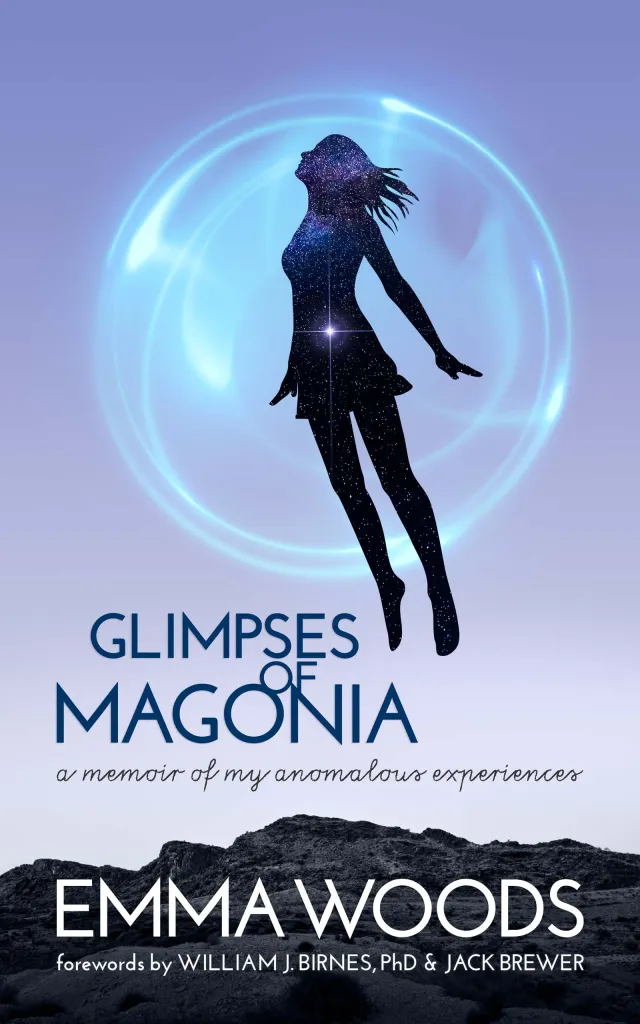
Woods’s 2022 memoir, Glimpses of Magonia: A Memoir of My Anomalous Experiences, gathers experiences that she says began in childhood. The book was published in hardcover and paperback on February 26, 2022, and is described as a 286-page nonfiction memoir (Woods, 2022).
One of the book’s most useful methodological features is that Woods says it focuses largely on events that occurred before she entered the organized UAP research community.
That creates a rough boundary between earlier memories and the interpretive language she later encountered through researchers, books and experiencer networks. It does not eliminate cultural influence, family influence or retrospective interpretation. It does, however, allow readers to compare earlier recollections with material developed later through regression and specialist discussion.
Her reported experiences do not form a single, orderly sequence. They include strange presences, unusual dreams, apparent precognition, missing-time-like episodes, bodily marks, anomalous events in domestic settings and memories she associated with nonordinary encounters.
Her website also presents supplementary materials connected with selected incidents. These include a statement from her late first husband concerning a dream she interpreted as precognitive of an earthquake, photographs of a forearm burn dated November 12, 2002, images of a cut and bruise dated February 28, 2007, and photographs of a scratch and yellow fluorescent staining dated August 12, 2018. She also provides images of apparent footprints in a former apartment and statements from relatives or acquaintances about particular events (Woods, n.d.-a).
These materials matter, but their limitations matter just as much.
A photograph may document the appearance of a mark at the time the image was made. It does not independently establish what caused the mark.
A spouse may corroborate that a dream was described before a later event. That testimony still requires attention to timing, specificity, record preservation and the number of other dreams that were not followed by comparable events.
An unusual footprint may remain unexplained within a witness’s knowledge while still permitting several physical explanations.
This is not a reason to discard the archive. It is a reason to classify it carefully.
Woods’s materials are strongest as evidence that she consistently reported a prolonged series of events she considered anomalous, that some incidents were witnessed or later discussed by people close to her, and that she made efforts to preserve physical or documentary traces.
They are not, by themselves, proof of a particular intelligence, technology or origin.
Woods has also expressed more uncertainty about causation than the word “abductee” might suggest. In an extended interview published by Grey Faction, she said she did not necessarily accept an extraterrestrial-abduction explanation and ultimately did not know what caused her experiences.
Grey Faction is not a neutral journalistic source. It is an advocacy organization that promotes a strong recovered-memory interpretation and introduced Woods as an “alien abduction retractor.” Its interview is nevertheless useful as a primary record of Woods’s own answers, provided its perspective is clearly identified (Grey Faction, n.d.).
Her agnosticism is important. She has allowed that a real phenomenon may underlie at least some reports while also acknowledging possible internal, psychological or mixed components.
Her position is not a declaration of certainty. It is an admission that the cause remains unresolved.
That restraint is central to understanding her advocacy. She is not asking readers to accept every interpretation. She is asking them to recognize that uncertainty does not cancel the witness’s dignity or the investigator’s obligations.
How regression became central to abduction research
By the late twentieth century, regression hypnosis had become one of the signature methods used in abduction research.
Investigators applied it to missing time, dreams, fragmentary images, bodily sensations and memories that witnesses could not fully reconstruct while awake. When similar examination scenes, entities, reproductive motifs or hybrid narratives appeared across cases, some researchers treated the repetition as independent corroboration.
There was always another possibility.
Recurring motifs might also spread through books, lectures, media, therapy, investigator expectations and the structure of the interview itself. Similarity is most persuasive when witnesses are independently interviewed before exposure to specialist terminology. It is less persuasive when the same researchers, questions, narrative models and hypnotic procedures circulate through multiple cases.
Woods entered a field in which regression often carried considerable authority. A detailed hypnotic narrative could be treated as a recovered episode rather than a collaboratively produced account. The investigator might occupy several roles at once: interviewer, confidant, interpreter, archivist and expert on the supposed phenomenon.
Her case did not create this methodological problem.
It made the process audible.
The publicly released recordings allow listeners to examine not only what the witness said, but how questions, expectations and reassurance interacted with her answers. That makes the Woods material unusually significant. It preserves part of the process by which an uncertain impression can become a highly structured contact narrative.
Case study: the long-distance regression archive
The most consequential phase of Woods’s public story began through her contact with historian and abduction researcher David M. Jacobs.
According to Woods, a former therapist contacted Jacobs in 2001. Woods later entered a prolonged series of telephone sessions with him. She states that between December 2004 and February 2007 she underwent 91 regressions during 37 telephone sessions, totaling approximately 180 hours. She was in New Zealand, often alone in her apartment, while Jacobs conducted the sessions from the United States (Woods, n.d.-b; Woods, 2011).
Jacobs is a retired associate professor of history at Temple University. His doctorate concerned intellectual history rather than psychology, psychiatry, medicine or licensed hypnotherapy. His official biography states that he conducted nearly 1,200 hypnotic regressions involving more than 150 people who reported abduction experiences (Jacobs, n.d.-a).
Those figures demonstrate extensive involvement in the subject. They do not convert historical training into clinical qualification.
Woods later released recordings and transcripts from selected sessions and argued that the process had become suggestive and unsafe.
In her 2011 essay, “Dangerous Games: Experiencers as Human Research Subjects,” she alleged that she was exposed to details from other cases, encouraged toward particular interpretations, given post-hypnotic suggestions and sometimes left to emerge from trance without a trained professional physically present.
She also alleged that Jacobs asked her to mail unwashed underwear for testing and proposed a physical restraint intended to prevent the sexual or reproductive interference that his research model attributed to hybrid beings (Woods, 2011).
These are Woods’s allegations, supported by materials in her personal archive.
They are not presented here as findings issued by a court, professional licensing body, university inquiry or independent investigative panel.
That distinction is essential.
The archive establishes that Woods published the allegations and released recordings she says support them. It does not independently resolve every disagreement over context, editing, intent or institutional responsibility.
Why, then, do the recordings matter so much?
Because hypnosis does not merely retrieve information. It creates a social situation.
The participant is asked to narrow attention, accept guidance, search for imagery and treat the investigator as a source of procedural authority. The investigator chooses the questions, supplies much of the vocabulary, identifies significant details and often interprets uncertainty for the participant.
When the investigator already accepts a highly developed theory, even a seemingly gentle prompt can become directional.
“What happens next?” leaves more room than “Are they taking you into the examination room?”
“Do you notice anything unusual?” is methodologically different from “Can you see the hybrid?”
A statement such as “Other people have reported this too” can reassure a distressed witness, but it can also introduce a template.
Repeated exposure increases familiarity. Familiarity may later be mistaken for memory. Confidence may rise even when accuracy does not.
This does not mean that every image described during hypnosis is false. It means that hypnosis cannot independently determine which details are historically accurate simply because they are vivid, emotional or coherent.
Jacobs disputed Woods’s presentation.
In Jeremy Vaeni’s article “Aliens vs. Predator: The Incredible Visitations at Emma Woods,” Jacobs was quoted as saying that telephone sessions were not as thorough as in-person work but could still be satisfactory for helping a person remember an experience. He also argued that the released recordings had been edited to portray him negatively (Vaeni, 2010).
The publicly available record does not include a comprehensive independent forensic review of the complete audio archive. The completeness and contextual framing of the released excerpts therefore remain disputed.
There is also a notable tension in Jacobs’s later public statements.
His current website says that most abduction evidence consists of human memory, frequently obtained through hypnosis administered by amateurs, and characterizes this evidence as extremely weak. He urges readers to remain skeptical of hypnotically derived testimony, although he continues to defend a literal abduction framework and has not adopted Woods’s wider interpretation of their research relationship (Jacobs, n.d.-b).
This does not amount to an acceptance of Woods’s allegations.
It does show that both sides now acknowledge, in different ways, that hypnotically derived memory is methodologically fragile.
What hypnosis can show, and what it cannot prove
The scientific problem is not that memory is useless.
Human memory is indispensable to law, medicine, history and ordinary life. The problem is that memory is reconstructive. People do not replay a complete internal recording. They rebuild an event from sensory fragments, emotion, expectations, later information and the context in which recall occurs.
Hypnosis can increase the amount of material a person reports. More material is not automatically more accurate material.
In 1985, the American Medical Association’s Council on Scientific Affairs reviewed the use of hypnosis to refresh recollection. It concluded that hypnotically refreshed accounts could contain confabulations and pseudomemories and should not automatically be treated as more reliable than ordinary recall (Council on Scientific Affairs, 1985).
The importance of that report is not that it prohibited every clinical or investigative use of hypnosis. Its importance is that it rejected the assumption that vividness and confidence guarantee historical accuracy.
A 2002 study led by psychologist Susan Clancy examined people reporting recovered memories of alien abduction. At group level, the participants showed greater susceptibility than comparison groups to false recall and false recognition in a laboratory task (Clancy et al., 2002).
This was not a verdict on Woods or any other individual witness. It did not prove fabrication. It did show why detail, confidence and emotional intensity should not substitute for independent corroboration.
A 2004 study led by Richard McNally examined physiological responses among people reporting alien-abduction memories. Participants showed significant changes in heart rate, skin conductance and facial-muscle activity while listening to scripts describing their experiences (McNally et al., 2004).
The study did not establish whether the reported originating events were physical, psychological, neurological or mixed.
It demonstrated that recollection of a contested experience can produce substantial physiological arousal consistent with intense emotion.
Taken together, these findings support a more humane and more rigorous position.
A witness may be sincere.
The emotional response may be intense.
The memory may be vivid.
The interpretation may still be incomplete, mistaken or partly shaped by the interview process.
Conversely, the known fallibility of memory does not prove that every anomalous report is reducible to imagination.
It means that testimony requires provenance.
For contact research, provenance should identify whether a detail came from spontaneous waking recall, a dream, a hypnagogic episode, a hypnotic session, a leading prompt, a later inference, a physical record or an independent witness.
Without those distinctions, the narrative becomes smoother while the evidence becomes weaker.
Case study: physical traces without causal proof
Woods’s photographic archive offers a second instructive case.
Body marks, fluorescent substances and disturbed domestic environments are often treated in contact literature as bridges between private experience and public evidence. They appear to offer something more concrete than memory.
Yet every trace carries two different questions.
Was an apparent trace documented?
What caused it?
A photograph may document the appearance of a mark. It rarely identifies its cause.
To move from “a mark was photographed” to “the mark was caused by a non-human procedure” requires a documented chain of custody, medical examination, comparison images, environmental sampling, laboratory methods, control samples and, ideally, independent examiners who are not committed to the outcome.
Woods’s publicly available materials do not provide that level of forensic documentation. They should therefore be treated as case records rather than laboratory conclusions. This distinction protects both sides of the inquiry.
It prevents an advocate from overclaiming, but it also prevents a critic from casually declaring that nothing occurred.
The narrower conclusion is more defensible: the appearance of a physical trace was documented, but its cause remains undetermined.
That conclusion may feel unsatisfying, yet it is scientifically useful. It preserves the anomaly for future comparison.
If many experiencers independently document comparable fluorescent residues under controlled conditions, the pattern could become testable. If the substances repeatedly prove ordinary, the field would also learn something valuable.
Good research does not require every case to end in revelation. It requires the evidence to remain clean enough to support the next question.
Case study: oral history and human-subject risk
Woods’s institutional complaints reveal another important problem: the gap between regulatory classification and ethical responsibility.
In her published account, Woods says she complained to Temple University’s Institutional Review Board in 2008 and to the federal Office for Human Research Protections in 2009.
She states that Temple treated Jacobs’s work as oral history and that the federal office concluded it lacked jurisdiction. She also reports that a Temple administrator told her a consent document referring to the university was unauthorized and that Jacobs was instructed to remove those references (Woods, 2011).
The publicly available record does not include a complete institutional case file that independently resolves each point.
These statements therefore remain attributed to Woods.
The regulatory background helps explain how such a complaint could fall into a gray area.
In 2003, the Office for Human Research Protections responded to, and conditionally concurred with, a proposed oral-history policy prepared by representatives of the oral-history community. That policy stated that conventional oral-history interviewing generally falls outside the federal definition of research when it is not designed to produce generalizable knowledge.
The correspondence also recognized that human-subject research may use oral-history methods and still require review when it is intended to generate broader conclusions about a population (Office for Human Research Protections, 2003).
It is more precise to describe this as a qualified concurrence with an external policy proposal rather than as an independently authored OHRP guidance document.
The revised federal regulations later excluded certain scholarly and journalistic activities, including oral history, biography and historical scholarship focused directly on specific individuals, from the regulatory definition of research. The final regulatory text appears at 45 C.F.R. § 46.102(l)(1).
A 2018 explanatory document issued by OHRP concerning these provisions was published as draft guidance, not final guidance (Office for Human Research Protections, 2018).
These distinctions do not answer the ethical question.
A project can fall outside a particular office’s jurisdiction and still expose a participant to significant risk.
The Belmont Report, a foundational United States statement on human-subject ethics, identifies respect for persons, beneficence and justice as central principles. Those ideas become especially important when a participant is stigmatized, isolated, highly suggestible within the research setting or dependent on an investigator for an explanation of frightening experiences (National Commission, 1979).
Woods’s case therefore exposes a category problem.
Was the work oral history, private inquiry, psychological support, data collection or a hybrid of several activities?
Each label carries different expectations. Therapy implies professional competence and a duty of care. Academic research implies review, informed consent and data governance. Oral history implies negotiated authorship and respect for the narrator’s agency.
Private investigation may escape formal oversight, but it does not escape basic ethical responsibility.
The practical lesson is straightforward: ambiguity should not be used as insulation.
Before an interview begins, a participant should know the investigator’s qualifications, theoretical commitments, intended publications, recording practices, data-retention policy, withdrawal rights, foreseeable risks and complaint pathway.
When hypnosis or altered-state techniques are involved, the standard should be higher.
Publications and documented cultural uptake
Woods’s publication most directly concerned with research ethics is “Dangerous Games: Experiencers as Human Research Subjects,” first published in 2011.
The essay reframed the experiencer not simply as a source of unusual content, but as a participant whose welfare could be affected by the research process.
Woods argued that anonymity, stigma, investigator authority, prolonged hypnosis and the absence of external review could make experiencers unusually vulnerable. She drew directly on the language of informed consent, participant protection and research ethics (Woods, 2011).
Her 2022 memoir broadened the available record.
Rather than making the Jacobs dispute the whole story, Glimpses of Magonia returned to the underlying experiences and attempted to show why someone might seek out a specialist investigator in the first place.
That matters because vulnerable research relationships do not begin with foolishness.
They often begin with an intelligent person confronting experiences for which ordinary institutions provide little language, recognition or support.
Woods’s work also received documented attention in later media and performance.
During the 2015–16 academic year, Clark University students developed and presented the devised-theatre project …from the hand of strange children. The production included a verbatim segment based on Woods’s writings and recordings. Project documentation places the development and performances in March and April 2016 rather than supporting an unqualified 2015 staging date (From the Hand of Strange Children, 2016).
In 2023, Strange Arrivals released a three-part sequence examining Woods’s experiences, her relationship with Jacobs and the wider problems associated with recovered-memory research (Strange Arrivals, 2023a, 2023b, 2023c).
These examples demonstrate documented uptake.
They do not prove that Woods transformed the entire UAP research field.
They do show that her archive became a recurring reference point in discussions of testimony, authority, vulnerability and belief.
The controversy and its counterrecord
Public discussion of Woods became sharply polarized.
Supporters saw an experiencer documenting research practices they considered unsafe.
Defenders of Jacobs saw selective editing, broken confidentiality and an attempt to damage an established researcher.
Critics of regression-based abduction research used the recordings as evidence that interviewer influence could generate or reinforce narratives later cited as proof of abduction.
A responsible account does not need to flatten these positions into one verdict.
Jacobs’s responses should be represented, including his claim that excerpts were edited and his defense of remote sessions.
Woods’s recordings, writings and reported distress should also be taken seriously.
Neither professional status nor personal vulnerability automatically determines factual accuracy.
What can be assessed more firmly is method.
Repeated long-distance hypnosis conducted with a participant alone, interpreted through a highly specific theory and lacking independent clinical oversight creates foreseeable risks.
Those risks include suggestion, dependency, escalating fear, narrative contamination and confusion between emotional support and investigation.
Recognizing these risks does not require a final judgment about whether contact phenomena are external, psychological or mixed.
Woods’s work contributed to a documented discussion of experiencer rights and research ethics.
Its central question is not merely, “Do you believe the experiencer?”
It is, “What procedures allow us to learn from an experiencer without shaping, exploiting or harming the testimony?”
That question is more useful because it applies regardless of one’s preferred explanation for the phenomenon.
From witness as evidence to witness as participant
Older contact literature often treated the witness as a container.
The researcher’s task was to extract the hidden narrative, organize it into a pattern and compare it with other reports.
Woods’s critique redirects attention toward the participant.
The witness is not simply the location where evidence is stored. The witness is a person with continuing rights.
This has practical consequences.
Support and investigation should be separated whenever possible. A person in distress may need a trauma-informed clinician who does not impose an ontological explanation. An investigator may document dates, environments and corroboration, but should not become the sole emotional authority in the witness’s life.
Hypnosis-derived material should never be silently merged with conscious memory.
A transcript should preserve the exact prompt, the pauses, the uncertainty and the participant’s degree of confidence.
Summaries should identify which details appeared only after suggestion, repetition or exposure to other cases.
Complete recordings should be retained under clear consent and access controls.
Public excerpts can be informative, but they inevitably invite disputes about context. Independent review is possible only if a protected and complete archive exists.
Researchers should also disclose their theoretical model before asking a witness to enter an altered state.
Someone who believes in a covert hybrid program, a spiritual initiation, an intelligence operation or a neurological explanation will ask different questions.
The participant has a right to know the interpretive lens that may shape the interview.
The right to withdraw must be meaningful. It should address future sessions, publication, identifying details and secondary use of recordings.
Withdrawal cannot always erase material already distributed, but those limits should be explained before participation begins.
These practices do not make contact research less open to extraordinary possibilities.
They make it more capable of detecting something genuinely unexpected.
A method that pressures every account into a preferred story cannot distinguish a real pattern from its own reflection.
Comparisons with other contact cases
Woods’s case becomes more useful when placed beside classic cases that also relied partly on hypnosis.
The Allagash case contains a consciously remembered multi-witness light encounter followed by more elaborate abduction narratives recovered during later hypnosis.
Those evidentiary layers should not be assigned equal weight.
The shared waking sighting and the regression accounts may be connected, but they are methodologically distinct.
The same principle applies to the Andreasson Affair. Its elaborate scenes, entities and symbolic content became influential partly because regression produced a coherent cosmology.
Yet coherence can arise in several ways.
It may reflect an external event.
It may arise through symbolic imagination.
It may be shaped by the investigator’s framework.
It may result from an interaction among all three.
Woods’s contribution to this comparison is ethical as well as evidentiary.
Before researchers ask whether motifs repeat across cases, they must ask whether methods repeat.
Similar entities, procedures or messages become less persuasive as independent corroboration when interviewers supply similar expectations.
Cross-cultural comparison is strongest when investigators prioritize spontaneous reports, preserve the earliest account and distinguish culturally familiar imagery from genuinely unexpected detail.
The question is not only whether witnesses tell similar stories.
It is whether those similarities existed before the stories entered the same interpretive system.
Implications for experiencer research
The Woods case does not close the door on anomalous contact.
It narrows the doorway and improves the lighting.
A serious research program should begin with neutral documentation.
Dates, locations, sleep conditions, medications, environmental factors, witnesses, devices, medical records and physical traces should be recorded before an elaborate explanation is discussed.
Investigators should preserve the witness’s original language rather than translating it immediately into terms such as “Grey,” “implant,” “hybrid” or “download.”
Clinical referral should be available without implying that the experience was unreal.
Psychological care addresses distress and functioning. It does not decide metaphysics.
A clinician can help someone reduce panic, restore sleep and integrate a destabilizing experience while remaining neutral about whether the originating event was neurological, psychological, environmental or genuinely anomalous.
Research teams should include more than committed believers and more than committed skeptics.
A useful group might include an experienced interviewer, a trauma-informed clinician, a memory researcher, a physical-evidence specialist and a scholar of culture or religion.
The aim would not be to vote on the witness.
It would be to prevent one discipline’s blind spot from becoming the whole case.
Investigators should also separate four propositions that contact literature frequently merges.
The witness reported experiencing something.
The witness remembers it accurately.
The event had an external physical cause.
The cause involved a particular form of non-human intelligence.
Evidence for one proposition does not automatically prove the next.
Most importantly, unresolved should not be treated as a failed outcome.
“Unresolved” is often the most accurate classification available.
Woods’s own agnosticism offers a useful model.
Her experiences may remain significant without being forced into a single theory, and her methodological criticism may remain valid even if some contact events ultimately prove external and extraordinary.
What the case contributes
Emma Woods did not become important by offering a final answer to anomalous contact.
Her importance lies in asking who controls the process by which an answer is created.
The case demonstrates that contact research cannot be divided simply into believers and skeptics.
There is another distinction: careful method and careless method.
A person can believe that non-human contact occurs and still reject suggestive hypnosis.
A person can doubt a literal abduction account and still recognize substantial emotional and physiological responses associated with the reported memories.
A researcher can remain open to radical possibilities while insisting on consent, provenance and independent corroboration.
That is not an artificial compromise.
It is the position most capable of protecting both the witness and the anomaly.
When testimony becomes contaminated, everyone loses.
The experiencer may lose confidence in the ownership of memory.
The researcher loses credibility.
The field loses data that might have mattered.
Woods’s lasting contribution is therefore not a verdict about what may have visited her.
It is a warning about what can happen when certainty arrives before evidence, and an argument that contact research should be judged partly by how carefully it treats the contacts.
Claims taxonomy
Verified
Emma Woods is a pseudonymous author who has published a memoir, an essay on experiencer research ethics and a public archive concerning her work with David M. Jacobs.
A prolonged research relationship involving telephone hypnosis occurred, and both Woods and Jacobs have discussed it publicly.
Recordings, transcripts, photographs and witness statements attributed to the case are publicly accessible.
Jacobs is a retired Temple University historian whose own biography describes extensive use of hypnotic regression in abduction research.
Established scientific literature confirms that hypnosis can increase reported material without guaranteeing its accuracy.
“Experiencer advocate” is used here as a descriptive role based on Woods’s publication history rather than as a formal professional credential.
Probable
The research arrangement created elevated methodological and psychological risk because it involved repeated remote hypnosis, a geographically isolated participant, a highly specific interpretive model and limited independent oversight.
It is also probable that Woods’s publications contributed to continuing discussion of experiencer rights and research ethics, as shown by later interviews, the Clark University theatre project and the Strange Arrivals series.
The precise degree of psychological harm in Woods’s individual case remains contested.
Disputed
The completeness and contextual fairness of the publicly released audio excerpts remain disputed.
Jacobs says the material was selectively edited, while Woods maintains that the recordings document her concerns.
The exact institutional handling of her complaints is incompletely documented in the public record.
The causes of her reported anomalous experiences, body marks, fluorescent traces and domestic disturbances remain unresolved.
Speculation labels
Hypothesis
The Woods archive supports a boundary-failure hypothesis.
Under this hypothesis, evidentiary distortion and participant harm become more likely when one person simultaneously acts as investigator, interpreter, emotional support figure and authority on the phenomenon.
This hypothesis does not require the original experiences to be imaginary. It predicts that even a genuinely anomalous event may acquire investigator-supplied content when roles are not clearly separated.
Witness Interpretation
Woods interprets her life as containing genuine anomalous experiences, including events that may involve an external phenomenon.
She does not claim certainty about their final cause.
She interprets her later research relationship as unsafe and believes experiencers require stronger consent, privacy and oversight protections.
This interpretation is supported by her writings, interviews and archive, but it remains her perspective rather than a formal institutional finding.
Researcher Opinion
The strongest research value of the Woods case lies in ethics, interview methodology and evidentiary provenance rather than in proving or disproving non-human contact.
The public record justifies treating hypnosis-derived details as lower-confidence evidence unless they are independently corroborated.
It also justifies treating substantial physiological arousal and emotional engagement associated with such memories as genuine measured responses, regardless of the ultimate cause of the reported experiences.
The broader influence of Woods’s work is best described as documented uptake within later commentary, media and academic performance rather than as a measurable transformation of the entire UAP field.
References
Clancy, S. A., McNally, R. J., Schacter, D. L., Lenzenweger, M. F., & Pitman, R. K. (2002). Memory distortion in people reporting abduction by aliens. Journal of Abnormal Psychology, 111(3), 455–461. https://doi.org/10.1037/0021-843X.111.3.455
Council on Scientific Affairs. (1985). Scientific status of refreshing recollection by the use of hypnosis. JAMA, 253(13), 1918–1923. https://doi.org/10.1001/jama.1985.03350370114035
From the hand of strange children. (2016). Project archive. Clark University student theatre project. Retrieved July 19, 2026, from https://fromthehandofstrangechildren.wordpress.com/
Grey Faction. (n.d.). The aliens in her mind: An interview with Emma Woods. Retrieved July 19, 2026, from https://greyfaction.org/resources/grey-faction-reports/aliens-in-her-mind/
Jacobs, D. M. (n.d.-a). Bio. David M. Jacobs, International Center for Abduction Research. Retrieved July 19, 2026, from https://www.davidmichaeljacobs.com/bio/
Jacobs, D. M. (n.d.-b). Official research website. David M. Jacobs, International Center for Abduction Research. Retrieved July 19, 2026, from https://www.davidmichaeljacobs.com/
McNally, R. J., Lasko, N. B., Clancy, S. A., Macklin, M. L., Pitman, R. K., & Orr, S. P. (2004). Psychophysiological responding during script-driven imagery in people reporting abduction by space aliens. Psychological Science, 15(7), 493–497. https://doi.org/10.1111/j.0956-7976.2004.00707.x
National Commission for the Protection of Human Subjects of Biomedical and Behavioral Research. (1979). The Belmont report. U.S. Department of Health and Human Services. https://www.hhs.gov/ohrp/regulations-and-policy/belmont-report/index.html
Office for Human Research Protections. (2003, September 22). Applicability of 45 CFR part 46 to oral history activities: Letter and proposed policy statement. U.S. Department of Health and Human Services. https://grants.nih.gov/grants/policy/hs/Oral_History.pdf
Office for Human Research Protections. (2018). Draft guidance: Scholarly and journalistic activities deemed not to be research, 2018 requirements. U.S. Department of Health and Human Services. https://www.hhs.gov/ohrp/regulations-and-policy/requests-for-comments/draft-guidance-scholarly-and-journalistic-activities-deemed-not-to-be-research/index.html
Protection of Human Subjects, 45 C.F.R. § 46.102(l)(1). https://www.ecfr.gov/current/title-45/subtitle-A/subchapter-A/part-46
Strange Arrivals. (2023a). The case of Emma Woods, Part 1 [Audio podcast episode]. Apple Podcasts. https://podcasts.apple.com/gb/podcast/the-case-of-emma-woods-pt-1/id1502150213?i=1000609596896
Strange Arrivals. (2023b). The case of Emma Woods, Part 2 [Audio podcast episode]. Apple Podcasts. https://podcasts.apple.com/gb/podcast/strange-arrivals/id1502150213
Strange Arrivals. (2023c). The case of Emma Woods, Part 3 [Audio podcast episode]. Apple Podcasts. https://podcasts.apple.com/gb/podcast/strange-arrivals/id1502150213
Vaeni, J. (2010). Aliens vs. Predator: The incredible visitations at Emma Woods. UFO Magazine, 24(1), 34–45. https://drmsh.com/michaelsheiser/EmmaWoods.pdf
Woods, E. (2011). Dangerous games: Experiencers as human research subjects. Paratopia Magazine, 1(1), 25–29. https://emmawoodsbooks.com/wp-content/uploads/2022/04/paratopia-magazine-emma-woods-dangerous-games.pdf
Woods, E. (2022). Glimpses of Magonia: A memoir of my anomalous experiences. Independently published.
Woods, E. (n.d.-a). About Emma Woods and supplementary case materials. Emma Woods Books. Retrieved July 19, 2026, from https://emmawoodsbooks.com/about/
Woods, E. (n.d.-b). David M. Jacobs research archive. Emma Woods Books. Retrieved July 19, 2026, from https://emmawoodsbooks.com/david-m-jacobs/
SEO keywords
Emma Woods, experiencer advocate, UAP experiencer research, Contact and Abduction Experiences, David M. Jacobs, regression hypnosis, hypnosis and memory, false memory research, human-subject ethics, Temple University, Office for Human Research Protections, Belmont Report, Glimpses of Magonia, experiencer testimony, UAP research ethics, contact research ethics, abductee advocacy, trauma-informed UAP research, anomalous experiences, contact experience case study, witness rights, informed consent, memory provenance, recovered memories, UAP witness privacy, regression controversy, experiencer welfare