Jeffrey Kripal does not begin the study of contact experiences by asking only what appeared in the sky. He asks what happened to the person who saw it.
What did the witness feel during the encounter? How did the experience affect their relationships, work, health, religious outlook or understanding of reality? Did the event end when the object disappeared, or did it continue through dreams, apparent synchronicities, altered states, perceived communications and a lasting sense that the witness had crossed an invisible boundary?
These questions have made Kripal one of the most distinctive academic voices working near the intersection of UAP studies, religious experience, consciousness research and experiencer testimony.
Kripal is the J. Newton Rayzor Chair in Philosophy and Religious Thought at Rice University. He co-hosts Rice’s Archives of the Impossible collection and conference series and co-directs the Center for Theory and Research at the Esalen Institute in California. Rice identifies How to Think Impossibly, published in 2024, as his most recent book and describes his current work on The Super Story, a planned three-volume study of paranormal currents in science, esoteric literature and science fiction (Rice University, n.d.).
Kripal is not a conventional UAP field investigator. He does not generally travel to reported landing sites to collect soil, analyse radar returns or reconstruct flight paths. His principal methods come from comparative religion, intellectual history, literary analysis, archival research and the close reading of first-person accounts.
That difference is central to his importance.
Many UAP investigators concentrate on the object. Kripal concentrates on the experience surrounding the object, including the parts that do not fit neatly into an aerospace report. His work asks whether contact testimony may involve several overlapping dimensions: an external event, an altered state of consciousness, a culturally shaped narrative and a personal transformation.
He does not prove that every extraordinary experience has an external or non-human source. His contribution lies in preserving testimony, identifying patterns and arguing that difficult experiences should be investigated without ridicule or premature certainty.
Listening without surrendering judgment
Experiencer research has long struggled with two opposing errors.
The first is automatic dismissal. Under this approach, a report containing apparent telepathy, missing time, visionary imagery or unusual beings is classified as fantasy before its evidential details are examined. The witness’s emotional intensity becomes evidence against them. A lack of immediate physical proof is treated as proof that nothing significant happened.
The second error is automatic confirmation. Here, every reported detail is accepted literally. A perceived being becomes an independently established entity. A dream becomes a verified communication. A recovered memory becomes a historical recording. A powerful personal interpretation becomes proof of the source of the event.
Kripal’s most useful methodological position lies between those extremes.
A person can report an experience honestly without correctly identifying its cause. A witness can undergo a genuine psychological or physiological transformation without proving that an external intelligence produced it. Equally, the presence of psychological processes does not establish that the initiating event was imaginary.
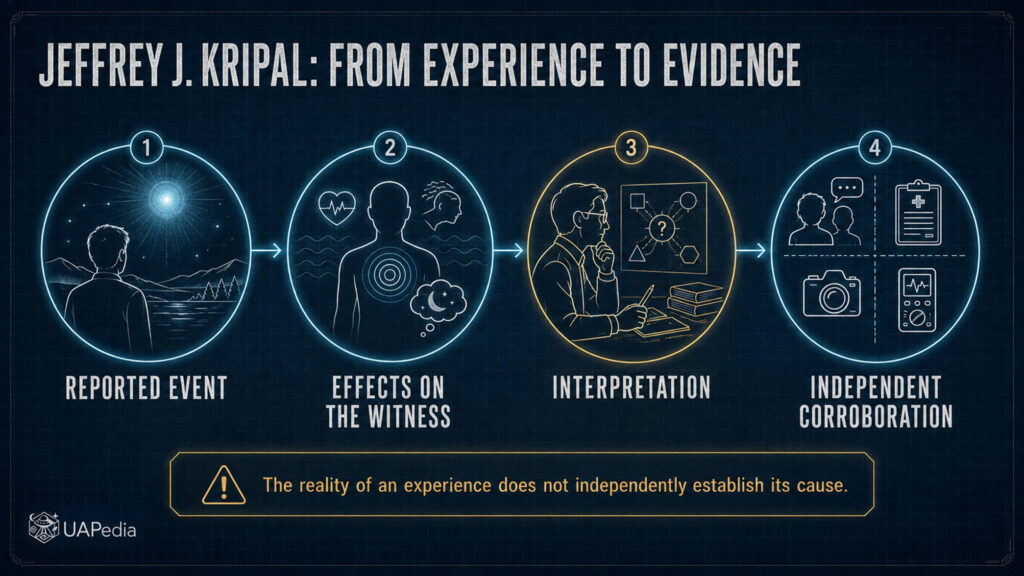
Four layers should therefore be kept separate.
The first is the reported event. A witness saw, heard, felt, remembered or otherwise experienced something.
The second is the effect. The witness experienced fear, physical symptoms, altered beliefs, recurring dreams, changes in behaviour or other consequences.
The third is interpretation. The witness or researcher attributed the event to visitors, non-human intelligence, spirits, future humans, psychic processes or another source.
The fourth is independent corroboration. Other witnesses, instruments, medical records, photographs, physical traces or contemporaneous documentation support some aspect of the account.
These layers may overlap, but they are not interchangeable. The existence of a published testimony verifies that the account was made. It does not automatically verify the proposed cause. A medical record can document an injury without identifying what produced it. A radar return can indicate an object without explaining the witness’s later dreams.
Kripal’s work is most useful when these distinctions remain visible.
His method can be compared, cautiously, with historical and testimonial evaluation. Historians often work with incomplete documents, conflicting recollections and events that cannot be recreated. They assess consistency, chronology, motive, context, corroboration and the relationship between early and later versions of an account.
This is only an analogy. Academic experiencer research does not operate under the formal evidentiary rules, burdens of proof or adversarial procedures used in courts. It can nevertheless borrow the principle that testimony should be weighed rather than either worshipped or discarded.
The Kolkata experience
Kripal’s openness to anomalous experience is not purely theoretical. He has repeatedly discussed a personally transformative event that occurred while he was conducting research in Kolkata, then commonly called Calcutta, in 1989.
In a September 1, 2024 interview with journalist Tim Adams in The Guardian, Kripal described becoming seriously ill in Kolkata in November 1989. He reported waking while unable to move, unusual electrical sensations, an apparent out-of-body experience and a sense that information had suddenly arrived or been “downloaded” (Adams, 2024).
Kripal had described the experience previously. In a 2014 interview conducted by Jules Evans for the History of Emotions Blog at Queen Mary University of London, he recalled living in Calcutta in 1989, attending Kali Puja observances and becoming paralysed while in bed after visiting temples during the festival period. He again described electrical sensations, a perceived presence and an apparent departure from his body (Evans, 2014).
Paulson: You’ve written about a profound, transformative experience you had in Calcutta in 1989. Can you describe that experience?
Kripal: I was studying a tradition called “Shakta Tantra.” The central iconography involves a black or blue goddess standing on her husband, Shiva, who is lying prostrate and is imagined as asleep or in meditation or as dead. She’s often described as erotically engaging him. During Kali Puja, a fall festival dedicated to this particular goddess, I had just been visiting all the temples and was embedded in this beautiful ritual display. I woke up early in the morning and couldn’t move. I was paralyzed. I was lying on my back, exactly like Shiva, and this astonishing erotic energy entered the room or came out of me and started to engage my body. I was perfectly awake, but I was paralyzed. My first assumption was that there was an electrical dysfunction in the wall and that I was being electrocuted. That’s how strong it was. Then I thought I was having a heart attack and was dying. And when both of those didn’t happen, I surrendered to it until it sort of imploded into my chest region. At that point, I had the sensation of leaving my body and floating up to the ceiling in a kind of classic out-of-body experience or near-death experience. When I eventually got back into my body and could move my fingers and feet again, I felt as if this tremendous download had been transmitted into my body and my mind, though I had no idea what it was about. I just had this sense that something profound had happened.
Excerpt from the interview of Jeffrey Kripal by Steve Paulson – LA Review of Books.
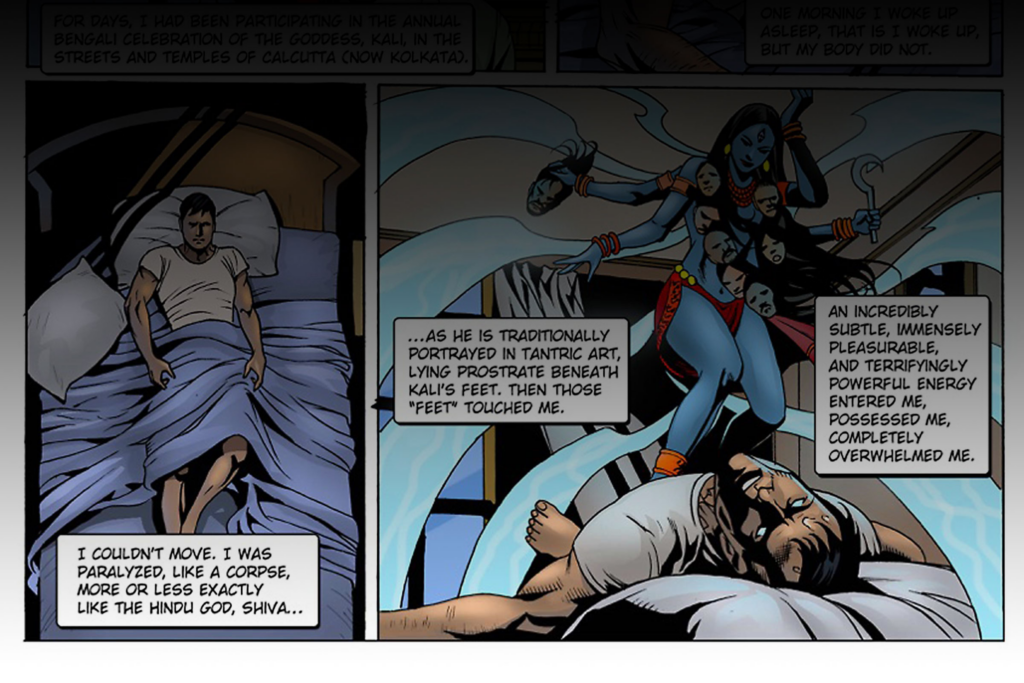
He interpreted the episode through the religious and Tantric context surrounding Kali Puja and later described its energy in terms of shakti.
The account should be presented carefully.
It is a first-person report of an anomalous and religiously interpreted experience. Its relevance lies in the effect it had on his intellectual development.
A scholar who experiences something that appears to exceed his existing worldview faces several options. He can dismiss the event to protect his prior assumptions. He can adopt a literal supernatural explanation immediately. Or he can take the experience seriously while leaving its ultimate cause unresolved.
Kripal took the third path.
His later work repeatedly distinguishes the reality of an experience from the certainty of its explanation. A perceived out-of-body state may be experientially real even when its neurological, psychological or metaphysical cause remains disputed. A powerful sense of presence may transform a person without the source of that presence being independently identified. An event may contain culturally specific imagery while still resisting a complete cultural explanation.
Published experiencer accounts, including those examined by Kripal, sometimes describe events as feeling more real than dreams while also being stranger than ordinary physical encounters. Some accounts include simultaneous bodily sensations and altered consciousness. Others describe information arriving without spoken language or technological settings mixed with symbolic or religious imagery.
These reports do not establish a non-human cause. They do show why a model based only on conventional visual observation may be incomplete.
What Kripal means by “impossible”
Kripal’s use of the word “impossible” does not simply mean supernatural, false or contrary to nature. He often uses it to describe experiences that conflict with a society’s established assumptions about what reality permits.
The distinction matters.
An event may seem impossible because it cannot occur. It may also seem impossible because the current intellectual model has no category capable of containing it.
In How to Think Impossibly, Kripal argues that the impossible is partly a product of changing assumptions about reality. The book examines precognitive dreams, apparent telepathy, near-death experiences, UAP encounters and other reports that are commonly excluded from respectable discussion before their content is considered (Kripal, 2024).
This does not mean that every extraordinary claim will eventually become accepted science. Many reports will remain unverified. Some will be misidentifications. Some will result from unusual but known psychological, neurological or environmental conditions. Some will be altered through memory and retelling.
Kripal’s narrower argument is that “impossible” should not function as a substitute for investigation.
His philosophical framework often approaches mind and matter as two aspects of a deeper reality rather than as completely separate substances. This position is sometimes associated with dual-aspect or neutral-monist thinking. In simplified form, it asks whether consciousness and physical events may emerge from a shared underlying process.
Applied to UAP encounters, this could permit an event to possess physical, mental and symbolic features at the same time.
A luminous object might be externally observable while also producing altered perception, dream imagery or a sense of communication. A contact experience might contain physiological effects and culturally shaped symbolism. A witness might interpret the event through religious language, while another person exposed to a similar stimulus might describe it through science fiction or technological imagery.
This is a philosophical hypothesis, not an established mechanism.
No accepted experiment has shown that dual-aspect monism explains contact experiences. The model does not predict when encounters will occur, what instruments will detect or why witnesses report particular beings and messages. Its value is exploratory. It creates conceptual room for cases that appear neither conventionally physical nor entirely subjective.
Whitley Strieber and the two-voice method
Whitley Strieber’s reported experiences are among the most culturally influential contact narratives of the modern period.
Strieber stated that a disturbing encounter occurred at his family’s cabin in New York State in December 1985. His account involved apparent visitors, fragmented memory, bodily intrusion, intense fear and a continuing series of experiences that he interpreted as contact with an unknown intelligence.
He published the account in Communion in 1987.
The event has not been independently verified as an encounter with non-human beings. What is established is that Strieber publicly reported it, continued discussing it over many years and received thousands of responses from readers who believed that elements of his account resembled their own experiences.
Kripal collaborated with Strieber on The Super Natural: Why the Unexplained Is Real, published by TarcherPerigee in 2016. The book alternates between Strieber’s first-person perspective and Kripal’s academic interpretation (Strieber & Kripal, 2016).
The structure is methodologically significant.
Strieber is allowed to describe the experience from inside it. Kripal responds through comparative religion, literary history and consciousness studies. The scholar does not entirely replace the witness’s language, while the witness’s interpretation is not treated as the only available conclusion.
This two-voice approach addresses a persistent problem in experiencer research. Investigators sometimes translate a witness’s account so aggressively that the witness no longer recognises it. At other times, researchers become so committed to a particular interpretation that questioning the account is treated as an act of betrayal.
Kripal’s dialogue with Strieber leaves the tension visible.
For Kripal, Strieber’s case is not only a claim about beings entering a room. It is also an account involving terror, memory, sexuality, bodily vulnerability, religious meaning, literature and the collapse of ordinary categories. The experience is simultaneously personal and cultural.
The influence of culture requires particular care.
The face appearing on the cover of Communion became one of the most recognisable images associated with contact experiences. Once that image circulated widely, it may have influenced how later witnesses described, remembered or visualised unusual beings. At the same time, cultural influence does not automatically explain the initiating experiences of every witness.
Human beings describe all events using available language and imagery. The fact that a witness uses a culturally familiar symbol does not determine whether the underlying stimulus was psychological, external or mixed.
The 3,400 Communion letters
One of the clearest products of Kripal’s collaboration with the Striebers is the preservation of the Anne and Whitley Strieber Communion correspondence at Rice.
Rice University reported in June 2025 that the collection contains approximately 3,400 responses from individuals who identified with the face depicted on the cover of Communion or recognised aspects of their own experiences in Strieber’s account (Ramirez, 2025).
The letters are not 3,400 independent confirmations of Strieber’s interpretation. They do not establish that thousands of people encountered the same external beings.
They are, however, a substantial body of historical testimony.
The collection records how people attempted to describe experiences that they often believed could not be discussed openly. Some correspondents may have reported waking encounters. Others may have described dreams, sleep paralysis, missing time, bodily sensations, spiritual experiences or memories emerging after exposure to Strieber’s work.
The archive allows researchers to ask more precise questions.
Which motifs appeared before the Communion image became widely known? Which descriptions changed as the image entered popular culture? Were reports written immediately after an experience or years later? Did some correspondents include drawings, medical records, additional witnesses or contemporaneous diaries? How stable were their accounts over time? Did recurring motifs vary by religion, geography, age or prior exposure to contact literature?
These questions cannot be answered by counting similar stories alone. Researchers would need transparent coding methods, careful chronology, protection of personal information and comparison groups.
A pattern proves that a pattern exists. It does not automatically prove what produced it.
The archival preservation and cataloguing of these letters constitutes a significant contribution to the historical study of contact testimony. Its eventual scientific and scholarly impact will depend on access, methodology and the quality of research performed on the material.
Elizabeth Greenfield Krohn and the lightning case
Kripal’s collaboration with Elizabeth Greenfield Krohn provides another example of his approach.
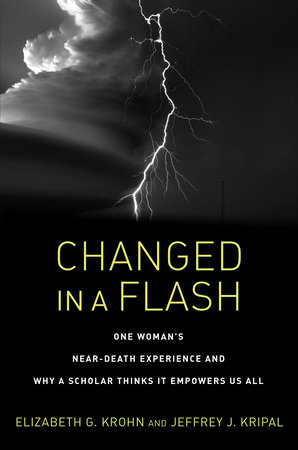
Krohn reported that she was struck by lightning in the car park of a Houston synagogue in September 1988. She stated that she entered a near-death state in which she experienced a garden-like environment and communication with a spiritual presence. She later reported apparent communications involving deceased people and dreams that she believed anticipated future events (Krohn & Kripal, 2018).
Krohn and Kripal presented her account in Changed in a Flash: One Woman’s Near-Death Experience and Why a Scholar Thinks It Empowers Us All, published in 2018.
This case contains several distinct evidentiary layers.
The lightning incident is potentially documentable as a physical event. Krohn’s near-death experience is a first-person report associated with that incident. The garden, presence and communication form part of her remembered interpretation. Later claims of precognitive dreams or contact with deceased people require their own evidence.
A prospective prediction recorded before the predicted event would carry more evidential weight than a remembered similarity identified afterward. A dated dream journal, independently witnessed statement or secure digital record would strengthen such a claim. Even then, researchers would need to define how specific the prediction was and calculate the probability of coincidental correspondence.
Kripal’s principal interest is broader than proving every subsequent claim. He examines how a sudden physical crisis may be followed by a radical change in identity, perception and belief.
A neurologist might ask whether the lightning strike altered brain function. A psychologist might examine trauma, memory and meaning-making. A scholar of religion might compare Krohn’s garden and guide imagery with near-death traditions. A parapsychologist might design prospective tests of apparent precognition.
These approaches need not cancel one another.
The case demonstrates why experiencer research benefits from separating event, effect and interpretation. “Krohn reported a spiritual presence” is not the same claim as “a spiritual being was independently identified.” “Krohn associated later dreams with future events” is not the same claim as “precognition was established under controlled conditions.”
Careful language protects both the witness and the integrity of the case.
Jacques Vallée and the creation of an archive
Kripal’s archival work may prove to be one of his more consequential contributions to UAP-related scholarship, although its long-term importance will depend on how the collections are used.
Rice’s Archives of the Impossible began with a conversation between Kripal and Jacques Vallée during a journey to an airport in December 2014. Vallée, an astronomer, computer scientist and major figure in modern UAP research, was concerned that his files might be scattered, commercialised or lost. He asked Kripal whether they could be placed in a university archive (Rice University, 2024).
Kripal contacted Rice’s special-collections staff, beginning a process that eventually brought Vallée’s materials and other anomalous-experience collections into the Woodson Research Center.
The origin story exposes a serious weakness in historical UAP research.
Investigators often accumulate interview tapes, private correspondence, photographs, field notes and unpublished reports over a lifetime. When the investigator dies, the material may be dispersed among relatives, sold without provenance or destroyed. Later authors then quote earlier books instead of returning to primary records.
An archive cannot guarantee that a claim is true. It can preserve the chain of documentation.
Rice reported in June 2025 that the Archives of the Impossible contained more than one million documents, recordings and files across 18 collections. Rice also stated that online content associated with its 2022, 2023 and 2025 conferences had received more than 300,000 views (Ramirez, 2025).
These figures demonstrate scale and public interest. They do not establish the truth of the claims contained in the collections.
The archive’s importance is procedural. It provides provenance, cataloguing, preservation and the possibility of intergenerational research. Future investigators can compare original letters with later retellings. They can examine whether a dramatic detail appeared in the first account or emerged after repeated interviews. They can trace communication among researchers and assess how interpretations developed.
Kripal’s role in creating this infrastructure is an important part of his legacy, even if the eventual conclusions drawn from the archive remain unknown.
John E. Mack and the problem of access
The donation of John E. Mack’s records increased the archive’s relevance to contact and abduction research.
Mack was a Harvard Medical School psychiatrist who conducted extensive interviews with people reporting abduction-like experiences. Rice reported that he investigated approximately 100 cases and produced hundreds of hours of interviews. The donated material comprised 150 boxes, representing approximately 450 linear feet of records and files (Rice University, 2024).
Rice’s Woodson Research Center catalogues the John E. Mack archives under identifier MS 1066. The catalogue dates the material from 1970 to 2010 and states that the collection is not yet open. It describes the records as part of Mack’s systematic Harvard research into reported abduction experiences (Woodson Research Center, n.d.).
This access limitation matters.
Researchers should not imply that a comprehensive independent analysis of the collection has already validated Mack’s findings. The records may eventually support important comparisons, but claims about their contents must be limited to what Rice has publicly documented until the relevant material becomes available.
Rice announced a two-year metadata project intended to anonymise and analyse archival collections related to abduction reports. The project was described as interdisciplinary and intended to produce white papers. That announcement establishes the project’s aims, not its results (Rice University, 2024).
If the collection becomes available for systematic research, it could permit comparisons among interview methods, recalled experiences, hypnosis-derived material, cultural exposure and independent corroboration.
It could also reveal limitations.
Interviewers may influence testimony through wording, repetition or theoretical expectations. Details recalled under hypnosis require special caution because confidence and vividness do not guarantee historical accuracy. The date of each statement, the questions asked and the witness’s exposure to previous accounts are essential parts of the evidence.
An archive preserves not only testimony but also the conditions under which testimony was produced.
The books that shaped Kripal’s approach
Kripal’s path into UAP and experiencer studies began with the academic study of religion, mysticism, embodiment and altered states.
His early research examined how intense experiences are translated into religious narratives and interpreted through culture. That background later became central to his approach to contact accounts.
Authors of the Impossible: The Paranormal and the Sacred was first published by the University of Chicago Press in 2010. The publisher lists November 2011 for the electronic edition (Kripal, 2010).
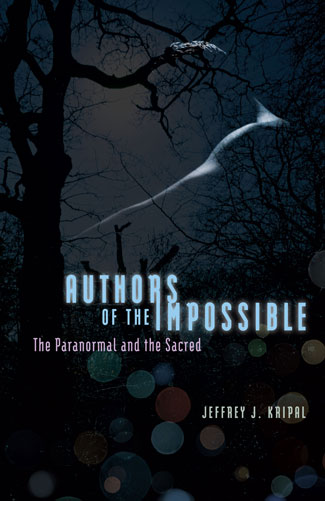
The book examines psychical researcher Frederic W. H. Myers, anomalist Charles Fort, UAP researcher Jacques Vallée and sociologist Bertrand Méheust. Kripal is interested not only in the phenomena they studied but also in the way their writing unsettled the boundary between fact and fiction, mind and matter, and the sacred and the scientific.
The book places modern anomalous research within a longer intellectual history. Scientists and philosophers such as William James and Alfred Russel Wallace took psychical reports seriously enough to investigate them, even while disagreeing over their implications.
This history complicates the claim that anomalous experience has always existed outside serious scholarship. The present boundary is partly institutional and historical.
Mutants and Mystics, published in 2011, turned toward comics, science fiction and popular culture. Kripal examined creators including Jack Kirby, Philip K. Dick, Alan Moore and Whitley Strieber, asking whether imaginative literature sometimes becomes a language for experiences that creators cannot express in conventional terms (Kripal, 2011).
This creates a feedback problem.
Culture provides images for describing unusual experiences. Those experiences then inspire new cultural images. Later witnesses encounter the images and may use them to interpret their own memories.
The grey being is a clear example. It can function as a reported entity, a cultural icon, a memory template and an artistic symbol at the same time.
Cultural circulation must therefore be investigated, but it cannot by itself determine the origin of every report.
The Super Natural moved Kripal into sustained dialogue with an experiencer. Changed in a Flash paired Krohn’s narrative with his interpretation. The Flip examined scientists and intellectuals who reportedly changed their worldviews following anomalous experiences.
In The Superhumanities, published in 2022, Kripal proposed that the humanities should study not only conventional social identities and institutions but also reports of exceptional human experience and capacity (Kripal, 2022).
How to Think Impossibly developed this proposal further. Rather than presenting a catalogue of solved mysteries, it challenged the assumptions used to decide which experiences deserve intellectual attention.
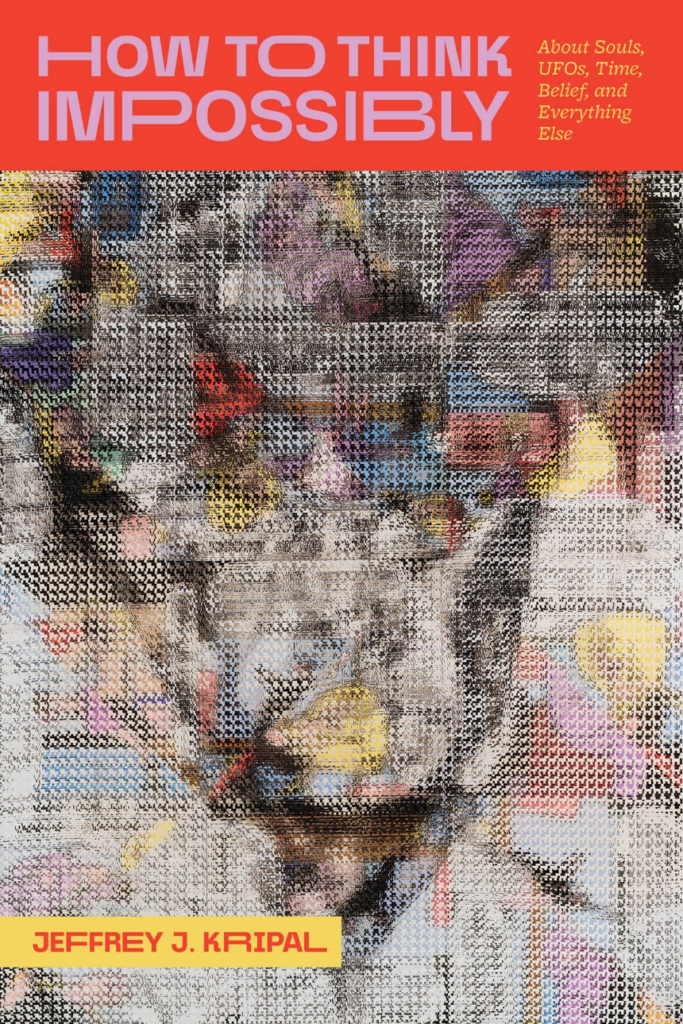
Across these publications, a clear pattern emerges. Kripal moved from the interpretation of mystical texts to the intellectual history of anomalous research, then to popular culture, direct collaboration with experiencers and the creation of a university archive.
Controversies surrounding Kripal
Kripal’s openness to unusual experience has not protected him from criticism. His academic career includes a major debate over interpretation, translation and scholarly authority.
The controversy emerged from Kali’s Child, his study of the Bengali mystic Ramakrishna. Kripal interpreted elements of Ramakrishna’s language and religious life through psychoanalytic and sexual frameworks. Critics argued that he mistranslated or decontextualised important Bengali terms and imposed Western categories on a revered religious figure.
Kripal acknowledged errors involving translation and identification, apologised for them and stated that corrections were included in a later edition. He maintained that the errors did not invalidate his central interpretation (Kripal, n.d.).
Critics, including Swami Tyagananda and Pravrajika Vrajaprana, argued that the linguistic, cultural and contextual problems were more damaging to Kripal’s conclusions. Francis X. Clooney discussed the wider dispute in the Harvard Divinity Bulletin, while Carl Olson reviewed Interpreting Ramakrishna: Kali’s Child Revisited in The Journal of Asian Studies (Clooney, 2012; Olson, 2011).
The dispute remains relevant to experiencer research because it demonstrates how interpretation can outrun source material.
A researcher may identify a coherent pattern but still depend on disputed translations. A metaphor may be treated as a literal statement. A culturally specific expression may be forced into the researcher’s preferred framework. Details that support the theory may receive more attention than details that resist it.
The lesson is not that interpretation should be abandoned. Every researcher interprets. The lesson is that interpretation should remain visible, correctable and open to challenge.
A second controversy concerns Kripal’s preference for consciousness-centred models.
Critics may argue that invoking a deeper unity of mind and matter risks turning an absence of explanation into evidence for a preferred metaphysics. An unresolved experience does not establish a nonlocal mind, dual-aspect monism or an invisible dimension of reality.
That criticism is justified whenever a philosophical model is presented as a demonstrated mechanism.
Kripal’s framework is better understood as a way of generating questions. It may help organise reports containing both physical and mental features. It does not establish why those features occur.
Researchers focused on physical UAP evidence may also worry that an emphasis on symbolism and consciousness distracts from measurable craft. This concern is valid when psychological interpretation is used to dismiss radar returns, physical traces or multi-witness observations.
The opposite error is equally serious. A structured object observed through sensors does not automatically explain every dream, synchronistic event or perceived message later associated with it.
Different parts of a case may have different causes.
Ethical and trauma-informed research
Some published contact accounts describe paralysis, invasive procedures, fear, bodily vulnerability, memory disruption or a lasting sense of being watched. Regardless of the cause, people reporting such experiences may be distressed by what they remember or believe occurred.
Principles developed for investigative interviews with traumatised adult witnesses may also offer useful guidance for UAP-experiencer interviews. Risan, Binder and Milne emphasise preparation, rapport, appropriate pacing, communication, emotional management and attention to witness wellbeing in investigative contexts (Risan et al., 2020).
The research was not conducted specifically with UAP experiencers, so its application here is an informed extrapolation rather than a direct finding about contact testimony.
This does not mean that fragmented memory confirms trauma or contact. Nor does it mean that inconsistencies should be ignored.
A trauma-informed approach should avoid humiliation, coercion and unnecessarily suggestive questioning. It should also preserve exact wording, distinguish spontaneous recall from prompted material and document the interview process.
Open-ended questions are generally preferable at the beginning. Investigators should avoid introducing entity types, procedures, locations or interpretations that the witness has not mentioned. Emotional validation should not become factual confirmation.
As an editorial recommendation, witnesses experiencing anxiety, disrupted sleep or severe distress should be able to seek appropriate clinical support without being required to adopt either a dismissive or extraordinary interpretation of the event. This recommendation is not presented as a finding of Risan and colleagues.
Respect and critical inquiry are compatible.
Impact and implications
Kripal’s work has helped change the status of anomalous testimony from disposable personal narrative to preservable historical material.
A letter stored in a private home may be lost. Thousands of catalogued letters in a university repository become a research collection. An investigator’s memory may change. An original recording preserves the questions, pauses and wording of the first interview. A claim repeated through decades of books can be traced back to its earliest documented form.
The scholarly impact of these archives remains to be assessed. Their existence does not guarantee that future researchers will use them well. Poor coding, selective interpretation or inadequate comparison groups could reproduce old problems on a larger scale.
Used carefully, however, the material may permit forms of research that were previously difficult or impossible.
Digitised and anonymised collections could be examined for the emergence of motifs across time. Researchers could separate reports made before and after major films or books. Accounts involving multiple witnesses or physical effects could be compared with sleep-related reports. Interview transcripts could be analysed for leading questions. Medical documentation could be distinguished from retrospective health claims.
Artificial intelligence may assist with pattern recognition, but it introduces new risks. A language model can identify recurring terms or narrative structures. It cannot determine whether a pattern was produced by a shared external stimulus, cultural influence, interviewer suggestion or ordinary linguistic convention unless the archive contains the information needed to test those possibilities.
Kripal’s contribution is therefore not a final explanation of contact. It is the preservation of material from which better explanations might eventually emerge.
For UAP policy, his work highlights the need to include the witness without reducing the witness to a sensor platform.
NASA and ODNI have documented the reporting problem created by stigma. Published experiencer testimony additionally describes fear, social disruption and changes in worldview, although the prevalence of these effects across the wider population has not been established.
Reporting systems should capture technical data while also providing confidential routes for witnesses who experience distress.
For science, the implication is more demanding.
Researchers must learn to remain uncertain without becoming passive. They must distinguish an unexplained event from a confirmed extraordinary cause. They must also resist using the word “subjective” as though it meant unimportant.
Human experience is part of the case.
Why Jeffrey J. Kripal matters
Jeffrey J. Kripal has not demonstrated that all contact experiences originate with non-human intelligence. He has not established that consciousness exists independently of the brain or that mind and matter are expressions of a single hidden reality.
He has done something more foundational.
He has helped create an academic environment in which anomalous experiences can be documented without requiring either ridicule or immediate belief. He has shown that popular culture may shape contact narratives while also preserving forms of experience that conventional language excludes. He has helped secure collections that might otherwise have disappeared.
Traditional UAP investigations often extract the observational data and then leave the witness behind.
Kripal asks what happened after the object vanished.
Did the witness sleep? Did the experience return in dreams? Did family members notice a change? Did the person become frightened, isolated, religious, creative or preoccupied? Did later events receive contemporaneous documentation, or were they recognised only in retrospect? Did the account change after contact with investigators or experiencer communities?
These questions do not establish an external intelligence. They reveal the larger human event.
Kripal’s work ultimately asks what kind of reality could produce an anomalous observation, an altered state, a symbolic narrative and a life permanently changed.
The answer remains unresolved.
The records, increasingly, do not have to disappear before it can be pursued.
Claims Taxonomy
Verified
Jeffrey J. Kripal is the J. Newton Rayzor Chair in Philosophy and Religious Thought at Rice University. He co-hosts the Archives of the Impossible and co-directs the Center for Theory and Research at the Esalen Institute.
Rice University has established the Archives of the Impossible and reported in 2025 that it contained more than one million documents, recordings and files across 18 collections.
The Anne and Whitley Strieber Communion collection contains approximately 3,400 responses, according to Rice University’s June 2025 description.
The John E. Mack archives are catalogued by Rice’s Woodson Research Center as MS 1066, dated 1970 to 2010 and not yet open.
Kripal, Strieber and Krohn have published or publicly discussed the experiences attributed to them in this article. Verification that testimony was published establishes the existence of the account, not the cause described by the witness.
Probable
Kripal’s work has increased the academic visibility and preservation of contact and anomalous-experience testimony. The archive’s university setting, scale, conferences and public engagement strongly support this assessment, although its long-term scholarly impact remains undetermined.
Stigma probably suppresses UAP reporting and contributes to the loss of potentially useful data. NASA and the Office of the Director of National Intelligence have both acknowledged stigma as an impediment.
Published contact and anomalous-experience accounts sometimes describe lasting psychological, social or spiritual effects. The prevalence and distribution of these effects across a wider population have not been established and require better longitudinal study.
Disputed
The proposition that some contact or abduction experiences involve external non-human intelligence remains disputed. Cases differ substantially in evidential quality, and no single conclusion should be imposed on the entire category.
Claims of telepathy, precognition, separable consciousness, continuing contact and communication with deceased persons remain disputed unless supported by prospective documentation, independent corroboration or controlled testing.
Kripal’s consciousness-centred ontology remains disputed. It is a philosophical framework rather than an established scientific theory of UAP.
Interpretations of Kali’s Child remain disputed. Kripal acknowledged and corrected some errors while defending his wider interpretation. Critics have argued that the linguistic and contextual issues affect the conclusions more substantially.
Legend
Religious and mythological narratives involving luminous beings, ascents, spirit journeys, divine communication and transformations should be classified as cultural or religious traditions when discussed in their historical contexts.
Their resemblance to modern contact motifs supports comparative analysis. It does not prove that ancient and modern reports share the same origin.
Speculation Labels
Evidence
The evidence addressed in this article includes Kripal’s documented academic positions and publications, his directly reported Kolkata experience, Strieber’s and Krohn’s published accounts, Rice University’s archival records, the catalogue description of the John E. Mack collection, and the findings reported in the 2021 ODNI assessment and NASA’s 2023 independent study.
This evidence establishes that the testimonies, publications, archives and official studies exist. It does not independently establish the ultimate cause of the anomalous experiences described by witnesses.
Hypothesis
Kripal’s dual-aspect framework proposes that consciousness and physical reality may be expressions of a deeper common reality. Applied to contact experiences, this could mean that some events are neither exclusively material nor exclusively private mental experiences. This remains a philosophical hypothesis. No accepted experimental result has established it as the mechanism behind UAP encounters, abduction reports or apparent communication.
Another hypothesis is that some UAP encounters may act as catalysts for altered consciousness, symbolic experience and long-term transformation. The reported association warrants study, but causation has not been established. Trauma, expectation, neurological processes, social reinforcement and an external agency remain possible competing or overlapping explanations.
Witness Interpretation
Kripal’s interpretation of his Kolkata experience, Strieber’s description of visitors and Krohn’s interpretation of a spiritual presence are meanings assigned by the respective witnesses to remembered events.
These interpretations should be documented faithfully because they are central to the experience. They should not be presented as independently identified entities or mechanisms without corroboration.
Terms such as “download,” “telepathy,” “visitor,” “presence” and “non-human intelligence” may describe how an event appeared or felt to a witness. They do not necessarily establish how information was transmitted or what produced the perception.
Researcher Opinion
Kripal’s view that an exclusively extraterrestrial spacecraft model is too narrow is a researcher’s interpretation. It is informed by the psychological, symbolic and high-strangeness elements found in some reports, but it does not exclude an extraterrestrial or technological explanation for cases involving physical objects.
This article assesses Kripal’s archival and methodological work as a significant contribution to experiencer research. That assessment does not establish that his philosophical conclusions are correct or that the collections will ultimately support a particular explanation of contact.
References
Adams, T. (2024, September 1). Philosophy professor Jeffrey J Kripal: “Thinking about a UFO as some kind of extraterrestrial spaceship is naive”. The Guardian.
Clooney, F. X. (2012, September 20). The meaning of a saint. Harvard Divinity Bulletin.
Evans, J. (2014, February 20). Jeff Kripal on the mystical humanities. The History of Emotions Blog, Queen Mary University of London.
Kripal, J. J. (2010). Authors of the Impossible: The Paranormal and the Sacred. University of Chicago Press.
Kripal, J. J. (2011). Mutants and Mystics: Science Fiction, Superhero Comics, and the Paranormal. University of Chicago Press.
Kripal, J. J. (2022). The Superhumanities: Historical Precedents, Moral Objections, New Realities. University of Chicago Press.
Kripal, J. J. (2024). How to Think Impossibly: About Souls, UFOs, Time, Belief, and Everything Else. University of Chicago Press.
Kripal, J. J. (n.d.). Textuality, sexuality, and the future of the past: A response to Swami Tyagananda. Rice University.
Krohn, E. G., & Kripal, J. J. (2018). Changed in a Flash: One Woman’s Near-Death Experience and Why a Scholar Thinks It Empowers Us All. North Atlantic Books.
National Aeronautics and Space Administration. (2023). UAP Independent Study Team Report.
Office of the Director of National Intelligence. (2021). Preliminary Assessment: Unidentified Aerial Phenomena.
Olson, C. (2011). [Review of Interpreting Ramakrishna: Kali’s Child Revisited, by Swami Tyagananda and Pravrajika Vrajaprana]. The Journal of Asian Studies, 70(4), 1210–1211. https://doi.org/10.1017/S0021911811002257.
Ramirez, F. (2025, June 18). Rice’s Archives of the Impossible offer insight and expertise for World UFO Day. Rice University News.
Rice University. (2024, April 9). A decade of discovery: 10 years of Rice’s Archives of the Impossible. Rice University News.
Rice University. (n.d.). Jeffrey J. Kripal. Archives of the Impossible.
Risan, P., Binder, P. E., & Milne, R. (2020). Trauma narratives: Recommendations for investigative interviewing. Psychiatry, Psychology and Law, 27(4), 678–694. https://doi.org/10.1080/13218719.2020.1742237.
Strieber, W., & Kripal, J. J. (2016). The Super Natural: Why the Unexplained Is Real. TarcherPerigee.
Woodson Research Center. (n.d.). John E. Mack archives, 1970–2010, MS 1066. Fondren Library, Rice University.
SEO keywords
Jeffrey J. Kripal, Jeffrey Kripal Rice University, Archives of the Impossible, experiencer research, contact experience research, UAP consciousness, Whitley Strieber, Communion letters, John E. Mack archives, Jacques Vallée, Elizabeth Greenfield Krohn, anomalous religious experience, ontological shock, non-human intelligence, contact testimony, dual-aspect monism, UAP witnesses, UAP archives, high strangeness, consciousness research, experiencer investigators, Rice University UAP research, How to Think Impossibly, Authors of the Impossible