
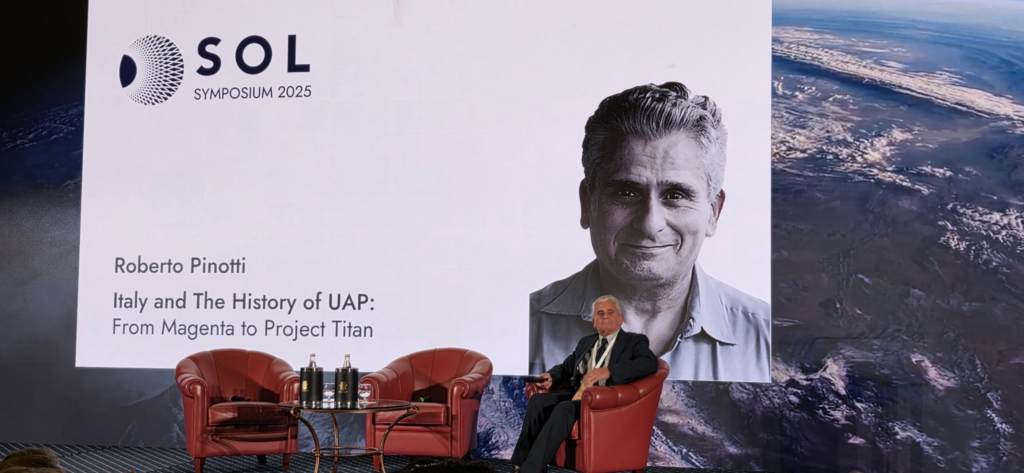
For more than half a century, Roberto Pinotti has stood near the center of Italian UAP research. He has written books, organized conferences, examined witness testimony, promoted disputed historical documents, and helped preserve some of Italy’s most unusual contact narratives.
Pinotti is not primarily an abduction investigator in the clinical or therapeutic sense. He did not build his reputation mainly through hypnosis sessions or long-term counselling of experiencers. His role has been wider. He became an organizer, editor, aerospace commentator, international representative, historian of Italian cases, and public interpreter of claims involving contact with non-human intelligence.
That breadth makes him unusually important. It also makes his work difficult to assess as a single body of evidence.
Some parts of Pinotti’s career are straightforwardly documented. His books exist. His public appearances can be traced. His institutional involvement is recorded. The Italian cases he discussed often involved identifiable witnesses, contemporary reporting, police interest, reported physical observations, or official correspondence.
Other parts of his work move into far more uncertain territory. These include long-term contact claims, hypnosis-derived abduction narratives, alleged secret government programs, religious interpretations, ancient visitation scenarios, and anonymously transmitted documents said to concern a recovered craft in Fascist Italy.
Understanding Pinotti therefore requires more than deciding whether one believes him. It requires separating what can be documented from what witnesses interpreted, what researchers inferred, and what remains unresolved.
That distinction is not a concession to dismissal. It is what allows the strongest material in the Italian UAP archive to remain visible.

A Venetian-born researcher with an international reach
Publisher and organizational biographies describe Roberto Pinotti as born in Venice in 1944 and later associated closely with Florence. They describe him as a sociologist, political scientist, aerospace journalist, and author of approximately fifty titles published in several languages.
These descriptions largely come from publishers and organizations connected with his public work rather than from independent academic profiles. They are still useful biographical sources, but their promotional context should be recognized.
Pinotti’s enduring public identity is closely tied to the Centro Ufologico Nazionale, generally known as CUN. He is commonly identified as a founder of the organization, although CUN’s own retrospective describes a broader founding network and a period of organizational development beginning before its formal constitution in 1967.
According to institutional history, an important meeting took place in Turin in 1965 under the initiative of Gianni Settimo. Giancarlo Barattini and Angelico Brugnoli received early organizational responsibilities. By late 1966, Pinotti was handling foreign contacts linked to the emerging group’s bulletin. He then became a prominent participant in the formally constituted organization and its first congress.
The distinction may sound minor, but it reveals something important about the development of Italian UAP research. CUN did not appear fully formed around a single personality. It emerged through a network of local investigators, editors, correspondents, and enthusiasts attempting to create a national structure.
Pinotti became one of the most visible and internationally connected figures within that structure.
His particular ability was synthesis. He connected regional witnesses with national publications, Italian investigators with foreign organizations, contemporary sightings with historical cases, and contact testimony with political questions about secrecy and disclosure.
That ability made him an unusually effective advocate for the study of Italian UAP events. It also encouraged him to construct larger interpretive frameworks from evidence of very different quality.
Building a national culture of investigation
Italian UAP research in the 1960s and 1970s operated without the institutional support normally available to established scientific fields. Investigators had to create their own reporting forms, newsletters, archives, correspondence networks, and relationships with journalists.
Reports were often scattered through local newspapers, police records, private letters, magazines, and the memories of witnesses who had little reason to expect serious attention.
CUN attempted to provide continuity. It gathered reports, organized conferences, maintained international contacts, and developed a public presence that allowed witnesses to locate investigators.
Pinotti’s military experience also became part of his public biography. CUN’s own chronology states that he completed military service as a second lieutenant in an artillery and missile environment. The same institutional account says he gave briefings about UAP to personnel associated with the Italian Army’s III Missile Brigade and published an article on the subject in the November 1972 issue of Rivista Militare.
These claims should be described as part of CUN’s documented institutional history rather than as independently reconstructed military history. Even so, they help explain why Pinotti often approached UAP as both an aerospace problem and a national-security issue.
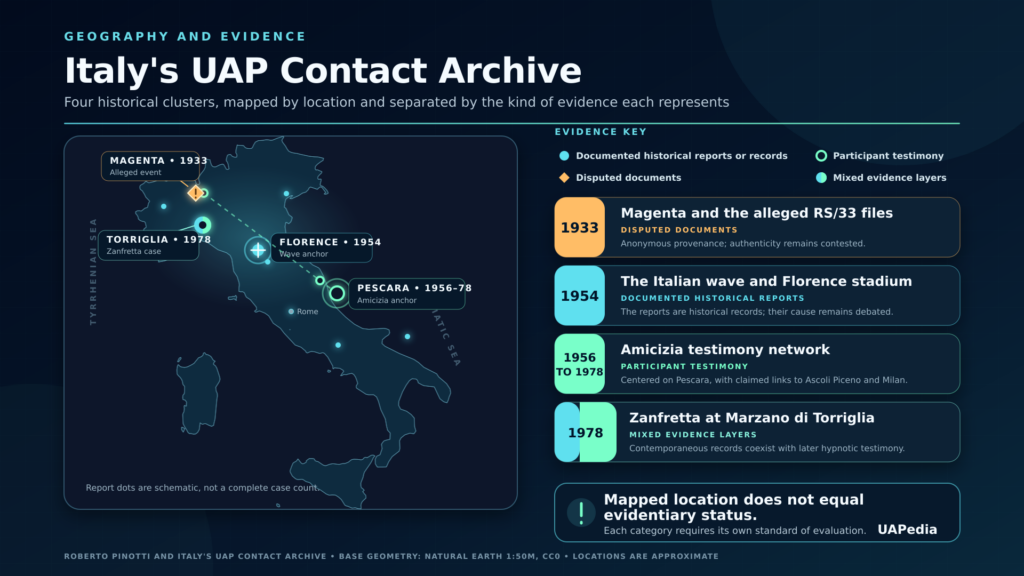
One of CUN’s more forward-looking projects reportedly took place in 1977. According to the organization’s retrospective, Pinotti and Pierluigi Sani coordinated a computerized analysis of 356 reports associated with Italy’s major 1954 UAP wave. Information was reportedly transferred onto punch cards and processed using a Honeywell 115 computer.
The project was innovative for its period. It represented an attempt to move beyond memorable stories and identify patterns across a larger body of reports.
Its limitations are equally important. The complete dataset, coding decisions, statistical methods, exclusion criteria, and underlying case files have not been made readily available through the cited institutional account. The existence of the project is therefore better supported than any conclusion it may have produced.
A modern reanalysis would require access to the original cases. Researchers would need to know how witness reliability was graded, how duplicate reports were removed, how astronomical and aviation explanations were handled, and whether later information altered initial classifications.
The project nevertheless shows that Pinotti’s interests were not confined to contact stories. He participated in an early effort to treat UAP reports as analyzable data.
From Italy to international UAP forums
Pinotti also helped move Italian cases into international discussion.
CUN’s institutional chronology records his participation in a British UAP research congress in 1979 and a presentation to a UAP study group at the House of Lords in July 1980. His paper reportedly explored a sociological and anthropological approach to the phenomenon.
That focus was characteristic. Pinotti did not treat UAP only as objects in the sky. He was interested in how societies interpret encounters, how institutions control information, how religious traditions absorb anomalous experiences, and how witnesses are treated after making extraordinary reports.
CUN’s retrospective also describes an informal visit to the French GEPAN program at the Centre National d’Études Spatiales in 1981. Pinotti reportedly met figures including Alain Esterle and physicist Peter Sturrock and discussed investigative methods.
Such visits did not amount to governmental endorsement of Pinotti’s conclusions. They did show that Italian civilian researchers were attempting to learn from more formal investigative structures.
Pinotti’s international activity gave Italy a stronger voice within the global UAP community. Cases that might otherwise have remained confined to Italian-language publications entered broader debates about contact, abduction, state secrecy, and witness credibility.
The split between CUN and CISU
By the mid-1980s, disagreements about method and organization produced a major division in Italian UAP research.
The Centro Italiano Studi Ufologici, or CISU, developed after a group of members left CUN. CISU’s account states that 34 members departed at the end of 1985 because of significant methodological and organizational differences.
The division reflected more than a dispute between personalities. It represented two competing models of UAP investigation.
CISU increasingly emphasized documentary provenance, sociological context, cautious attribution, and the historical study of UAP belief. Its researchers often preferred to examine how reports were formed, transmitted, interpreted, and transformed within culture.
CUN under Pinotti remained more open to the possibility that contact narratives, state secrecy, ancient traditions, religious manifestations, and modern sightings might be connected expressions of a genuine non-human presence.
Neither approach is automatically sufficient on its own.
A strictly sociocultural approach can underestimate the possibility that witnesses are responding to an external anomaly. An overly integrative approach can connect unrelated events through resemblance, expectation, or symbolism.
The productive space lies between those extremes. Witness testimony should be respected and preserved, while every claim remains tied to its original source, date, degree of independence, and evidentiary limits.
Italy’s official reporting system
The Italian state became more visibly involved in UAP reporting after the major wave of sightings in 1978.
The Italian Air Force states that Prime Minister Giulio Andreotti assigned it responsibility for collecting, verifying, and monitoring reports of unidentified aerial objects. Citizens can submit reports through the Carabinieri, after which military personnel may investigate possible correlations with aircraft, satellites, astronomical objects, atmospheric effects, or other identifiable causes.
Cases that cannot be attributed may remain classified as unidentified.
That outcome must be interpreted carefully.
An official record can establish that a report was received. It may establish that investigators interviewed witnesses, examined a location, consulted air traffic information, or failed to identify an object.
It does not automatically establish that the object was a craft controlled by non-human intelligence.
At the same time, an unresolved official classification should not be treated as meaningless. It indicates that the responsible institution did not find a satisfactory attribution using the information available.
Official uncertainty is not confirmation of an extraordinary explanation, but neither is it proof that nothing unusual occurred.
Pinotti’s work repeatedly occupies the space between those conclusions. He regards government records as important but does not accept state institutions as the sole authority on what witnesses experienced.
That instinct can preserve testimony that might otherwise be discarded. It can also lead researchers to give official ambiguity more significance than the underlying data justify.
How Pinotti constructs a UAP history
Pinotti’s work is characterized by an expansive method of comparison.
A pilot’s report may be discussed beside an alleged abduction. A modern contact narrative may be compared with a Marian apparition. A military memorandum may be placed beside a medieval account of luminous beings. An anonymous Fascist-era document may be interpreted within a longer history of state secrecy.
This produces a compelling picture. Events separated by decades or centuries begin to resemble parts of a continuing human interaction with an unknown intelligence.
The strength of this approach is that it resists artificial boundaries. Human experiences do not always divide neatly into scientific, religious, psychological, and historical categories. A witness may describe physical light, telepathic communication, altered time, fear, spiritual transformation, and bodily effects within the same event.
The danger is that similarity can be mistaken for common origin.
Two witnesses may report luminous humanoids because they encountered the same type of external intelligence. They may also use similar imagery because human perception, memory, religion, and popular culture provide recurring forms through which confusing experiences are interpreted.
A religious vision and a modern close encounter may arise from related causes. They may also be fundamentally different events that share symbolic features.
Pinotti’s strongest work begins with collection. Who made the report? When was the first account recorded? What documents survive? Were the witnesses independent? Did the story change over time?
His most controversial work begins when those records are woven into a single concealed history.
Zanfretta: the witness behind the legend
Pier Fortunato Zanfretta remains one of the most dramatic Italian experiencer cases connected with Pinotti’s public work.
During the night of December 6 to 7, 1978, Zanfretta was working as a private security guard in the Torriglia region near Genoa. He reported approaching a property, noticing an unusual light, and encountering an enormous humanoid figure.
His radio communications alarmed colleagues. He was later found in a highly distressed condition.
Journalist Rino Di Stefano became the principal chronicler of the case. Pinotti later helped present Zanfretta’s story to international UAP audiences, including appearances with Zanfretta and Di Stefano.
The case is frequently described as though more than 50 people witnessed Zanfretta’s encounter. That is inaccurate.
Reproductions of documents attributed to the Carabinieri and Genoa judicial authorities indicate that a resident in the wider region reported a luminous object earlier in the evening. The reproduced records also describe Zanfretta’s radio alarm, his account of a humanoid figure, his agitated condition, and a horseshoe-shaped mark observed on the ground.
The same material states that there were no direct witnesses to the alleged encounter itself.
A longer reproduced report, dated January 1979, describes colleagues finding Zanfretta after communication with him had been lost. He was reportedly shocked, perspiring heavily despite the cold, and physically overheated. His vehicle was also described as unusually warm.
The reproduced dossier refers to a large horseshoe-shaped impression in the grass and additional shoe-like marks associated with another reported location.
It also states that Zanfretta underwent a reported medical examination and was regarded as mentally healthy apart from temporary physical symptoms associated with shock. The reporting officer was said to have known him for years and considered him reliable.
These records are potentially important, but their status should be described precisely. They are publicly available reproductions hosted within a privately maintained case archive. Their presentation as Carabinieri and judicial documents is plausible, but their complete custodial and archival provenance has not been demonstrated through the cited source.
The documents should therefore be described as records attributed to the relevant authorities, not as independently authenticated government files retrieved directly from an official archive.
The same reproduced material refers to more than 50 reports of luminous objects in the wider region. Those reports provide context for a local wave of unusual observations. They do not establish that more than 50 people saw Zanfretta encounter a being or undergo an abduction.
This distinction strengthens the case by preventing exaggeration.
The available record supports the conclusion that Zanfretta contemporaneously reported an extraordinary experience, that others observed his distress, that unusual ground marks were described, and that a wider concentration of aerial reports occurred in the surrounding area.
It does not independently establish that a non-human entity stood before him.
Hypnosis and the expanding Zanfretta narrative
Many of the most elaborate details associated with Zanfretta emerged through hypnotic regression.
Under hypnosis, he described transportation into a craft, contact with beings, bodily examination, repeated encounters, and an expanding series of communications.
The reproduced Carabinieri material appears to include information about a hypnosis session relayed to an officer by a UAP investigator who attended it. The officer did not personally conduct or observe the session.
This creates several evidentiary layers. Zanfretta’s initial radio transmission and distress belong to the contemporaneous record. His later hypnotically elicited descriptions belong to a different category.
Research into memory has repeatedly shown that hypnosis can increase confidence and vividness without guaranteeing accuracy. Suggestive questioning, expectation, repeated narration, and reduced critical monitoring can contribute to false or distorted recall.
This does not prove that every detail recovered under hypnosis is false.
It means that hypnosis cannot independently authenticate a memory.
Pinotti’s handling of the Zanfretta case illustrates both the value and the vulnerability of his approach. He treated the witness as a person worthy of attention rather than ridicule. He helped preserve the case and ensured that it was not reduced to a brief newspaper curiosity.
Yet the strongest evidentiary layer remains narrower than the popular narrative.
A witness can be sincere and still misinterpret the cause of an experience. A physical mark can be genuine while its origin remains unresolved. A regional sighting wave can support the presence of unusual activity without confirming an abduction.
These distinctions are not attempts to explain the case away. They identify the point at which documented evidence ends and interpretation begins.
Amicizia and the problem of sustained contact
The Amicizia, or Friendship, narrative presents a different challenge.
Instead of a sudden frightening encounter involving one witness, Amicizia concerns a network of Italians who claimed prolonged interaction with human-looking non-human beings.
One of the principal public sources was Stefano Breccia, who was presented in contact literature as an engineer and university professor. Independent documentation of his academic roles would strengthen the biographical record, since many descriptions currently derive from participant publications and promotional material.
Breccia wrote two major volumes about the alleged contact network. The first described relationships with beings sometimes identified as the W56. The second continued the account and was published after his death.
The narratives include claims of meetings, communications, hidden facilities, craft observations, moral instruction, and long-term personal relationships.
Pinotti was not a neutral outsider to the publication process. He described himself as a close friend of Breccia and helped bring the material to a wider audience. He also contributed introductory material to later presentations of the case.
A documentary released in 2013 featured Pinotti alongside named participants including Breccia, Alfredo Benni, Mirella Bergamini, Gaspare de Lama, and Giuseppe Garofalo. The film presented the story as a prolonged mass-contact event.
Amicizia is historically significant because it is not based entirely on anonymous testimony. Named individuals published accounts, appeared on camera, and connected themselves publicly to the narrative.
That does not establish the physical reality of their interpretation.
The evidentiary difficulty lies in the timing and social structure of the testimony. Many accounts were organized or disclosed long after the alleged events. Participants belonged to overlapping social networks. They had opportunities to discuss memories, reinforce interpretations, and develop a shared vocabulary.
Multiple witnesses can strengthen a case, but only when their independence is carefully evaluated.
Ten people repeating a story developed within a close network do not carry the same evidentiary value as ten witnesses whose accounts were recorded separately before they communicated with one another.
The Amicizia material is also reported to include photographs and other physical evidence. Publicly available sources, however, have not established a complete chain of custody and independent technical authentication sufficient to confirm contact with non-human beings.
The testimony remains valuable. It can be studied for chronology, recurring descriptions, emotional consequences, social relationships, and the evolution of contact narratives.
Amicizia is especially important because its participants often described friendship rather than capture. The beings were portrayed as socially complex, ethically concerned, technologically advanced, and interested in human conduct.
This differs sharply from many abduction accounts built around fear, restraint, examination, or memory loss.
Pinotti’s willingness to treat the story as potentially literal helped preserve a distinctive European contact tradition. The evidence supports Amicizia as a documented body of testimony and publication. Sustained physical interaction with non-human intelligence remains disputed.
Magenta 1933 and the anonymous archive
The most controversial historical claim associated with Pinotti concerns documents said to describe a secret Fascist response to an anomalous craft near Magenta in 1933.
Pinotti and researcher Alfredo Lissoni promoted papers linked to a purported secret group known as RS/33. The alleged documents suggest that an unusual vehicle was recovered or secured during Mussolini’s government and studied under conditions of secrecy.
Pinotti published the materials and reported that they had been sent to him anonymously beginning in the 1990s.
That formulation is important. The publication history can be verified. The claimed method of transmission is known primarily through Pinotti’s account.
The anonymous origin creates an immediate provenance problem.
Historical documents become stronger when researchers can identify the archive, collection, file series, accession number, custodial history, signatures, routing marks, related correspondence, and independent copies.
The Magenta papers appeared without that foundation.
Pinotti reported that aspects of the paper, typography, bureaucratic language, and physical materials were compatible with the period. He also referred to specialist examination of some of the material.
Even a finding that paper or ink is old would not prove the truth of the text. Period stationery can be reused. A document may be historically authentic yet misinterpreted. A genuine bureaucratic communication may refer to an ordinary event later incorporated into an extraordinary narrative.
CISU researchers and archival critics have raised substantial questions about the documents’ historical characteristics, internal consistency, terminology, and lack of demonstrable chain of custody.
They have also called for complete expert reports, independent access to originals, and testing capable of being reviewed by specialists not connected with the claim.
These requests are reasonable.
The public chronology associated with the alleged event has also been presented with inconsistencies involving April and June 1933. Such discrepancies do not automatically prove fabrication, but they must be resolved before the papers can support a historical retrieval claim.
The story received renewed attention after former American intelligence officer David Grusch publicly referred to an alleged Italian recovery during the Mussolini era.
That later statement does not automatically corroborate Pinotti’s materials.
The Magenta account had already circulated publicly for years. A later source may be independent, partly independent, or derived from the earlier narrative. Without access to the source chain, the relationship cannot be determined.
The responsible conclusion is therefore narrow.
Pinotti published documents presented as evidence of a Fascist-era recovery and reported that they had arrived anonymously. The authenticity of the papers, the historical existence of RS/33 in the claimed form, the recovery of a non-human craft, and any later transfer remain disputed.
A hoax classification would require persuasive evidence of deliberate fabrication or deceptive presentation. Identifying the responsible actor would strengthen such a classification but is not always necessary.
The Magenta papers are therefore best described as disputed, weakly provenanced, and vulnerable to fabrication rather than as a demonstrated hoax.
Publications and the development of Pinotti’s worldview
Publisher and institutional catalogues credit Pinotti with roughly fifty titles, although totals vary depending on whether revised editions, translations, collaborations, and republications are counted separately.
His publication history traces the expansion of his ideas.
Early books focused on visitors from space, institutional silence, and the possibility that modern sightings represented a genuine external intelligence.
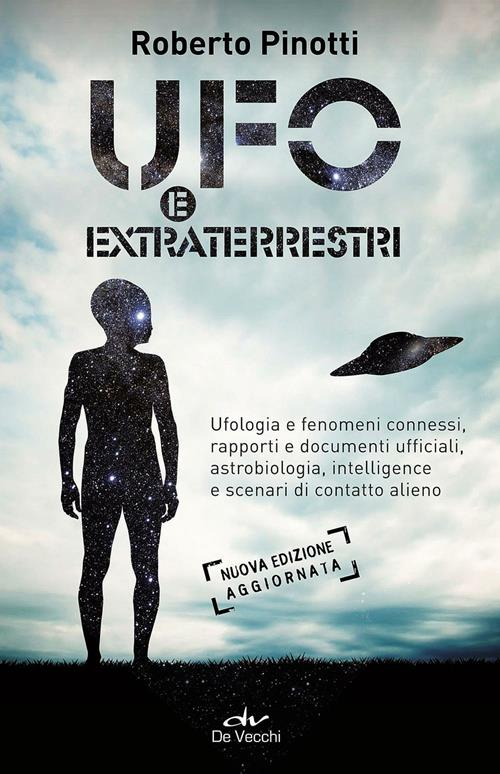
Later works broadened the field to include Italian military cases, religious apparitions, Vatican attitudes, underwater anomalies, ancient traditions, contact narratives, intelligence secrecy, and historical documents.
His 2021 English-language book, Timeless UFO Contacts in Italy, attempted to present approximately 120 years of Italian contact and sighting history to an international readership. Its scope included the 1978 wave, Amicizia, religious traditions, official interest, and the Magenta materials.

Pinotti’s books can be understood as a series of widening circles.
The first circle contains the sighting report.
The second contains the witness who claims contact.
The third contains the national archive.
The fourth contains religion, mythology, and ancient history.
The fifth contains state secrecy, geopolitics, and possible long-term non-human intervention.
This structure explains why his work is so engaging. Readers are not offered a collection of isolated cases. They are offered a connected landscape.
The problem is determining which connections arise from evidence and which arise from analogy.
The controversies surrounding Pinotti’s method
Criticism of Pinotti generally focuses on several recurring methodological issues.
The first is provenance. Who supplied a document? Where was it stored? Can the original be examined? Is there a demonstrable chain of custody?
The second is witness independence. Were accounts recorded before witnesses spoke with one another? Did investigators ask leading questions? Did the narrative expand through group reinforcement?
The third is memory recovery. Details obtained through hypnosis should not be given the same weight as spontaneous testimony recorded immediately after an event.
The fourth is interpretive scale. Pinotti often connects aerial reports, contact experiences, ancient traditions, religious visions, and political secrecy. These connections may reveal patterns, but they can also produce a theory broad enough to absorb contradictory evidence.
The fifth concerns source hierarchy.
A publisher biography, an organizational retrospective, a participant’s memoir, a reproduced police document, and an independently retrieved archival record should not be treated as evidentially equivalent.
Each may contain useful information, but each carries different risks.
Promotional biographies can simplify. Organizational histories can present institutional memory selectively. Participant books can preserve testimony while also defending a preferred interpretation. Reproduced documents can be genuine while lacking demonstrated custody. Official archives can be incomplete or politically constrained.
A coherent UAP investigation does not reject any of these sources automatically. It labels them accurately.
Pinotti’s impact on experiencer research
Pinotti’s most durable contribution may be the infrastructure he helped create.
He gave Italian witnesses a place to take experiences that might otherwise have remained private, local, or ridiculed. He helped preserve reports across decades. He connected investigators and brought Italian cases into international discussion.
That matters because experiencers often delay speaking.
They may fear professional consequences, family conflict, psychological labeling, media intrusion, or public mockery. By the time an investigator records the story, years may have passed and memory may have changed.
An ethical archive should therefore preserve every available version of a testimony. The earliest account should not be overwritten by later interpretation.
Pinotti’s career demonstrates the importance of treating witnesses as historical actors rather than curiosities.
Zanfretta was not merely a man who claimed to see a being. His case involved radio communications, observed distress, colleagues, reported marks, a reported medical examination, regional sightings, hypnosis, journalists, and decades of retelling.
Breccia was not merely a contact claimant. He was a participant in a social network, an author, and a central source for a body of testimony that developed over time.
The anonymous sender of the Magenta papers is also part of the history, although anonymity severely limits what can be established.
The next stage of research should be archival.
Original documents should be digitized at high resolution. Transcripts should be linked to scans. Testimony should be dated and versioned. Hypnosis-derived material should be marked separately. Witness relationships should be mapped. Claims involving physical traces should include custody documentation and independent laboratory analysis.
Official records should be compared with weather data, astronomical conditions, aviation activity, radar information, satellite passes, press reports, and independently recorded testimony.
If this work is undertaken, Pinotti’s archive could become more valuable than any single conclusion drawn from it.
Wider implications
Italy occupies a strategically important Mediterranean position and contains significant civil and military aviation activity. It also has a long maritime tradition, major religious institutions, ancient cultural layers, Cold War strategic importance, and repeated modern contact narratives.
Pinotti interpreted these elements as parts of a continuous mystery.
For policymakers, his career suggests that UAP reporting cannot be limited to air-defense concerns. Military systems are designed to record location, altitude, flight safety, radar correlation, and possible conventional causes.
They are less prepared to document missing time, telepathic impressions, reported beings, dreamlike states, social stigma, altered beliefs, or long-term psychological effects.
Those features require a separate experiencer research framework built around informed consent, privacy, mental-health safeguards, and careful source classification.
For scientists, testimony should not be mistaken for laboratory proof. It can still identify patterns, locations, physiological complaints, environmental effects, and questions suitable for instrumental testing.
For historians, Pinotti’s work illustrates the fragility of anomalous archives. Important claims often survive through photocopies, private collections, aging witnesses, informal correspondence, and publications with uncertain sourcing.
The answer is not to discard such material. It is to document every uncertainty so that future evidence can strengthen or weaken the claim.
For readers, Pinotti’s career presents a more difficult challenge.
Can a witness be respected without every interpretation being accepted? Can official uncertainty be acknowledged without treating it as official confirmation? Can the possibility of non-human contact remain open without pretending that it has already been established?
Serious UAP research depends on being able to answer yes to all three.
Claims taxonomy
Verified
Roberto Pinotti has been a major public figure in organized Italian UAP research since the late 1960s.
He is commonly identified as a founder of CUN, although the organization’s own retrospective describes a wider founding network and development before its formal constitution.
He has published extensively, participated in international events, and helped introduce Italian cases to audiences outside Italy.
The Italian Air Force was assigned an official role in collecting and investigating UAP reports after the 1978 wave.
Books, films, and named testimony connected with Amicizia exist, and Pinotti helped present the material publicly.
Pinotti published documents associated with the alleged Magenta recovery and stated that they had been sent to him anonymously.
Probable
Pinotti materially shaped Italian public understanding of UAP and helped preserve reports that might otherwise have disappeared.
Zanfretta experienced a severe and distressing episode during his security patrol. The available testimony and reproduced records make complete dismissal inadequate, although the cause remains unresolved.
Many Amicizia participants probably understood their experiences sincerely as contact. Sincerity does not determine whether the cause was external, psychological, social, anomalous, or mixed.
CUN’s archive probably contains historically valuable material that would benefit from digitization, source grading, and independent scholarly access.
Disputed
Zanfretta’s claim that he was physically abducted and examined by non-human beings remains disputed.
The claim that Amicizia participants maintained prolonged physical contact with non-human intelligence remains disputed.
The authenticity and meaning of the RS/33 documents, the alleged 1933 Magenta recovery, and the claimed transfer of a craft remain disputed.
Pinotti’s proposed connections among ancient traditions, religious manifestations, modern contact testimony, and contemporary UAP remain disputed because similarity does not establish common cause.
Legend
Ancient sky vehicles, divine messengers, Marian manifestations, and comparable narratives belong in the Legend category when presented as inherited religious or cultural traditions.
They may be compared with modern UAP reports, but they should not be converted into confirmed technological encounters without independent historical evidence.
Misidentification
Some reports within the wider Italian archive will be attributable to aircraft, astronomical objects, balloons, satellites, atmospheric effects, perceptual error, or other conventional causes.
The available evidence does not justify classifying Pinotti’s entire body of work, the complete 1978 Italian wave, Zanfretta’s experience, or Amicizia as demonstrated misidentification.
Attribution must be made case by case.
Hoax
There no evidence to classify Zanfretta’s experience, the full Amicizia testimony corpus, or the Magenta narrative as a proven hoax.
The Magenta documents remain vulnerable to fabrication because their sender and chain of custody are unknown. A Hoax classification would require persuasive evidence of deliberate fabrication or deceptive presentation.
Speculation labels
Evidence
Pinotti has a documented publication and public-speaking career extending from the early 1970s through at least 2021, with later organizational biographies and event notices continuing to associate him with Italian UAP activity.
He played a formative role in CUN, represented Italian UAP research internationally, helped publicize the Zanfretta case, supported the publication of Amicizia testimony, and published the documents associated with the alleged Magenta recovery.
Reproductions of records attributed to the Carabinieri and Genoa judicial authorities indicate that Zanfretta’s report was investigated and that his distress, reported ground marks, and the wider regional sighting context were documented. Their archival provenance requires fuller demonstration.
Hypothesis
Pinotti’s central hypothesis is that Italian UAP reports, contact narratives, religious manifestations, historical accounts, and institutional secrecy may represent different expressions of sustained interaction with advanced non-human intelligence.
A narrower research hypothesis is that systematic analysis of the CUN archive may reveal recurring patterns in geography, timing, reported entities, reported physical effects, and witness aftermath that remain difficult to explain through conventional attribution alone.
Neither hypothesis has been established by the publicly available evidence.
Witness Interpretation
Zanfretta interpreted his experience as a physical encounter with non-human beings followed by repeated abductions.
Breccia and other Amicizia participants interpreted their experiences as prolonged relationships with technologically advanced visitors.
The anonymous source associated with the Magenta papers apparently presented the material as evidence of a secret Fascist-era recovery program.
These interpretations are part of the historical record. They are not equivalent to independent physical confirmation.
Researcher Opinion
Pinotti’s researcher opinion is that the accumulated Italian record strongly supports a genuine non-human presence and a long history of institutional secrecy.
CISU researchers and archival critics argue that stronger provenance, conservative attribution, and sociocultural analysis are required before extraordinary historical claims can be accepted.
The evidence supports a more limited conclusion: Pinotti’s preservation, publishing, and institution-building are more securely established than his broadest interpretations of contact and secrecy.
That remains a substantial legacy.
References
Aeronautica Militare. (n.d.). Oggetti volanti non identificati. Italian Ministry of Defence. https://www.aeronautica.difesa.it/ovni/
Bompiani. (n.d.). Roberto Pinotti. https://www.bompiani.it/autori/roberto-pinotti-9555
Breccia, S. (2009). Mass contacts. AuthorHouse. https://books.google.com/books/about/Mass_Contacts.html?id=6lkPZkxAv7wC
Breccia, S. (2013). 50 years of Amicizia. CreateSpace Independent Publishing Platform. https://books.google.com/books/about/50_Years_of_Amicizia_Friendship.html?id=CPTunQEACAAJ
Centro Italiano Studi Ufologici. (n.d.). Fascist UFO files: A professional archivist’s opinion. https://www.cisu.org/fascist-ufo-files-a-professional-archivists-opinion/
Centro Italiano Studi Ufologici. (n.d.). Italian UAP research in the 1970s. https://www.cisu.org/ufology-in-the-1970s/
Centro Ufologico Nazionale. (n.d.). Eventi storici e partecipazione del CUN e di Roberto Pinotti. https://www.centroufologiconazionale.net/documenti/eventi-storici-partecipazione-cun-pinotti.pdf
Di Stefano, R. (2014). Il caso Zanfretta: La vera storia di un incredibile fatto di cronaca (6th ed.). https://www.rinodistefano.com/it/libri/caso-zanfretta.php
Italian Carabinieri and Genoa judicial authorities. (1978–1979). Records attributed to the Zanfretta investigation [Publicly reproduced dossier]. https://www.rinodistefano.com/docs/Dossier-Pretura-Unificata-di-Genova-caso-Zanfretta.pdf
Leo, D. G. (2025). Remembering what did not happen: The role of hypnosis in memory recall and false memories formation. Frontiers in Psychology, 16, Article 1433762. https://doi.org/10.3389/fpsyg.2025.1433762
Molle, A., & Bader, C. D. (2014). Paranormal science from America to Italy: A case of cultural homogenisation. In O. Jenzen and S. R. Munt (Eds.), The Ashgate research companion to paranormal cultures (pp. 121–138). Ashgate. https://digitalcommons.chapman.edu/sociology_books/2/
Pinotti, R. (2020). The UFO files of Mussolini. The Black Vault. https://www.theblackvault.com/casefiles/the-ufo-files-of-mussolini-fascist-ufo-files-by-roberto-pinotti/
Pinotti, R. (2021). Timeless UFO Contacts in Italy. Independently published. https://books.google.com/books/about/Timeless_UFO_Contacts_in_Italy.html?id=L73rzgEACAAJ
Royal College of Psychiatrists. (2021). Hypnosis and hypnotherapy. https://www.rcpsych.ac.uk/mental-health/treatments-and-wellbeing/hypnosis-and-hypnotherapy
Trovellesi Cesana, L. (Director). (2013). The Friendship Case [Documentary]. https://tv.apple.com/us/movie/ufotv-presents-the-friendship-case—the-extraordinary-story-of-mass-alien-contact/umc.cmc.3pmql2a827x0thvtkpz06wk5h
Vallecchi. (n.d.). Roberto Pinotti. https://www.vallecchi-firenze.it/autore/roberto-pinotti/
SEO keywords
Roberto Pinotti, Italian UAP researcher, Italian ufologist, Centro Ufologico Nazionale, CUN Italy, Pier Fortunato Zanfretta, Zanfretta abduction case, Torriglia UAP wave, Amicizia Friendship case, Stefano Breccia, Magenta 1933 UAP, RS/33 documents, Italian Air Force UAP files, 1978 Italian UAP wave, experiencer research Italy, contact and abduction investigators, UAP testimony, hypnosis and memory, Italian UAP history, UAP disclosure Italy, Italian contact cases