
Russ Estes usually stood behind the camera. That is where his importance to contact and abduction research begins.
An artist, documentarian, interviewer and co-author, Estes spent years recording people who said they had experienced missing time, non-human entities, medical examinations and other events that resisted conventional explanation. Yet his most consequential contribution was not simply collecting extraordinary accounts. He helped redirect attention toward the investigators who shaped those accounts after they were reported.
What happens when an experiencer enters an interview room? What changes when a researcher asks a suggestive question, introduces another famous case or applies hypnosis? Can a witness be sincere while parts of the resulting narrative remain unreliable? Can genuine distress coexist with uncertainty about what caused it?
Those questions placed Estes in an unusual position within late twentieth-century UAP research. He did not treat experiencers as liars, fantasists or passive curiosities. He also refused to assume that every detail obtained during hypnosis represented a recovered record of an external event.
His work offered a more complicated possibility. An experiencer might accurately describe terror, paralysis, missing time or an unexplained presence, while later details could be influenced by dreams, cultural imagery, memory reconstruction, interviewer expectations or therapeutic procedures. The initial experience and the final published story might be related, but they were not necessarily identical.
Estes did not resolve the contact mystery. His enduring contribution was to show why it could not be responsibly investigated without examining the methods used to produce evidence.
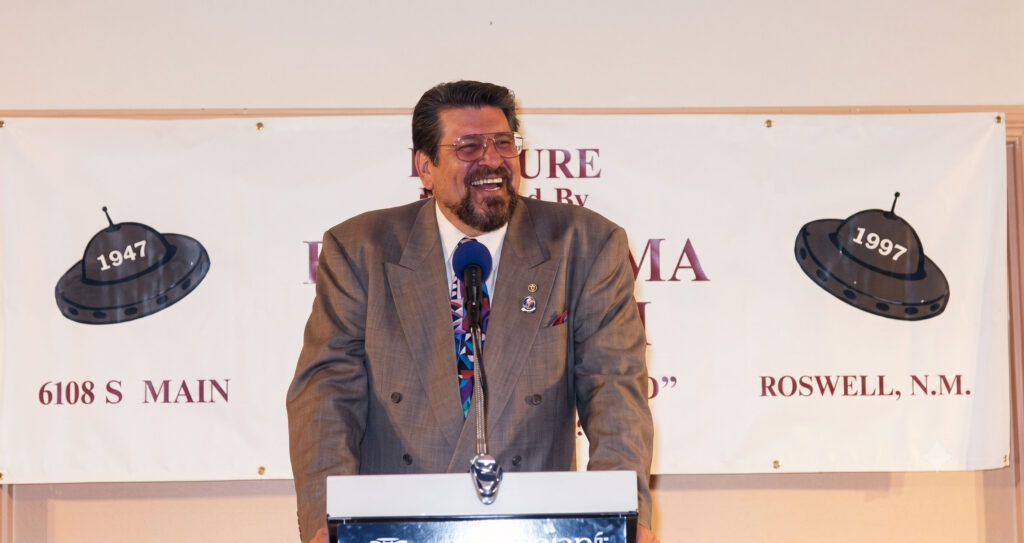
The observer behind the lens
Much of the available biographical information about Estes comes from Kevin D. Randle, his friend and frequent co-author. Randle’s account is valuable as testimony from a close colleague, but it is not an independent biography and should be read accordingly.
Randle recalled meeting Estes at a civilian UAP convention in Albuquerque, where Estes was producing a documentary and interviewing witnesses, investigators and conference speakers. They met again at a UAP event in Florida, developed a friendship and eventually collaborated on three books.
In his August 2006 memorial, Randle described Estes as an accomplished artist, documentary producer, video editor, lecturer and performer. He also reported that Estes had served with the United States Army Security Agency in Vietnam. These details are best classified as biographical information reported by a primary participant because they are principally supported by Randle’s remembrance rather than independently published records.
Randle announced Estes’s death in August 2006 after describing years of serious health problems. The surviving memorial does not establish a precise date of death, so the announcement date should not be treated as an exact death date. (Randle, 2006)
Estes’s documentary background appears to have influenced his investigative style. A filmmaker must consider not only what a person says, but how the account is framed, edited and presented. A camera records pauses, uncertainty, repetition, emotion and contradiction that may disappear when an interview is converted into a polished case summary.
Randle remembered Estes as someone who could allow interview subjects to reveal themselves without aggressive confrontation. That approach made him an attentive collector of testimony, but it also exposed him to an uncomfortable pattern. Accounts did not emerge in isolation. They developed through conversations with investigators, exposure to books and conferences, participation in support groups and, in some cases, hypnosis.
According to Randle, Estes and psychologist William P. Cone developed much of the central insight that became The Abduction Enigma. Their attention gradually shifted from the contents of reported encounters to the processes by which those contents were retrieved and interpreted.
Three publications and an evolving inquiry
Estes co-authored three books with Randle. Read together, they trace an intellectual journey from cataloging what witnesses described to questioning how those descriptions were formed.
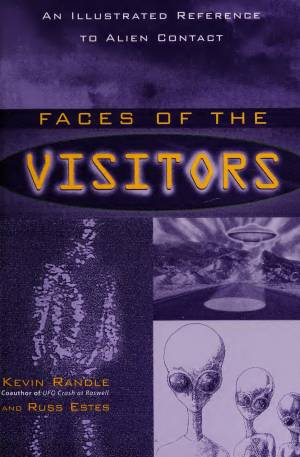
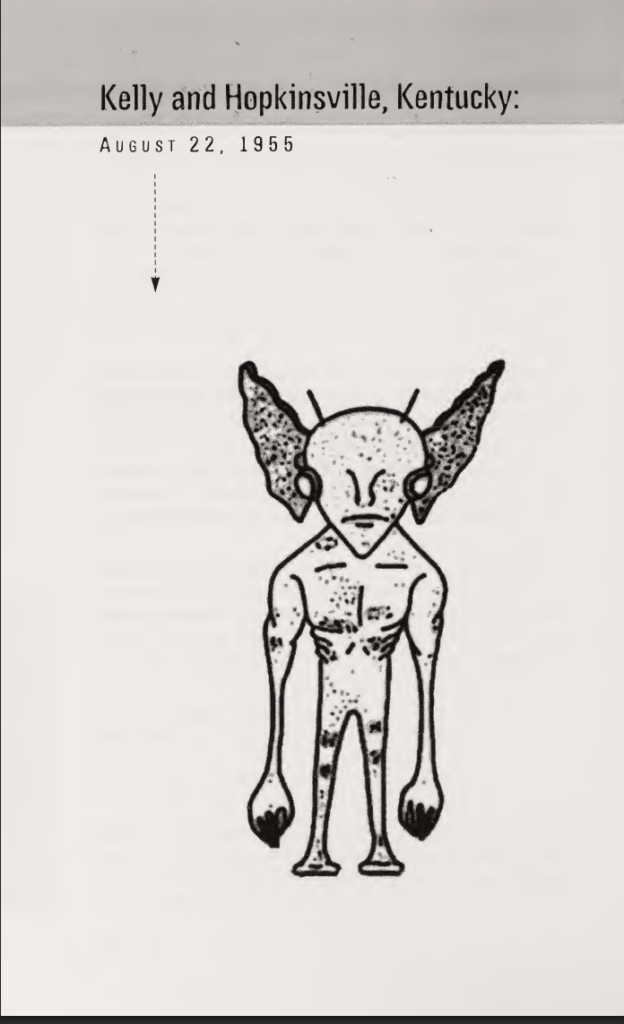
The first was Faces of the Visitors: An Illustrated Reference to Alien Contact, published in 1997. The book assembled descriptions and illustrations of more than one hundred reported entities. Estes’s artistic contribution was central, and Randle later observed that Estes served more as illustrator than principal writer in two of their joint books.
The volume documented far more variety than the popular image of the small grey being with large dark eyes might suggest. Its entries included human-like figures, hairy entities, reptilian forms and other beings that resisted simple classification.
This diversity can be interpreted in several ways. It might indicate that witnesses encountered multiple forms of non-human intelligence. It might reflect variations in perception, symbolic imagery, cultural expectation or dream-like cognition. It may also suggest that fundamentally different phenomena have been grouped together under the single label of contact.
The book does not prove a biological catalog of visiting species. Its historical importance lies in preserving the range of reported forms and showing that any comprehensive explanation must account for diversity as well as recurring patterns.
Yet illustrated case collections also introduce a methodological problem. A witness may initially describe an indistinct shape, uncertain color or approximate face. Once an artist converts that description into a polished image, the image may appear more definite than the original memory.
That image can then circulate through books, television and online media, potentially influencing later reports. The illustration becomes both a record of testimony and a new cultural stimulus.
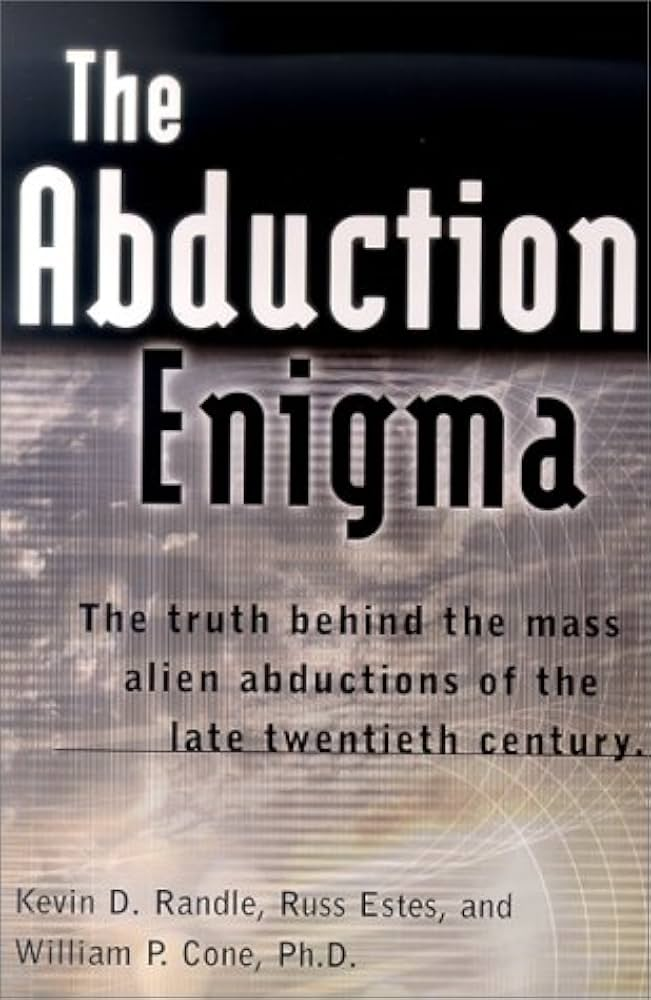
The second major work, The Abduction Enigma: An Investigation of the Alien Abduction Phenomenon, was published by Forge in 1999 and written with Randle and Cone. The 416-page volume included a bibliography, index, case discussions and an appendix containing a transcript from the Pat Roach investigation.
This book defines Estes’s legacy. It questioned the reliability of hypnosis, leading questions, selective presentation and investigator-centered interpretations. It also examined the extent to which familiar abduction narratives might be influenced by popular culture and by researchers who already held strong theories about what experiencers were encountering.
Its most important conceptual move was to separate sincerity from causation.
A witness may sincerely remember being immobilized, seeing an entity or experiencing missing time. Sincerity establishes that the person is reporting a meaningful memory. It does not establish whether the cause was external, neurological, psychological, environmental or some combination that remains poorly understood.
The third collaboration, The Spaceships of the Visitors: An Illustrated Guide to Alien Spacecraft, appeared in 2000. Publisher descriptions identify more than one hundred entries, with illustrations based on photographs or witness drawings, along with information about dimensions, color, sound, reported exhaust and source reliability.
As with Faces of the Visitors, the book created a comparative visual record. Its enduring value is documentary rather than conclusive. It helps readers compare the shapes witnesses described, but drawings alone cannot determine whether an observed object was a structured craft, a misperception, an unfamiliar human technology or an unidentified phenomenon.
Together, the books reveal an important tension in Estes’s work. He considered entity and craft reports worthy of preservation, yet he became increasingly skeptical of the confidence with which some researchers converted uncertain memories into detailed narratives of non-human programs.
That was not necessarily a contradiction. It was a distinction between taking testimony seriously and accepting every interpretation placed upon it.
The reported interview project
Publisher material associated with The Abduction Enigma credited Estes with conducting or collecting more than 150 videotaped interviews with people reporting abduction experiences.
Randle later described a larger project involving 316 participants from the United States and several other countries. He reported that each participant was videotaped, that questions were asked in approximately the same order and that Estes and Cone conducted most of the interviews.
The publicly accessible record does not fully explain the difference between the promotional figure of more than 150 interviews and the later figure of 316 participants. The numbers may refer to different stages, subsets or definitions within the research project.
No complete public inventory, independently audited archive or participant-level dataset was located during research for this article.
The most accurate formulation is therefore that Randle reported a survey involving 316 videotaped participants. The figure is documented as a statement by a project co-author, but it has not been independently verified through a publicly accessible archive, participant register or research dataset. (Randle, 2007)
The project should not be treated as a representative demographic survey. Participants had already entered the contact research environment. Some had been identified by established investigators, attended conferences, joined support groups or otherwise become involved in communities where abduction narratives were discussed.
Randle acknowledged that the sample was not statistically random.
That limitation prevents the study from determining how common contact experiences are within the general population. It also means the project cannot reliably establish the typical age, occupation, sexuality, education or personality of experiencers as a whole.
Its potential value is narrower, but still significant. It may reveal how people describe their experiences after entering a network of investigators, books, lectures, support groups and interpretive frameworks.
In other words, Estes was not only recording unusual experiences. He was recording the social life of those experiences.
The project reportedly identified a possible association involving participants’ sexual orientation. Randle wrote that the question was introduced after Estes believed he had noticed a pattern. Responses were self-reported, categories overlapped and the sample was nonrandom.
This makes the observation post hoc and exploratory. It cannot support a demographic conclusion about experiencers or sexual minorities. Its inclusion in the history of the project is useful primarily because it demonstrates how easily an apparent pattern can acquire significance before a research design is capable of testing it.
The interviews also highlighted the motivations of participants. According to Randle, many agreed to appear on camera because they hoped their accounts might help others who had undergone similar experiences.
Public testimony can expose witnesses to ridicule, strained relationships and professional consequences. Agreeing to be recorded does not establish the external cause of an experience, but it may be relevant when considering motivation and willingness to face scrutiny.
It also creates ethical responsibilities. Investigators must protect privacy, preserve context, distinguish direct recollection from later interpretation and avoid turning distress into entertainment.
Case study: Pat Roach and the power of a question
The Pat Roach incident became one of the most important examples in The Abduction Enigma because Randle had participated in the original investigation and later reconsidered its methods.
Roach reported that she awoke during an October 1973 event at her Utah home and initially believed a prowler or intruder was present. Police were called, but the response reportedly produced no conventional intruder. Members of the household later described unusual figures, and Roach eventually came to interpret the event as involving non-human beings.
Before contacting Randle, she had encountered a published abduction account in a UAP magazine. James Harder, then associated with the Aerial Phenomena Research Organization, subsequently conducted hypnosis sessions.
The case is discussed throughout The Abduction Enigma, particularly on pages 45–46, 59, 178–191 and 345–349 of the Forge hardback edition. A transcript identified as the Pat Roach interview appears on pages 367–384.
According to Randle’s later account, Harder discussed the Betty and Barney Hill case with Roach between sessions. Randle also reported that when Roach indicated that she might have been examined, Harder asked whether the examination had been gynecological. (Randle, 2005)
That wording matters because it supplied a specific interpretive possibility at a moment when the witness’s description was less definite.
It does not prove that Roach fabricated her experience, nor does it establish that every later detail was suggested. It does show that the developed account cannot be treated as if it emerged from an untouched memory.
The immediate event, the family’s conscious recollections, the police response, later reading, conversations with investigators, hypnotic sessions and final published narrative represent separate evidentiary layers. Each layer may contain valuable information, but they should not be merged without indicating when and how each detail entered the record.
Critics of The Abduction Enigma have argued that Randle’s treatment underestimates consciously remembered aspects of the incident, including statements attributed to Roach’s children, the reported light and the family’s fear. They also contend that isolated leading questions do not prove that an entire narrative was created through suggestion.
That criticism has force. Identifying contamination in part of a case does not automatically explain every component of the original event.
The most supportable conclusion is therefore limited. Roach and her family appear to have experienced an alarming event that prompted a police response. Some later details were developed under conditions that created identifiable opportunities for suggestion. The ultimate cause remains disputed.
Sleep paralysis, fear of an intruder, cultural influence and memory reconstruction are possible partial explanations. None has been conclusively established as a complete account of the event.
Case study: Herbert Schirmer and the layered record
The Herbert Schirmer incident offers a comparatively clear example of why early documentation should be separated from later hypnotic material.
Schirmer, a Nebraska police officer, reported encountering a brightly illuminated, apparently structured object near a road during the early morning of December 3, 1967. His initial account included an unusual object, physical discomfort, temporary paralysis and approximately twenty minutes he could not explain.
The case was examined by the University of Colorado UAP project, commonly known as the Condon Committee. The relevant official document is “Case 42: State Trooper Sighting,” preserved in the online edition of Scientific Study of Unidentified Flying Objects. (University of Colorado, 1968)
The case record includes Schirmer’s report, comments about his reputation and a reported polygraph examination. The polygraph belongs to the historical record, but it should not be treated as proof that the encounter occurred as described. Polygraph testing does not reliably determine factual truth. At most, the result was interpreted at the time as indicating that Schirmer was not knowingly fabricating his account.
Investigators found no persuasive physical evidence at the reported site.
Schirmer later underwent psychological evaluation and a session involving partial hypnotic procedures with psychologist R. Leo Sprinkle. Additional material emerged during that process, including an expanded narrative involving beings and entry into a craft.
The Colorado project record stated that the authenticity of the expanded account was not established. Sprinkle considered Schirmer sincere in describing what he remembered, while other project personnel remained unconvinced that the encounter had occurred as a physical event.
These positions are not logically incompatible. A witness can be sincere, emotionally affected and psychologically convinced while the external cause of the memory remains unresolved.
The Abduction Enigma discusses Schirmer on pages 40–42, 60, 160–162 and 354 of the Forge hardback edition. Estes and his co-authors focused on whether information provided before or during hypnosis might have influenced the expanded narrative.
Randle later wrote that he tried to determine what Schirmer had been told before the session but could not locate sufficient documentation to answer the question. He did not claim that Sprinkle had definitely implanted the abduction account. (Randle, 2007)
That unresolved gap cuts in both directions.
There is insufficient evidence to conclude that the later narrative was produced through coaching. There is also insufficient evidence to treat the hypnosis-derived material as an uncontaminated recovery of historical events.
The Schirmer case is therefore best preserved in layers. The roadside encounter and time discrepancy belong to the early record. His apparent sincerity is relevant testimony, but not proof of non-human causation. The detailed onboard narrative is a later witness interpretation developed during a disputed memory-retrieval process.
The controversy around The Abduction Enigma
The book challenged investigators who had developed distinctive models of abduction, including Budd Hopkins, John E. Mack and David M. Jacobs.
Estes, Randle and Cone argued that different researchers often produced different recurring narratives. One investigator might repeatedly encounter threatening reproductive programs, another might emphasize clinical experimentation, while another found spiritual transformation and expanded consciousness.
The authors interpreted these differences as possible signs of investigator influence. An interviewer’s expectations, questions and preferred explanations could shape what witnesses remembered and emphasized.
Critics Keith Rowell, Janet Colli and Deborah Lindemann objected to the book’s reasoning and qualifications. They argued that Estes lacked conventional academic credentials and that the authors did not adequately understand traumatic memory or the ways carefully conducted hypnosis might be used in clinical settings.
Their criticism identifies genuine weaknesses. The interview sample was selected, no complete codebook has been published and the study was not independently replicated. The authors also sometimes moved too quickly from demonstrating that narrative contamination was possible to implying that broad portions of the phenomenon had been explained.
Yet invoking trauma does not establish that a reported event had an external non-human cause. Nor does an investigator’s professional credential remove the risks of suggestion, confirmation bias or selective interpretation.
The dispute therefore should not be reduced to whether Estes was formally qualified. The more important question is whether his methodological concerns were supported by evidence.
On that point, later psychological research gives substantial support to his narrower caution, though not to the broadest explanatory conclusions sometimes associated with the book.
What scientific research contributes
A 1985 review by the American Medical Association’s Council on Scientific Affairs concluded that memories obtained through hypnosis may include confabulations and pseudomemories and are not necessarily more accurate than ordinary recollection.
That finding supports a central concern raised by Estes and his co-authors. Hypnosis is not a recording device that unlocks an untouched archive of experience. (Council on Scientific Affairs, 1985)
Other experimental research has found that hypnosis may increase confidence in recollections without improving their accuracy. This distinction is important because confidence can make a memory sound more persuasive even when its factual reliability has not increased. (Whitehouse et al., 2005)
A 2002 study by Susan Clancy and colleagues examined participants who reported recovered or repressed memories of non-human abduction. In a laboratory word-association task, those participants demonstrated greater false recall and false recognition than control participants, while correct recall did not differ significantly.
This finding suggests that some people reporting recovered abduction memories may be more vulnerable to particular forms of memory distortion. It does not determine whether any specific encounter was false. Group-level tendencies cannot adjudicate individual cases. (Clancy et al., 2002)
A 2004 study led by Richard McNally measured heart rate, skin conductance and facial-muscle activity while participants listened to scripts describing their reported experiences. Participants displayed substantial physiological responses.
The researchers concluded that believing one has been traumatized may generate emotional reactions resembling those associated with recognized trauma. The crucial point is that the distress can be real and measurable even when the study does not establish what caused the experience. (McNally et al., 2004)
A 2008 study by Christopher French and colleagues found that a small sample of experiencers scored higher than controls on measures involving dissociation, absorption, anomalous experiences, hallucination tendency and reported sleep paralysis.
The sample was small and self-selected. Its findings may help explain vulnerability to some experiences or interpretations, but they cannot support a universal psychological profile. (French et al., 2008)
Sleep paralysis is a plausible explanation for a portion of bedroom encounters because it can involve temporary immobility, a sensed presence, intense fear and vivid intruder imagery. These features have been widely documented in clinical and phenomenological studies of the condition. (Sharpless & Barber, 2011)
A separate systematic review found that sleep paralysis is associated with disrupted sleep, stress, trauma, anxiety and other variables. (Denis et al., 2018)
It remains a differential explanation rather than a universal answer. It does not readily account for every outdoor encounter, multi-witness event, physical trace or independently recorded anomaly.
Eyewitness research also reinforces Estes’s concern that investigative procedures become part of the evidentiary environment. Question wording, repeated interviews, feedback and exposure to prior descriptions can alter later recollection or confidence. Although much of this research comes from criminal identification rather than UAP studies, the underlying memory principles remain relevant. (National Research Council, 2014)
Taken together, these studies support the narrower methodological concerns raised by Estes and his co-authors more strongly than their broadest explanatory conclusions.
Memory is reconstructive. Interviewers can influence recall. Hypnosis does not provide privileged access to historical truth. Physiological distress can be genuine. None of those findings proves that every reported contact event is internally generated.
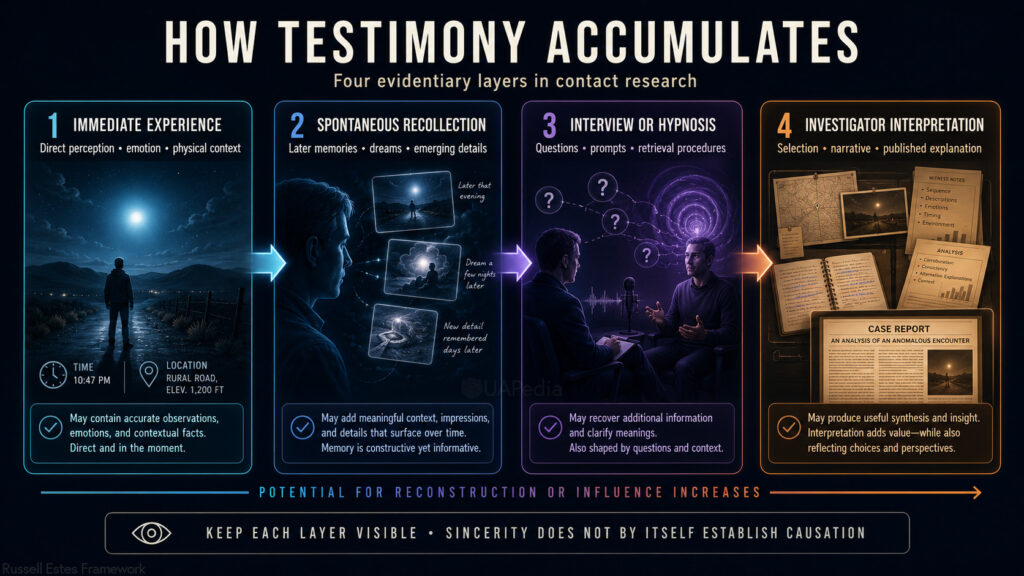
Estes’s methodological impact
Estes’s most important legacy may be an investigative protocol that was never formally presented as one.
The first account should be recorded before the witness reads case literature or speaks with multiple investigators. Questions should remain neutral and should be preserved in full. Conscious memory should be separated from dreams, hypnosis, meditation and later impressions. Witnesses should be asked what media, books and earlier cases they encountered before each new recollection emerged.
Investigators should also distinguish support from evidence collection. A clinician may help a distressed person cope with anxiety or sleep disturbance without deciding whether the cause was neurological, psychological or non-human. An investigator may document a possible external anomaly without using therapy to confirm a preferred explanation.
The evidence can be imagined as a set of transparent layers.
The first contains the immediate experience. The next contains later spontaneous recollections. Another contains information developed in interviews or hypnosis. A final layer contains the investigator’s interpretation.
When the layers remain separate, readers can see when each detail entered the case. When they are fused, a coherent narrative may conceal a complicated chain of influence.
Estes’s work as an illustrator also has implications for modern case documentation. A witness’s original sketch should be preserved before an artist produces a refined version. Each revision should be dated. Investigators should distinguish features supplied spontaneously from those selected after comparison with existing entity or craft images.
A polished illustration may eventually become more influential than the uncertain testimony from which it was created.
There is also an unresolved archival question. Randle reported a substantial videotaped interview collection, but no complete public archive, catalog or participant inventory was located during research for this article.
Should the recordings survive, their study would require careful attention to consent, privacy and the vulnerability of participants. With appropriate safeguards, they might allow researchers to examine interviewer effects, language patterns and the development of narratives over time.
Until such an archive can be assessed, the project’s scale and procedures should remain attributed to its participants rather than treated as independently reproduced findings.
Implications for experiencer research
Estes’s work points toward a model that is more respectful of witnesses and more demanding of investigators.
Testimony should be accepted as evidence that a person perceived, remembered and lived through an event. Its evidentiary weight increases when it is supported by contemporaneous documentation, independent witnesses, sensor data, physical effects and a clearly preserved interview history.
Its weight decreases when decisive details emerge only after hypnosis, when leading questions are documented or when media exposure cannot be separated from later recall.
Experiencers should not be forced into a false choice between “nothing happened” and “non-human beings took me.” A person may have undergone a genuine anomaly whose cause remains unresolved. Care can address fear, trauma and social consequences without imposing an ontology.
Future investigations should compare contact testimony with known memory errors, sleep paralysis, trauma-related imagery and sociocultural influences. They should also compare those accounts with stronger UAP cases involving independent observers, physical traces or multiple sensors.
The objective is not to reduce every experience to a conventional explanation. It is to identify what remains unexplained after conventional pathways have been carefully examined.
Russ Estes matters because he recognized that listening is not passive.
The interviewer affects the testimony. The camera affects the performance. The illustration affects later memory. The published case may influence the next witness.
Recognizing that chain does not eliminate the anomaly. It gives investigators a better chance of finding it.
Claims taxonomy
Verified
Russ Estes co-authored Faces of the Visitors in 1997, The Abduction Enigma in 1999 and The Spaceships of the Visitors in 2000. Publisher and bibliographic records document the titles, co-authors and publication history.
The University of Colorado’s Schirmer case record documents an initial roadside UAP report, a period of unexplained time, psychological evaluation, a search that produced no persuasive physical evidence and later material developed through partial hypnotic procedures.
The cited scientific literature documents risks of confabulation under hypnosis, elevated false-recognition tendencies in some selected experiencer samples and measurable physiological distress during recollection.
Probable
It is probable that Estes played a major role in shaping the central methodological argument of The Abduction Enigma. Randle explicitly credited Estes and Cone with developing much of the book’s insight.
It is also probable that Estes conducted a substantial number of videotaped experiencer interviews. The precise scale, composition and methodological uniformity of the collection have not been independently established through a public archive.
Biographical details concerning his documentary work, military service, artistic career and performance history are probable because they were reported by a close colleague, but independent documentation has not been cited for each claim.
Disputed
The external non-human interpretation of the Roach and Schirmer cases is disputed.
The claim that investigator influence explains most or all abduction narratives is also disputed. Documented examples of suggestion establish a methodological risk, not a universal explanation.
Demographic patterns reported from the interview project remain disputed and methodologically unverified because the sample was nonrandom and the dataset has not been independently examined.
Legend
Some cosmic histories, home-world descriptions and entity narratives within contact literature are best classified as legend when their cultural transmission is better documented than their literal physical basis.
Legend does not imply worthlessness. Such narratives may preserve psychological, spiritual and cultural meaning even where physical verification is absent.
Misidentification
No central case discussed here can presently be assigned to misidentification without a demonstrated conventional cause. Sleep paralysis may explain some aspects of certain bedroom encounters, but resemblance to a known condition is not sufficient for definitive reclassification.
Speculation labels
Hypothesis
Investigator expectations, hypnosis, media exposure and repeated retelling may standardize otherwise diverse contact narratives. This could help explain why particular researchers repeatedly obtained accounts matching their own preferred models.
The hypothesis is compatible with established memory research. It does not exclude the possibility that some witnesses first encountered an external anomaly.
A second hypothesis is that cases grouped under “abduction” may represent several distinct populations, including sleep-related events, dissociative or trauma-linked experiences, environmental misinterpretations, fabricated accounts and genuinely anomalous encounters.
Under this model, the search for one universal explanation would be a category error.
Witness Interpretation
Pat Roach’s conclusion that non-human beings entered her home is a witness interpretation developed from an alarming event, family testimony and later investigative sessions.
Herbert Schirmer’s account of entering a craft and interacting with occupants is also a witness interpretation, particularly where the details emerged during partial hypnotic procedures.
These interpretations should be preserved accurately and respectfully. Their external causes remain unresolved.
Researcher Opinion
Estes, Randle and Cone believed that investigator influence, cultural exposure and unreliable memory-retrieval procedures could account for substantial portions of the established abduction narrative.
Their critics argued that this approach underestimated conscious recollections, trauma and the possibility that recurring patterns reflected genuine encounters.
The available evidence strongly supports caution about hypnosis and interviewer effects. It does not establish that all reported contact experiences have the same origin.
References
Clancy, S. A., McNally, R. J., Schacter, D. L., Lenzenweger, M. F., & Pitman, R. K. (2002). Memory distortion in people reporting abduction by aliens. Journal of Abnormal Psychology, 111(3), 455–461. https://doi.org/10.1037/0021-843X.111.3.455
Condon, E. U., & Gillmor, D. S. (Eds.). (1968). Case 42: State trooper sighting. In Scientific study of unidentified flying objects. University of Colorado. https://files.ncas.org/condon/text/case42.htm
Council on Scientific Affairs. (1985). Scientific status of refreshing recollection by the use of hypnosis. JAMA, 253(13), 1918–1923. https://pubmed.ncbi.nlm.nih.gov/3974082/
Denis, D., French, C. C., & Gregory, A. M. (2018). A systematic review of variables associated with sleep paralysis. Sleep Medicine Reviews, 38, 141–157. https://doi.org/10.1016/j.smrv.2017.05.005
French, C. C., Santomauro, J., Hamilton, V., Fox, R., & Thalbourne, M. A. (2008). Psychological aspects of the alien contact experience. Cortex, 44(10), 1387–1395. https://doi.org/10.1016/j.cortex.2007.11.011
McNally, R. J., Lasko, N. B., Clancy, S. A., Macklin, M. L., Pitman, R. K., & Orr, S. P. (2004). Psychophysiological responding during script-driven imagery in people reporting abduction by space aliens. Psychological Science, 15(7), 493–497. https://doi.org/10.1111/j.0956-7976.2004.00707.x
National Research Council. (2014). Identifying the culprit: Assessing eyewitness identification. National Academies Press. https://doi.org/10.17226/18891
Randle, K. D. (2005, March 28). Alien abduction and leading the witness. A Different Perspective. https://kevinrandle.blogspot.com/2005/03/alien-abduction-and-leading-witness.html
Randle, K. D. (2006, August 25). Russ Estes is gone. A Different Perspective. https://kevinrandle.blogspot.com/2006/08/russ-estes-is-gone.html
Randle, K. D. (2007, August 23). The Abduction Enigma. A Different Perspective. https://kevinrandle.blogspot.com/2007/08/abduction-enigma.html
Randle, K. D., & Estes, R. (1997). Faces of the visitors: An illustrated reference to alien contact. Fireside. https://archive.org/details/facesofvisitorsi00rand_0
Randle, K. D., Estes, R., & Cone, W. P. (1999). The abduction enigma: An investigation of the alien abduction phenomenon. Forge. See pp. 40–46, 59–60, 160–162, 178–191, 345–354 and 367–384. https://archive.org/details/abductionenigma0000rand
Randle, K. D., & Estes, R. (2000). The spaceships of the visitors: An illustrated guide to alien spacecraft. Fireside. https://archive.org/details/spaceshipsofvisi00kevi
Rowell, K., Colli, J., & Lindemann, D. (n.d.). The truth about The Abduction Enigma: An exposé. Alien Jigsaw. https://alienjigsaw.com/reviews-op-eds-interviews/Rowell-Abduction-Enigma.html
Sharpless, B. A., & Barber, J. P. (2011). Lifetime prevalence rates of sleep paralysis: A systematic review. Sleep Medicine Reviews, 15(5), 311–315. https://doi.org/10.1016/j.smrv.2011.01.007
Whitehouse, W. G., Dinges, D. F., Orne, E. C., & Orne, M. T. (2005). Hypnotic hypermnesia: Enhanced memory accessibility or report bias? International Journal of Clinical and Experimental Hypnosis, 53(1), 3–22. https://doi.org/10.1080/00207140490914253
SEO keywords
Russ Estes, Russ Estes biography, Russ Estes UAP investigator, The Abduction Enigma, Kevin Randle and Russ Estes, William P. Cone, experiencer research, contact experience testimony, abduction investigation methods, hypnosis and memory, regression hypnosis risks, leading interview questions, memory contamination, false memory research, Pat Roach incident, Herbert Schirmer incident, missing time, sleep paralysis and contact experiences, Faces of the Visitors, Spaceships of the Visitors, UAP entity illustrations, witness reliability, experiencer ethics, observer expectancy effect, UAP contact research, abduction case methodology, Contact and Abduction Experiences, UAPedia