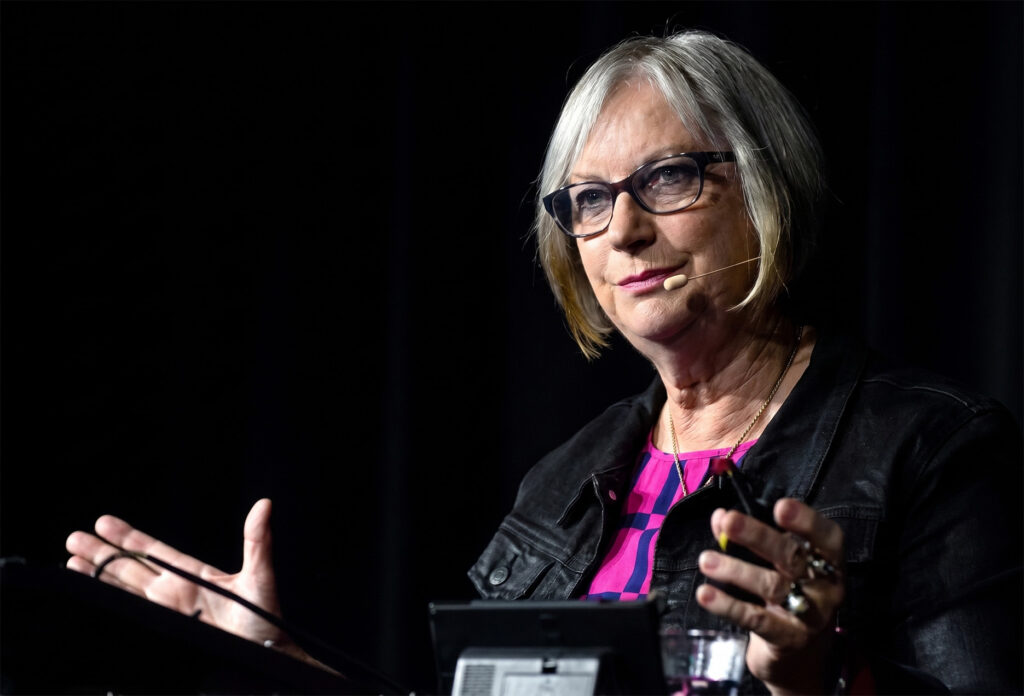
Suzanne “Suzy” Hansen occupies an unusual place in New Zealand’s UAP history. She is at once a collector of other people’s testimony, an advocate for witnesses, the author of an extensive personal contact narrative, and a public interpreter of what such experiences might mean.
That combination makes her work unusually rich and unusually difficult to assess.
At one level, Hansen’s contribution is practical. Through UFOCUS NZ, she has helped collect reports that might otherwise have remained confined to private conversations, newspaper archives, correspondence or the silence created by social stigma. Her published case files include aerial sightings, close encounters, missing-time episodes, reports of entities and accounts in which witnesses believed they were monitored or contacted by an intelligence.
At another level, Hansen is herself part of the evidence she asks readers to consider. She has described a personal history involving anomalous light, missing time, continuing contact and an elaborate interpretation of non-human intelligence. Her experiences form the basis of her 2014 book, The Dual Soul Connection: The Alien Agenda for Human Advancement.
The central question is therefore not simply whether Hansen is a credible person. The more useful questions are narrower. What has been independently documented? What comes from Hansen’s own recollection? What was reported by witnesses? Which details emerged only later? Where do records end and interpretations begin?
Those distinctions do not diminish the experiencer. They make the material more intelligible.
From witness to investigator
According to Hansen’s published biographies, her professional background includes education and grief counselling. These claims appear consistently in Hansen-associated profiles, although independent employment records or professional-register documentation were not identified in the sources used for this article.
The background is relevant to the way Hansen presents her investigative work, although professional titles should not be treated as proof of investigative accuracy. Her interviews and articles tend to emphasize listening, witness privacy and the personal consequences of anomalous encounters. She has repeatedly argued that a witness should not be treated merely as a source of dramatic material.
According to UFOCUS NZ’s organizational history and Hansen’s public biographies, she established the New Zealand-based research network in 2000. The organization describes its original structure as a seven-person group that included people with aviation, scientific and technical experience.
Because this history is supplied principally by UFOCUS NZ itself, it should be understood as an institutional account rather than an independently audited founding record.
The organization’s continuing activity is easier to observe. UFOCUS NZ maintains a publicly accessible collection of New Zealand reports and provides a route through which witnesses can submit new material. Its published archive covers cases involving pilots, air traffic personnel, hunters, fishermen, families and other civilians.
Hansen’s own interest in the subject reportedly began much earlier.
She has described a childhood family sighting near the Bombay Hills involving an orange, cigar-shaped aerial object. Some retellings say other people also saw it and that a newspaper reported the event. No contemporaneous clipping confirming those wider details has been located for this article. The episode is therefore best classified as autobiographical witness testimony rather than an independently documented historical case.
Her most consequential personal account concerns an event she places at the age of 20.
According to Hansen, she was driving on a rural road in daylight when her vehicle became surrounded or engulfed by a brilliant white light. She has said that she later became aware of her surroundings after darkness had fallen and that approximately 90 minutes were unaccounted for.
The National Library of New Zealand catalogue entry for The Dual Soul Connection confirms that Hansen published this account and that it forms part of the book’s autobiographical narrative. The catalogue does not verify the event itself. The white light, the time interval and Hansen’s interpretation of the experience must therefore remain explicitly attributed to her.
No publicly available contemporaneous police record, aviation record, medical assessment, instrument reading or independent witness statement has been identified that establishes what occurred during the missing interval.
That does not make the event irrelevant. It means the publicly available evidence consists primarily of retrospective first-person testimony.
The book that placed Hansen inside the story
Hansen’s principal publication is The Dual Soul Connection: The Alien Agenda for Human Advancement, published by Skylight Books in Tauranga in 2014.
The National Library of New Zealand records the volume as a 2014 publication and identifies physicist and astronomer Rudolph “Rudy” Schild as a contributor. The catalogue description presents the book as an account of Hansen’s reported lifelong encounters combined with scientific commentary and an epilogue by Schild.
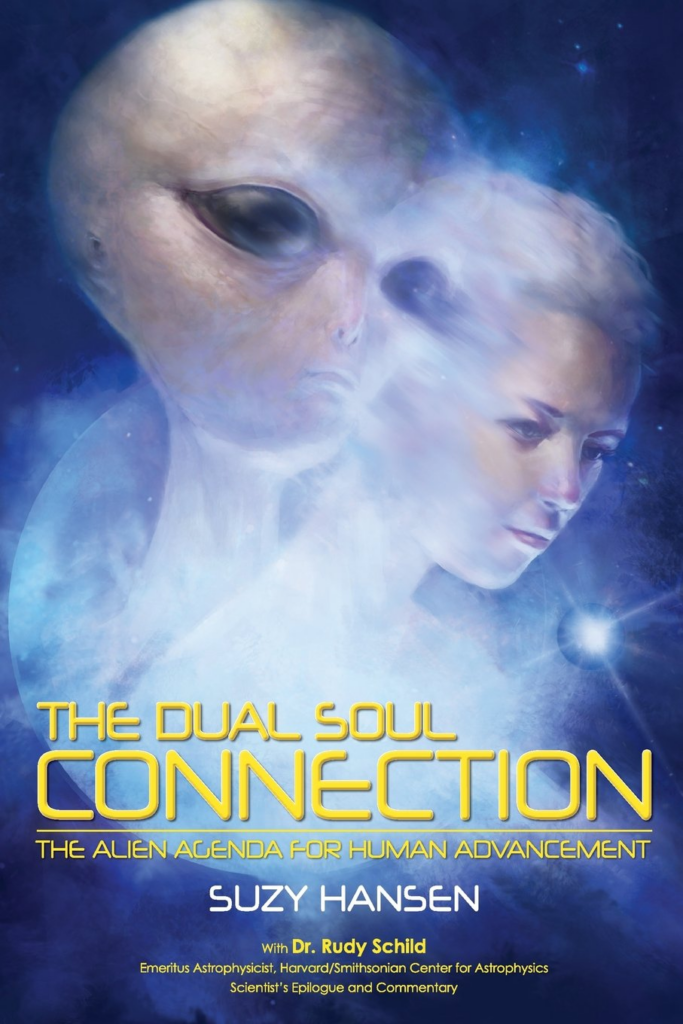
Schild has been associated with the Harvard-Smithsonian Center for Astrophysics and is described in the National Library record as an emeritus astrophysicist. His presence in the book is important because he engages with some of Hansen’s descriptions using concepts drawn from astronomy, physics and consciousness research.
It is equally important not to overstate what that participation establishes.
Scientific commentary on testimony is not independent confirmation of the event described. A physicist may observe that an alleged technology resembles a theoretical model without demonstrating that the technology exists, that it was present during an encounter or that the witness interpreted it accurately.
Hansen’s book extends well beyond the road event. It presents a proposed system of contact involving telepathy, consciousness, advanced technology, spiritual development and a concept she calls the “dual soul.” She interprets these elements as part of a purposeful interaction between humanity and non-human intelligence.
Readers can approach the book more clearly by separating three layers.
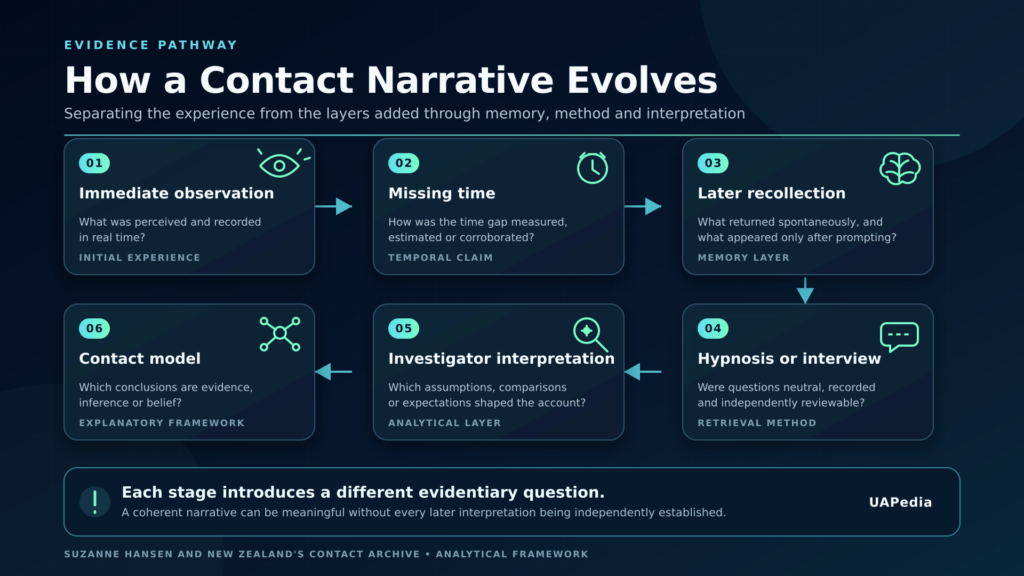
The first layer is autobiography. This includes what Hansen says she saw, remembered, felt or later understood about her own life.
The second is an analogy. Here, physical and metaphysical concepts are used to interpret the experiences.
The third is the ontological claim. This is the assertion that the experiences originated with real non-human beings participating in a structured programme involving human development.
The first layer is testimony. The second is interpretation. The third remains an unverified hypothesis.
Hansen’s work is still significant because it attempts something many contact narratives do not. Rather than presenting only disconnected scenes, she constructs a complete model of what contact might be, how it might operate and why it might occur.
That coherence is intellectually interesting. It also creates a methodological risk. A comprehensive explanatory system can become capable of absorbing almost any new experience, including events that might have different causes.
An unofficial archive after official withdrawal
Hansen’s public role became more consequential after the release of historical New Zealand Defence Force material in 2010.
The National Library of New Zealand catalogues a collection of 15 volumes covering material accumulated between 1952 and 2009. The records include reports by civilians and military personnel, correspondence, government material, newspaper clippings and letters from people claiming contact with non-human beings or craft.
The New Zealand Defence Force independently confirmed the release in a 2023 response under the Official Information Act.
UFOCUS NZ states that Hansen participated in sustained efforts to encourage the release of the files. The release itself is documented, while the degree to which Hansen or UFOCUS NZ directly caused the decision is less firmly established. The most supportable conclusion is that the network took part in public advocacy surrounding access to the records and helped draw attention to them after their release.
The 2023 Defence Force response also clarified the present institutional position. It stated that the Defence Force was not undertaking research or programmes relating to UAP, did not investigate or maintain incoming reports, and referred such reports to the Civil Aviation Authority as standard practice.
That wording should not be interpreted as proof that the Civil Aviation Authority operates a specialist UAP investigation programme. It establishes only the referral procedure described by the Defence Force.
The resulting situation is striking. New Zealand possesses a substantial historical official archive, yet its Defence Force says it does not currently conduct dedicated research or maintain new reports.
Civilian organizations consequently perform a significant role in preserving publicly submitted testimony.
Hansen’s work has contributed to a publicly accessible archive of New Zealand witness reports. That is not the same as creating a scientifically controlled national database. The reports differ in age, detail, documentation and investigative quality. Even so, without civilian collection, some accounts might never enter a publicly accessible archive.
The fishermen reports: a useful withheld-detail test
One of the more methodologically interesting cases published by UFOCUS NZ concerns two fishermen whose reported encounters occurred separately in 2011 and 2012.
According to UFOCUS NZ’s case report, the first witness described an orange light and an apparently structured object near a coastal fishing location. The report states that investigators withheld a particular arrangement of lights and other details from public circulation.
A second fisherman later reported features that UFOCUS NZ considered similar to those in the earlier account. The organization presents this as significant because the second witness had allegedly not been given the withheld description.
Both witnesses were also said to have experienced an unusual darkness surrounding the encounters. One account included a humming sound and a nearby creature-like figure.
The withheld-detail method is potentially valuable. Once unusual case details circulate publicly, later witnesses can absorb them consciously or unconsciously. Keeping a feature private creates an opportunity to examine whether a later independent witness supplies comparable information without prompting.
Its value depends entirely on documentation.
Investigators would need to show when the first account was recorded, exactly what was withheld, when the second statement was obtained, whether the witnesses could have communicated, and whether the interview questions were open or suggestive. The degree of similarity also matters. A general orange light is common. A highly unusual pattern of lights described in the same sequence would carry greater weight.
The publicly available article does not provide original recordings, signed independent statements, complete interview transcripts or outside verification of the investigative procedure.
The case therefore contains a potentially important correspondence between two reports, but the procedure has not been independently audited.
Hansen also notes that one witness feared professional repercussions. That concern is relevant to understanding why witnesses may request anonymity. It should not be treated as a reliable test of truthfulness. People can fear stigma while being accurate, mistaken, confused or influenced by complex personal motives.
The most defensible assessment is that the fishermen’s reports contain unresolved and potentially corroborative features. They do not establish the identity or origin of the phenomenon.
The full UFOCUS NZ account is available at:
The Kaimai hunters: a group encounter in the bush
Another case published by Hansen concerns a group of hunters in the Kaimai Ranges.
According to UFOCUS NZ’s case report, four witnesses, including a 12-year-old, observed an orange aerial light during a hunting trip. The account later developed into a closer encounter involving what was described as a structured or cone-like object and a humanoid figure.
The witnesses reportedly believed that the phenomenon followed or monitored their movements.
Several aspects make the account worth preserving. It took place outdoors rather than in a bedroom or sleep-transition setting. It involved more than one witness. The participants were described as familiar with bush conditions and nocturnal environments.
None of those points settles the case.
Multiple witnesses improve a report when they independently describe the same event. Group testimony can also become mutually reinforcing. A single person’s interpretation can rapidly shape how others describe an uncertain object. For that reason, separate interviews conducted before extensive group discussion are critical.
Outdoor competence is similarly relevant but not decisive. Experienced hunters may be better than average at judging animal sounds, movement and terrain. They are not automatically skilled at estimating the distance, scale or speed of an unfamiliar aerial light at night.
The public case report does not contain complete original recordings, independently timestamped witness statements, calibrated imagery, aviation data or a reconstruction of the observation geometry. The reported number of witnesses, sequence of events and descriptions therefore derive from UFOCUS NZ’s presentation of the case.
The account remains unresolved. It is stronger as an example of a multi-witness close-encounter report than as evidence for a specific non-human origin.
The UFOCUS NZ report is available at:
Waimata Valley: separating the first report from hypnosis
The Waimata Valley material requires particular care because the story appears in later regional treatments, secondary histories and accounts involving hypnosis.
The Gisborne region experienced a series of reported aerial anomalies during the late 1970s. Hansen later presented the Waimata Valley as an important location in New Zealand’s history of close encounters.
A later secondary account by British researcher Jenny Randles describes three women who were said to have been skywatching in the valley when they experienced unusual sounds, bodily pressure and an apparent discrepancy in time. Additional details involving an unfamiliar interior, beings and medical-examination imagery reportedly emerged during hypnosis.
The account is discussed in Randles’s Alien Contact: The First Fifty Years. Accessible catalogue records confirm the publication, although an edition-specific page range for the Waimata material has not been independently verified. Because pagination may vary between editions, the book itself should be consulted before assigning a definitive page citation in a print reference system.
The precise date, participant count, missing-time duration and division between consciously remembered material and hypnosis-associated recollection depend on later accounts rather than readily available original case files.
That distinction changes how the narrative should be evaluated.
The foundational claim is that several people reportedly experienced unusual sensations and an apparent time discrepancy.
The more elaborate onboard sequence belongs to a later layer associated with hypnosis.
Hypnosis is not a reliable recording device for recovering an untouched memory. It can increase confidence, narrative detail and emotional intensity without guaranteeing historical accuracy. Questions, expectations, cultural imagery and the witness’s own developing beliefs can become incorporated into the remembered account.
Research by Susan Clancy and colleagues is relevant here. Their 2002 study compared people reporting recovered or repressed memories of non-human abduction with control participants. The recovered-memory group displayed greater false recall and false recognition on a standardized memory task, while the groups did not differ in correct recall. Hypnotic suggestibility was among the factors associated with false-memory performance.
The study does not prove that the Waimata witnesses remembered falsely. It demonstrates why hypnosis-derived details require a separate evidentiary label.
The most responsible presentation preserves the layers rather than blending them. The apparent time discrepancy and unusual sensations form one claim. The interior environment, beings and examination narrative form a later and more disputed claim.
Hansen’s regional discussion is available at:
What the research says about experiencer testimony
Scientific and academic studies do not provide a single explanation for contact experiences. They do, however, help distinguish questions that are often confused.
One question is whether a person is emotionally affected.
A 2004 study led by Richard McNally measured physiological responses while participants reporting non-human abduction experiences listened to personalized scripts. The participants showed strong physiological reactions to their encounter narratives. Their heart rate, skin conductance and facial-muscle activity indicated that the material had genuine emotional force.
That finding is important because it challenges the assumption that an unusual claim is necessarily told without emotional consequence.
It does not establish that the proposed external event occurred.
Physiological distress verifies distress. It does not identify the cause of the memory or belief.
Another question is whether sleep phenomena can explain some reports.
Sleep paralysis can involve temporary immobility, pressure, fear, sensed presence and vivid figures during transitions between sleep and waking. McNally and Clancy examined its relevance to reported non-human abduction experiences in a 2005 paper.
Sleep paralysis is a plausible explanation for some bedroom encounters, especially those beginning during sleep or partial awakening. It is far less useful as an explanation for every daylight road experience, outdoor group event or observation accompanied by independently recorded physical effects.
A third question concerns the reported long-term effects of contact experiences.
Reinerio Hernandez, Robert Davis, Russell Scalpone and Rudy Schild published a large survey study in the Journal of Scientific Exploration in 2018. The project involved 554 survey questions across two phases. Phase 1 included 3,256 respondents, while Phase 2 involved a smaller subset.
On pages 340–341, the authors reported that approximately 70 percent of the Phase 1 study population described positive behavioural transformation associated with their contact experiences, while approximately 15 to 20 percent reported a negative impact. The authors also reported that 56 percent of 1,560 respondents described contact occurring in a non-physical way rather than through physical abduction.
These findings are consistent with Hansen’s interest in transformation, consciousness and reported non-physical contact.
They must be read within the study’s limitations. Participants were self-selected and already identified with contact experiences. The survey measured what participants reported about themselves. It did not establish how common such experiences are in the wider population, nor did it independently verify that non-human intelligence caused them.
The study is valuable for mapping patterns of belief, experience and reported life change within an experiencer population. It is not proof of external causation.
The core controversy: three roles in one person
Hansen’s most important controversy is methodological rather than personal.
She has occupied the roles of experiencer, investigator and witness advocate at the same time.
That combination has advantages.
An experiencer may recognize the difficulty of describing an event that appears impossible. A person familiar with counselling may understand why witnesses hesitate or fragment their accounts. An advocate may create conditions in which people disclose details they would otherwise conceal.
The same combination can introduce confirmation effects.
An investigator who already accepts a comprehensive model of non-human contact may interpret ambiguous details through that model. A witness may also recognize the interviewer as a prominent experiencer and adapt language, consciously or unconsciously, toward the investigator’s known framework.
Supportive listening must therefore be distinguished from confirmation.
It is reasonable to tell a witness that the experience deserves to be documented and that its emotional consequences are real. It is a separate step to conclude that non-human beings caused the event exactly as remembered.
Hansen’s writings tend to favour a connected and often developmental interpretation of contact. Experiences that initially appear frightening may be understood as purposeful. Technological imagery may be connected with consciousness. Spiritual change may be interpreted as part of a wider programme.
This framework may reflect Hansen’s genuine understanding of her experiences. It remains difficult to test.
A light can sometimes be checked against aircraft, astronomical objects, satellites or atmospheric conditions. A physical trace can be photographed and sampled. Missing time can be compared with phone records, clocks and travel distance.
Claims involving a pre-existing soul relationship, a cosmic development programme or telepathic instruction do not presently offer the same level of independent access.
They belong to the domain of hypothesis and witness interpretation unless additional evidence emerges.
Publications, public work and influence
The Dual Soul Connection remains Hansen’s central book, but her wider output is dispersed across case reports, interviews, presentations and the UFOCUS NZ website.
Her published subjects include the Waimata Valley, pilot observations, air-traffic reports, close encounters involving hunters and fishermen, unusual object shapes, oceanic anomalies, witness ethics and the release of New Zealand’s historical Defence Force files.
This breadth has helped preserve a specifically New Zealand body of testimony.
Hansen’s work has also contributed to a more experiencer-centred style of investigation. In this approach, the aftermath matters alongside the sighting. Researchers ask not only what appeared in the sky, but what happened to the witness’s identity, relationships, worldview and sense of reality.
That shift has value because anomalous encounters can produce long-term consequences regardless of their eventual explanation. A person may experience fear, fascination, social isolation, spiritual change or ontological shock.
The approach also requires controls. Witness meaning should be preserved without being confused with observation.
A modern case file might record:
“A witness observed a bright white light.”
It should separately record:
“The witness interpreted the light as an intelligent craft.”
It should separately label:
“The witness believes the event was intended to initiate spiritual development.”
All three statements matter. They do not have the same evidentiary status.
Hansen’s enduring impact is most securely located in this combination of preservation, witness support and public discussion. Claims that she created a definitive national archive or established the nature of contact would go beyond the documentation.
Implications for future research
Hansen’s work reveals both why civilian investigators are necessary and why their methods must become more rigorous.
New Zealand would benefit from a standardized reporting system capable of preserving testimony, original files and environmental data in a consistent format.
Initial witness statements should be recorded as soon as possible. In multi-witness cases, participants should be interviewed separately before extensive discussion. Investigators should document the exact wording of questions, especially when entities, missing time or telepathy are suspected.
Leading terms should be avoided.
Instead of asking, “Did the craft communicate with you?” an investigator might ask, “Did you notice any thoughts, sounds, images or sensations that seemed unusual?”
Instead of asking, “Were you abducted?” the investigator might ask, “What is the last thing you remember before the time discrepancy?”
Hypnosis-associated recollection should be stored separately from conscious recall. Any detail first emerging during hypnosis should carry an explicit label.
Original recordings, photographs and documents should be preserved with timestamps and metadata. Where witnesses consent, investigators should check aviation records, astronomical conditions, satellite passages, weather, seismic activity and local sources of light or sound.
Prospective studies may be especially valuable. Researchers could work with people reporting recurring experiences and use synchronized clocks, environmental monitors, sleep tracking, physiological sensors and independent interviewers.
Such a study would not assume that the phenomenon is conventional. It would create an opportunity to detect whatever is present.
Hansen’s archive offers leads. A future scientific programme would need to turn those leads into testable cases.
Claims taxonomy
Verified
Hansen published The Dual Soul Connection in 2014. The National Library catalogue identifies Rudy Schild as a contributor. UFOCUS NZ operates a public reporting and case-publication website and states in its organizational history that Hansen established the network in 2000. The New Zealand Defence Force released 15 volumes of historical material covering 1952 to 2009 and stated in 2023 that it did not conduct dedicated UAP research or maintain new reports.
Probable
Hansen appears to have conducted a sustained collection of New Zealand witness testimony. No reviewed evidence establishes deliberate fabrication of her publication history or the cited case reports. It is also probable that several witnesses sincerely perceived events they considered anomalous. Sincerity does not determine the external cause of an experience.
Disputed
Hansen’s interpretation of lifelong non-human contact, the cause of her reported missing-time event, the “dual soul” concept and the proposed programme for human advancement remain disputed.
The non-human origin of the fishermen, Kaimai and Waimata events is unresolved. Details first reported during hypnosis carry greater uncertainty than consciously recalled observations.
Speculation labels
Evidence
Suzanne Hansen is the author of The Dual Soul Connection, published in 2014. The National Library of New Zealand catalogues the book and identifies Rudy Schild as a contributor. UFOCUS NZ maintains a public collection of New Zealand reports and states in its organizational history that Hansen established the network in 2000. The New Zealand Defence Force released 15 volumes of historical material covering 1952 to 2009 and stated in 2023 that it was not conducting dedicated UAP research or maintaining incoming reports.
Witness Interpretation
Hansen interprets her missing-time experience and other reported events as part of continuing contact with non-human intelligence. Witnesses in the fishermen and hunters reports interpreted the phenomena as structured, intelligent and responsive. Later versions of the Waimata account interpret the apparent time discrepancy as involving an interior environment, entities and examination procedures.
Researcher Opinion
Hansen’s most clearly supportable contribution is her role in collecting, publishing and advocating for New Zealand witness testimony. Her personal experience may have helped some witnesses feel understood, while also increasing the possibility that ambiguous reports were interpreted through an established contact framework.
Hypothesis
One hypothesis is that some cases in Hansen’s archive involve an external non-human intelligence operating through physical craft, consciousness or a combination of both.
Another is that the archive contains several different phenomena, including unexplained external events, conventional aerial objects, sleep-related experiences, altered states and reconstructed memory.
A third is that an external anomaly may initiate an experience whose later interpretation is shaped by memory, expectation, culture and personal belief.
The available evidence does not establish a single explanation for every case.
References
Clancy, S. A., McNally, R. J., Schacter, D. L., Lenzenweger, M. F., & Pitman, R. K. (2002). Memory distortion in people reporting abduction by aliens. Journal of Abnormal Psychology, 111(3), 455–461. https://doi.org/10.1037/0021-843X.111.3.455
PubMed record: https://pubmed.ncbi.nlm.nih.gov/12150421/
Hansen, S. (2014). The dual soul connection: The alien agenda for human advancement. Skylight Books.
National Library of New Zealand catalogue record: https://natlib.govt.nz/records/35068685
Hansen, S. (2020, July 23). Two fishermen experience close encounters, 2011 and 2012. UFOCUS NZ. https://ufocusnz.org.nz/2020/07/23/two-fishermen-experience-close-encounters-2011-2012/
Hansen, S. (2020, July 23). Hunters tracked by a UAP and its occupants. UFOCUS NZ. https://ufocusnz.org.nz/2020/07/23/part-two-hunters-tracked-by-a-ufo-and-its-occupants-2012/
Hansen, S. (2020, August 5). The Waimata Valley UAP encounters. UFOCUS NZ. https://ufocusnz.org.nz/2020/08/05/the-waimata-valley-ufo-encounters/
Hernandez, R., Davis, R., Scalpone, R., & Schild, R. (2018). A study on reported contact with non-human intelligence associated with unidentified aerial phenomena. Journal of Scientific Exploration, 32(2), 298–348. https://doi.org/10.31275/2018.1282
Full article: https://journalofscientificexploration.org/index.php/jse/article/viewFile/1282/801
McNally, R. J., & Clancy, S. A. (2005). Sleep paralysis, sexual abuse, and space alien abduction. Transcultural Psychiatry, 42(1), 113–122. https://doi.org/10.1177/1363461505050715
PubMed record: https://pubmed.ncbi.nlm.nih.gov/15881271/
McNally, R. J., Lasko, N. B., Clancy, S. A., Macklin, M. L., Pitman, R. K., & Orr, S. P. (2004). Psychophysiological responding during script-driven imagery in people reporting abduction by space aliens. Psychological Science, 15(7), 493–497. https://doi.org/10.1111/j.0956-7976.2004.00707.x
PubMed record: https://pubmed.ncbi.nlm.nih.gov/15200635/
National Aeronautics and Space Administration. (2023). Unidentified anomalous phenomena independent study report. https://science.nasa.gov/uap/
National Library of New Zealand. (2010). Unidentified flying objects files: Copies for release to the public. https://natlib.govt.nz/records/22979464
New Zealand Defence Force. (2023). Official Information Act response OIA-2023-4763: Unidentified anomalous phenomena, unidentified aerial phenomena and unidentified submerged objects. https://www.nzdf.mil.nz/assets/Uploads/DocumentLibrary/OIA-2023-4763_UAP-UFO-USO.pdf
Randles, J. (1997). Alien contact: The first fifty years. Collins & Brown. WorldCat record: https://search.worldcat.org/title/Alien-contact-%3A-the-first-fifty-years/oclc/38207375
UFOCUS NZ. (n.d.). About UFOCUS NZ. https://ufocusnz.org.nz/about-us-2/
SEO keywords
Suzanne Hansen, Suzy Hansen, New Zealand UAP researcher, UFOCUS NZ, experiencer investigator, contact experiences, abduction research, missing time, Waimata Valley encounters, Kaimai hunters encounter, New Zealand UAP cases, The Dual Soul Connection, Rudy Schild, non-human intelligence testimony, regression hypnosis, contact experiencer research, New Zealand Defence Force UAP files, civilian UAP reporting, witness testimony, UAP case investigation, contact research, UAPedia