
Bruce Maccabee spent much of his professional life asking light to reveal information that the unaided eye could not provide.
In his government career, that meant working with optical processing, laser systems and experiments in which intense light generated sound beneath the surface of water. In his civilian UAP investigations, the conditions were rarely controlled. His evidence might consist of two photographic negatives from an Oregon farm, motion-picture film exposed aboard a cargo aircraft, radar records from an airline encounter or a sequence of photographs taken at a private home in Florida.
The settings changed, but Maccabee’s central question remained remarkably consistent.
What could be measured?
That question explains why he became one of the most technically consequential figures in civilian UAP research. He was not primarily known for investigating hypnotically recovered memories, alleged medical procedures or accounts of communication with non-human beings. His contribution to experiencer research came through a different route. He studied witnesses whose experiences appeared to intersect with external evidence, including photographs, film, radar indications, air-traffic-control recordings, contemporary interviews and government files.
Maccabee attempted to convert human reports into optical and geometric problems. Where had the witness been standing? Which direction was the camera facing? What was the lens focal length? How large was the image on the negative? How bright was the source relative to the surrounding sky? Did a radar indication occur at the same time and bearing? Was the available image derived from an original negative, a first-generation print or a later reproduction?
Those questions did not remove uncertainty. They made the uncertainty visible.
Maccabee did not solve every case he examined. Several of his most confident conclusions remain disputed. One case he strongly defended, the Gulf Breeze photographic series, became an enduring warning about chain of custody, replication and investigator commitment. Yet his willingness to publish calculations, disclose assumptions and preserve original material made his work unusually valuable.
His legacy is not merely a set of verdicts about famous sightings. It is an extended demonstration of what happens when optical science enters a field where instruments are incomplete, witnesses are indispensable and the most important variable may be the one nobody measured at the time.
From naval research to civilian investigation
Bruce S. Maccabee was born on 6 May 1942. He earned a doctorate in physics and entered the United States Navy’s research establishment in 1972. He remained there until retiring in 2008, a career of approximately 36 years.
His professional work included optical data processing, high-power laser applications and laser-generated underwater sound. His institutional affiliations included the Naval Ordnance Laboratory and the Naval Surface Weapons Center. Maccabee died at his home in Ohio on 10 May 2024, four days after his eighty-second birthday. His obituary and MUFON’s memorial account confirm the date and describe his long involvement in UAP research. (Legacy.com; MUFON)
A bibliographically important detail concerns his professional publication with physicist Charles E. Bell. “Experimental Study of Laser-Induced Underwater Sound” appeared in a 1985 supplement to the Journal of the Acoustical Society of America. It was a published conference-session abstract rather than a conventional full-length research article. The abstract described experiments designed to characterize acoustic effects generated when laser energy was delivered into water. It listed the authors’ Naval Surface Weapons Center affiliation and appeared in volume 77, supplement 1, page S103 (Maccabee & Bell, 1985).
That work did not concern UAP. It is relevant because it establishes the kind of professional environment from which Maccabee approached anomalous photographs. His scientific background involved light propagation, measurement, energy transfer and the interpretation of signals produced under complex physical conditions.
His interest in UAP developed during the late 1960s. The timing was significant. The United States Air Force was preparing to end Project Blue Book, while the University of Colorado study led by physicist Edward Condon was shaping the public and academic judgment that sustained UAP research was unlikely to produce important scientific discoveries.
Civilian organizations increasingly became the custodians of witness reports, photographic evidence and historical files.
Maccabee became involved with the National Investigations Committee on Aerial Phenomena, historically known as NICAP. He joined the Mutual UFO Network in 1975 and later served for many years as MUFON’s Maryland state director. He also served as chairman of the Fund for UFO Research, an organization founded in 1979 to support civilian investigation and archival work. Contemporary reporting identifies him in that leadership role, while MUFON’s memorial confirms his NICAP participation, MUFON membership and long service as a state director. (MUFON; UPI Archives)
Historical names should be preserved when discussing these organizations. Modern editorial usage may prefer UAP, but the Fund for UFO Research, NICAP and the Mutual UFO Network retain the names under which they operated.
Maccabee’s scientific credentials did not guarantee that his conclusions were correct. Credentials cannot substitute for evidence. What distinguished him was his effort to produce analyses that could be inspected. He published calculations, measured photographic density, reconstructed witness positions and disclosed the assumptions behind his estimates.
That openness allowed critics to disagree with specific parts of his reasoning rather than merely accepting or rejecting him as an authority.
His place in experiencer research
Within UAPedia’s taxonomy, experiencers are a subset of witnesses rather than a universal label for everyone who reports something unusual.
Maccabee’s subjects often occupied the border between witness and experiencer. They were pilots, farmers, photographers, television workers and radar personnel who believed they had encountered something outside ordinary expectation. Some described only lights. Others interpreted what they saw as a structured object. A few reported prolonged or repeated encounters.
Maccabee’s role was to examine the point at which the reported experience intersected with an external record.
A photograph does not explain the circumstances in which it was made. Investigators still need the photographer’s account. Where was the camera held? Was the object moving? How long had it been visible? Did the witness change position? Was the photograph made through a window? Did the witness see surface structure that the film failed to record?
The witness supplies context, but testimony is not an infallible measurement. People may misjudge distance, size, direction and speed. Memory can change as an event is retold. Expectation may influence the interpretation of an ambiguous light.
Those limitations do not make testimony worthless. They make prompt and structured interviewing essential.
Radar creates a similar evidential problem. A return on a radar display can represent an aircraft, weather, terrain, a ship, anomalous propagation, electronic interference or a processing effect. A light seen at approximately the same time may be related, but simultaneity alone does not prove identity.
A persuasive radar-visual case therefore requires more than the existence of both visual and radar records. Investigators must demonstrate compatible timing, direction, location, motion and, where possible, range.
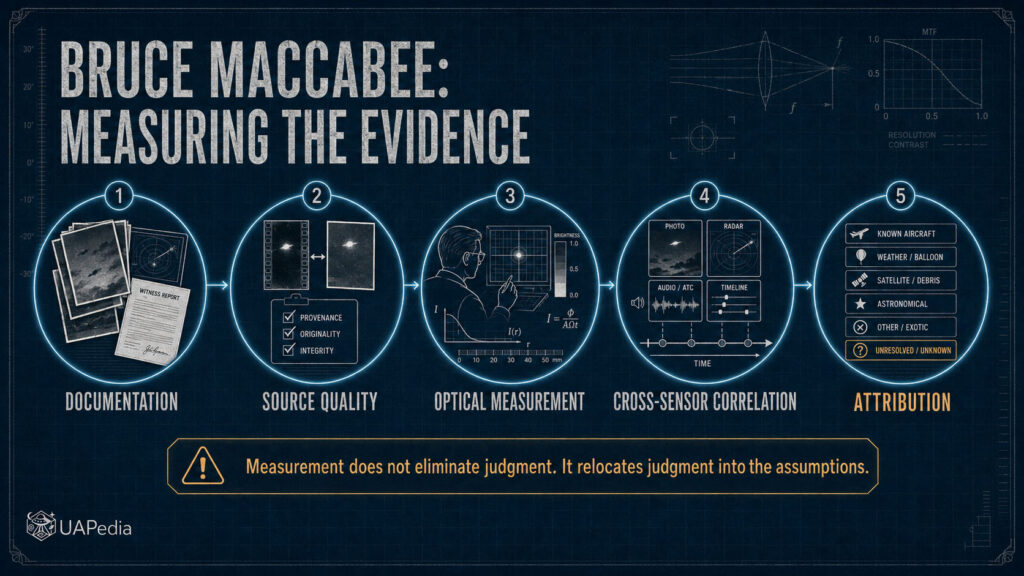
Maccabee’s work becomes easier to understand when a case is divided into three evidential stages.
The first stage is documentation. Did the event generate records, identifiable witnesses or physical media?
The second is correlation. Do the records appear to describe the same event?
The third is attribution. What caused it?
These stages are often merged in popular retellings. An official investigation may verify that witnesses were interviewed without confirming their interpretation. A radar operator may confirm an unexpected return without proving that it represented the light seen outside a cockpit. A photograph may be genuine as a photographic object while the subject’s distance and nature remain uncertain.
Maccabee’s strongest work kept those levels visible. His most controversial conclusions sometimes moved from correlation toward attribution more firmly than alternative analysts considered justified.
How optical analysis works
Optical analysis can appear forbiddingly technical, but the underlying questions are familiar.
Photometry measures brightness. An analyst can compare the density of an object’s image with the surrounding sky or with a calibrated reference. Under suitable conditions, that comparison can help estimate how much light reached the film.
Photogrammetry examines geometry. If the camera and lens are known, the apparent angular size of an object can be calculated from its image. Yet angular size does not reveal physical size by itself. A small object near the camera and a large object far away may occupy the same number of millimetres on a negative.
Contrast may also provide information. A distant dark object can appear less distinct against a bright sky because atmospheric light is scattered between the object and the observer. This effect may be useful in estimating distance, but only if the atmosphere, film response, exposure and surface reflectivity are sufficiently understood.
Veiling glare is another complication. Light scattered inside a lens or photographic emulsion can alter the apparent darkness of an object. An analyst who interprets contrast without accounting for glare may derive an unreliable estimate.
Maccabee frequently sought original negatives or early-generation prints because each reproduction introduces uncertainty. Contrast can change. Dust and scratches may appear. Compression can create edges or lines that were absent from the original.
Measurement does not eliminate judgment. It relocates judgment into the assumptions.
A brightness calculation may be mathematically correct but depend on an unverified distance. A size estimate may be exact but depend on the object being farther away than a nearby wire. A radar range may be precise while belonging to a different target. A faint line in a scan may be a suspension thread, a scratch or a copying artifact.
Maccabee’s career repeatedly encountered this boundary.
McMinnville: what two negatives can and cannot prove
On 11 May 1950, Evelyn and Paul Trent reported seeing a disc-like object near their farm outside McMinnville, Oregon. Evelyn called her husband, and Paul retrieved a camera and took two photographs before the object disappeared.
The photographs became among the most reproduced UAP images of the twentieth century.
They were examined during the University of Colorado’s official study as photographic Case 46. Investigator William K. Hartmann considered the possibility that the object had been a small model suspended near the camera. He also found that aspects of the testimony, geometry and photographic density were compatible with a more distant object.
Hartmann did not declare the case solved. He described it as unusually resistant to simple interpretation while leaving fabrication open as a possibility. His full discussion remains available in the archival edition of the Condon Report. (Hartmann, 1968)
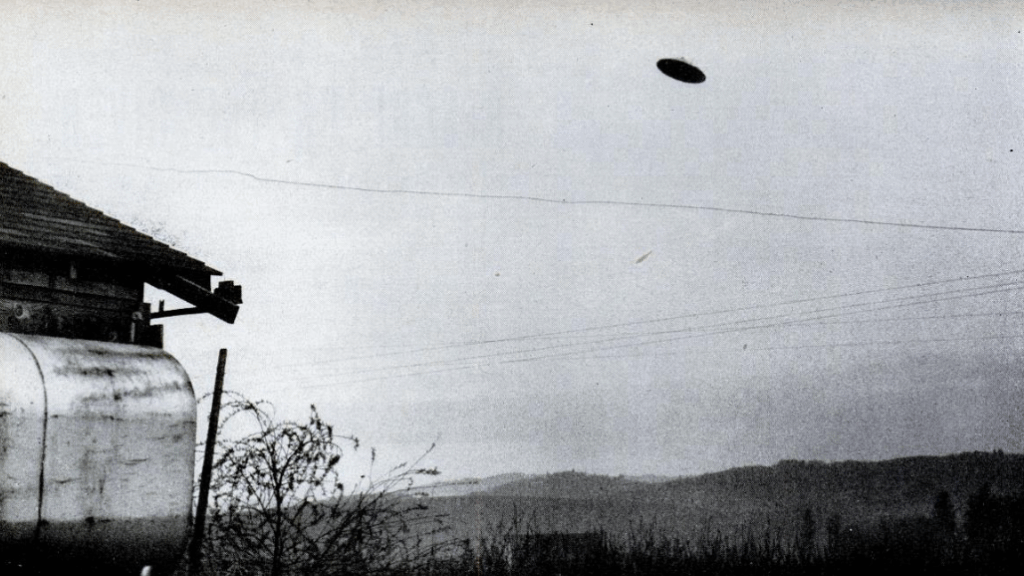
Maccabee examined the original negatives in 1975. He used calibrated densitometric measurements to compare the object with the sky and surrounding scene. He presented his findings at the 1976 Center for UFO Studies conference, where his analysis was included in the published proceedings. The proceedings should be cited as the source without assigning a paper title not securely established by the document’s contents. (Proceedings of the 1976 CUFOS Conference)
Maccabee argued that the tonal properties of the photographs were more compatible with a distant object affected by atmospheric scattering than with a small model hanging close to the camera. His work helped establish McMinnville as one of the central photographic cases in UAP research.
It also gave alternative analysts a clear technical argument to challenge.
Philip J. Klass and Robert Sheaffer questioned the witness chronology, apparent illumination, overhead-wire geometry and assumptions used in the contrast analysis. They argued that a small model suspended beneath one of the wires could produce the apparent form and perspective.
In 2014, analysts from IPACO published a digital re-examination based on high-resolution scans of first-generation prints and measurements Maccabee had made from the negatives. The report interpreted faint linear features above the object as a suspension thread. It also used the relationship between the object, the wires and the camera positions to support a nearby-model reconstruction.
IPACO’s conclusion was categorical. It stated that the photographed object was a model hanging from a thread. (Cousyn, Louange, & Quick, 2014)
That conclusion should neither be softened nor enlarged beyond what the evidence establishes.
IPACO did not possess a confession, the alleged model or a direct modern scan of the original negatives. Its conclusion was an analytical finding derived from scans of first-generation prints, scene geometry and Maccabee’s earlier measurements.
The case therefore contains several distinct propositions.
The photographs and original negatives existed. The witnesses were identifiable. The location could be reconstructed. Hartmann found the case difficult to resolve. Maccabee found optical support for a distant object. IPACO later concluded that the image showed a suspended model.
What remains disputed is the physical interpretation of the photographed subject.
McMinnville also demonstrates the value of preservation. Maccabee’s access to the negatives and willingness to share measurements allowed later analysts to conduct work that would have been impossible using magazine reproductions alone.
The most important question is not whether the photographs are authentic pieces of film. They are. The question is whether the subject can be placed reliably in three-dimensional space.
Kaikōura: the promise and danger of sensor convergence
The New Zealand sightings of December 1978 provided Maccabee with a richer evidential package.
Flight personnel and television workers reported unusual lights near the east coast of New Zealand’s South Island. During a flight extending into the early hours of 31 December, television cameraman David Crockett recorded color motion-picture footage while journalist Quentin Fogarty made contemporaneous commentary. Pilot Bill Startup later published a first-hand account.
The New Zealand Defence Force file AIR 1080/6/897, Volume 1, is titled Investigations of Unidentified & Radar Sightings, East Coast South Island, December 1978. The file covers the period from 1978 to 1981 and was declassified in December 2010. The National Library of New Zealand catalogue describes it as containing reports, correspondence and government investigation material relating to the sightings. (National Library of New Zealand)
Maccabee attempted to synchronize witness recollections, film, audio and radar reports. That reconstruction was one of the strongest features of his method. Instead of treating every light and radar return as a separate anecdote, he tried to establish whether they fitted a common timeline.
In 1979, Applied Optics published his paper “Photometric Properties of an Unidentified Bright Object Seen off the Coast of New Zealand.” The article examined the luminous intensity of a filmed source using photographic information and an assumed distance derived from reported radar data. The publication record identifies his Naval Surface Weapons Center affiliation. (Maccabee, 1979)
W. Ireland and M. K. Andrews published comments later that year, and Maccabee replied in 1980. The exchange placed a disputed UAP case inside the conventional technical structure of claim, criticism and response. (Ireland & Andrews, 1979; Maccabee, 1980)
The central issue was not whether Maccabee could perform a brightness calculation. It was whether the assumed radar distance belonged to the same source that appeared on the film.
If the radar target and visible light were identical, the range could be used in estimating luminous intensity. If they were different, the calculation would remain mathematically valid but physically inapplicable to the filmed source.
The New Zealand file discusses several conventional possibilities for portions of the sightings and radar activity, including astronomical objects, ship or fishing lights, anomalous propagation and spurious or marine-related returns. These proposals do not form one universally accepted explanation of the entire sequence. They show that officials considered the possibility that different observations had different causes. (New Zealand Defence Force, AIR 1080/6/897, Vol. 1)
This is why the phrase “radar confirmed” must be used cautiously.
The Kaikōura events were documented in the sense that witnesses, film, audio, radar reports and official files exist. That does not mean every visual observation was independently verified by radar or that all records described one object.
Maccabee regarded the combined evidence as indicating a physically real unknown. Alternative analysts argued that the apparent convergence weakened when each observation and radar response was evaluated separately.
The case remains important because both positions can be tested against surviving records.
It also anticipates a central principle of modern UAP science. Multiple sensors do not automatically create a verified multi-sensor event. They create separate data streams whose relationship must be demonstrated.
Japan Airlines Flight 1628
On 17 November 1986, Japan Airlines Flight 1628 was crossing Alaska when its three-person crew reported unusual lights near the aircraft.
The flight was commanded by Captain Kenju Terauchi. His first name is also rendered as Kenji in some English-language records. The other crew members were Takanori Tamefuji and Yoshio Tsukuda. Some archival reproductions render the last surname differently, but Tsukuda is the conventional romanization.
The Federal Aviation Administration interviewed the crew, preserved communications and radar-related material and assembled a substantial documentary package. The records are held by the United States National Archives under Catalog ID 733667. (National Archives)
Popular accounts often merge every stage of the incident into a shared observation of an enormous structured craft. The contemporary interviews are more restrained.
All three crew members reported unusual lights. The jointly described portion of the event did not establish that all three saw a clearly defined vehicle. Terauchi separately interpreted a later visual impression as a much larger dark form.
That distinction does not make his report irrelevant. It identifies the difference between a shared observation and one witness’s interpretation.
The FAA interview packet preserves the crew accounts and related material. It shows that the other crew members did not describe the later enormous object in the same developed terms used by Terauchi. (FAA JAL 1628 records, NARA ID 733667)
The radar record was also ambiguous.
The aircraft’s weather radar reportedly displayed an unusual indication during part of the encounter. Ground controllers discussed possible returns, but the available FAA analysis did not show continuous independent tracking of a separate craft.
At least one intermittent second return was attributed to an uncorrected combination of primary radar and beacon information associated with the Boeing 747. The FAA documented the event but did not claim to have scientifically identified what the crew saw.
Philip J. Klass emphasized that distinction in his published review of the FAA data. His article quoted the agency as stating that it had not attempted to determine the identity of the visual phenomenon. Klass proposed astronomical objects, observer interpretation and radar-processing effects as parts of a conventional explanation. (Klass, 1987)
Maccabee reached a different judgment. His 1987 analysis, “The Fantastic Flight of JAL 1628,” assembled the witness statements, aircraft movements, communications and radar discussion into a detailed reconstruction. He argued that the duration, reported relative motion and changing appearance were difficult to explain as bright planets alone.
The disagreement remains useful because it demonstrates how a complex narrative can become more certain than its individual components.
The verified core is substantial. Three professional crew members reported unusual lights. Air-traffic personnel responded. Official interviews and records exist. Radar information was reviewed.
The claim that all three saw the same enormous structured craft is not supported to the same degree.
The claim that ground radar independently tracked such a craft is disputed.
Maccabee’s reconstruction remains historically important because it attempted to integrate the available evidence. Its principal vulnerability lies in the assumption that several uncertain observations and equipment responses belonged to one physical object.
Gulf Breeze: the limits of optical expertise
Beginning in late 1987, Ed Walters of Gulf Breeze, Florida, produced a sequence of photographs and accounts describing repeated encounters with luminous and structured objects.
The images attracted national attention. Maccabee conducted an extensive analysis and publicly supported their authenticity. His work examined image geometry, brightness, camera positions, apparent stereo effects and the recurrence of similar forms across multiple photographs.
The evidential situation changed after Walters moved from the house.
A small model resembling the photographed object was found beneath insulation in the attic area of the former Walters residence. Contemporary reporting described the model and its similarity to the photographed form. Photographic tests demonstrated that images resembling Walters’s pictures could be produced using a small model and relatively simple methods.
Walters denied making or using the model. He maintained that it had been planted to discredit him. (Tampa Bay Times, 11 June 1990)
Four propositions must be kept separate.
A model was found in the former residence.
It resembled the object in Walters’s photographs.
Comparable photographs could be produced using a similar model and photographic arrangement.
Walters personally constructed and used the recovered model.
The first three propositions have evidential support. The fourth remains an inference because there is no confession, continuous chain of custody or direct recording proving authorship and use.
This distinction does not make the photographs strong evidence. The model discovery and successful replication substantially weaken their evidential value. It simply prevents the article from claiming more than the surviving record demonstrates.
The case is especially important for understanding the limits of Maccabee’s approach.
An image can be measured precisely while its origin remains uncertain. Brightness ratios, perspective and apparent stereo relationships cannot establish that the photographer’s description of the scene was truthful. Mathematical sophistication cannot repair a broken chain of custody.
Gulf Breeze also illustrates the risk of investigator commitment.
A researcher who spends hundreds of hours on a case, establishes a relationship with a witness and defends a conclusion publicly may find it difficult to reassess the evidence when adverse information appears.
That danger is not unique to UAP investigation. It occurs in criminal inquiries, intelligence analysis, archaeology and laboratory research. The safeguard is procedural rather than personal. Investigators need independent replication, adversarial review, preserved originals, disclosed assumptions and a clear statement of what evidence would change their minds.
Problems with Walters’s photographs do not automatically explain every unusual report made by other Gulf Breeze residents. A regional wave and one individual’s photographic series are separate bodies of evidence.
They do mean that Walters’s images cannot responsibly be presented as established documentation of unknown technology.
Publications and historical research
Maccabee’s public reputation was built around famous cases, but his publications reveal a broader project.
His 1979 Applied Optics article brought a reported UAP into a professional optics journal in a form that permitted technical criticism. The subsequent comments and reply made its assumptions part of the published record.
His 1985 meeting abstract with Charles E. Bell documented conventional research into laser-induced underwater sound.
In 2000, Llewellyn Publications released The UFO/FBI Connection: The Secret History of the Government’s Cover-Up. Library catalogues vary slightly in punctuation, but The UFO/FBI Connection is the form most commonly associated with the edition’s title presentation. The book examined federal records, agency correspondence and institutional responses to early UAP reports. (WorldCat)
Maccabee later wrote Three Minutes in June: The UFO Sighting That Changed the World, concerning Kenneth Arnold’s 1947 report, and The Legacy of 1952: Year of the UFO, examining the extraordinary concentration of reports associated with that year.
In 2005, he co-authored “Inflation-Theory Implications for Extraterrestrial Visitation” with James Deardorff, Bernard Haisch and Harold Puthoff. Published in the Journal of the British Interplanetary Society, the article argued that modern cosmology did not justify dismissing interstellar visitation as physically impossible in advance.
The paper was a theoretical argument about possibility. It did not provide empirical proof that any particular UAP event involved extraterrestrial technology. (British Interplanetary Society)
Across these works, Maccabee repeatedly encountered the problem of fragmented evidence.
Important material was scattered among personal archives, government files, newspapers and civilian organizations. Before a case could be analyzed, the evidence often had to be found, preserved and arranged into a reliable chronology.
That archival work may be one of his most durable contributions.
Critics and alternative analysts
Maccabee’s critics did not form one uniform school.
Ireland and Andrews challenged his New Zealand analysis through the formal comment-and-reply structure of an optics journal.
Klass emphasized astronomical sources, radar behavior, perceptual error and the danger of combining uncertain evidence into a single extraordinary narrative.
Sheaffer concentrated on photographic replication, lighting, model scenarios and adverse evidence.
IPACO applied later digital methods to the McMinnville material and concluded that the object was suspended from a thread.
Journalists investigating Gulf Breeze concentrated on the recovered model and practical replication rather than abstract optical theory.
These responses exposed the hidden assumptions carrying much of Maccabee’s reasoning.
How reflective was the object?
How much veiling glare affected the image?
Did the radar target and visible light occupy the same position?
Was the image derived from a negative or a later print?
Could a model reproduce the perspective?
Was the distance measured or inferred?
How much weight should be assigned to a witness whose narrative expanded over time?
Maccabee’s openness gave critics something concrete to examine. His vulnerability was that an unresolved remainder could sometimes receive more explanatory weight than the evidence justified.
Critics could make the opposite error. Naming a possible conventional cause does not establish that it explains the event. A planet, ship, radar artifact or model must reproduce the relevant timing, geometry and appearance.
A responsible investigation must resist both shortcuts.
An unresolved observation is not proof of extraordinary origin.
A plausible ordinary mechanism is not a complete explanation until it fits the evidence.
What Maccabee changed
Maccabee helped establish that serious photographic analysis requires the earliest available source material.
Newspaper images and magazine reproductions may be useful for illustration, but they are poor foundations for photometry, artifact identification or forensic comparison.
He demonstrated the value of contemporaneous audio. Recordings constrain later memory and reduce the freedom to reorganize a famous event after the fact.
He treated witness interviews as technical resources. A witness could provide position, direction, sequence, duration and perceived motion. These details could then be compared with physical evidence.
He also anticipated what is now called multimodal data fusion.
Film, radar, audio, weather, astronomy and geography were not independent curiosities. They were evidence streams that had to be synchronized before they could support a common conclusion.
The comparison with current scientific approaches is methodological rather than genealogical. There is no clear evidence that modern observatory programs directly inherited their designs from Maccabee.
The resemblance is nevertheless striking.
The Galileo Project’s published framework describes integrated optical, infrared, radar, radio, acoustic and environmental sensing intended to distinguish artifacts from corroborated detections. Maccabee worked with much poorer and more accidental records, but he pursued a similar logic: no single sensor should carry the entire case. (Watters et al., 2023)
He also demonstrated why official records should be treated critically.
A government file is not automatically definitive. It has an author, institutional purpose, date, evidential basis and chain of transmission. It may preserve valuable testimony while offering a weak conclusion. It may contain expertise while lacking access to essential data.
Maccabee treated such records as evidence to be compared rather than doctrine to be repeated.
Implications for modern UAP research
The first implication of Maccabee’s work concerns testimony.
A witness is neither a perfect instrument nor meaningless noise. Human observers can describe chronology, context, attention and interaction. They may also misjudge physical variables. The appropriate response is structured interviewing followed by comparison with independent evidence.
The second implication concerns sensor correlation.
Two sensors detecting something unusual at roughly the same time do not necessarily create a verified multi-sensor event. Investigators must demonstrate compatible time, direction, range, position and movement.
The third concerns the meaning of the unknown.
Unknown describes the limits of attribution. It does not identify an origin. A case may remain unexplained without supplying evidence sufficient to choose among extraterrestrial, interdimensional, advanced-human, atmospheric or psychological interpretations.
The fourth implication is that reanalysis should be expected.
Better scans, atmospheric models, radar knowledge and forensic methods can change earlier conclusions. That is not a failure of inquiry. It is how cumulative research works.
The fifth implication concerns transparency.
Maccabee’s strongest legacy is not any single judgment about McMinnville, Kaikōura, JAL 1628 or Gulf Breeze. It is that he often made enough of his reasoning visible for later investigators to disagree with him.
A disputed analysis with disclosed assumptions is more useful than an impressive conclusion whose method cannot be inspected.
Modern investigations should preserve original files, record interviews before memories consolidate, document calibration, retain metadata, distinguish measurement from assumption and publish the conditions under which a conclusion would change.
The important question is not whether Bruce Maccabee should be believed as an authority.
The important question is whether the evidence can withstand examination by someone who does not share his conclusion.
A complicated and durable legacy
Bruce Maccabee brought optical methods into a civilian field that rarely possessed calibrated instruments, controlled observations or complete sensor records.
He preserved evidence that might otherwise have survived only through degraded reproductions. He treated witnesses as sources of measurable information. He brought UAP photometry into a professional optics journal. He reconstructed aviation cases from records rather than relying only on later storytelling.
He also made conclusions that remain vulnerable.
The McMinnville photographs are subject to a categorical suspended-model analysis.
The Kaikōura record contains several forms of documentation, but the identity of the filmed sources and radar returns was not securely established across the full sequence.
The JAL 1628 record confirms unusual lights reported by three crew members but does not establish that all three observed the enormous structured object later described by Terauchi.
The Gulf Breeze photographs carry serious evidence consistent with model-based fabrication, even though direct proof that Walters personally made and used the recovered model remains absent.
These difficulties do not make Maccabee’s career disposable. They make it instructive.
His work shows how numbers may create an impression of certainty when a crucial variable remains unknown. Brightness depends on distance. Size depends on geometry. Radar confirmation depends on target identity. Photographic interpretation depends on provenance.
Maccabee took witnesses seriously enough to investigate what they reported.
The next generation must take his critics seriously enough to test what he concluded.
That combination, respect for experience joined to discipline about evidence, is the standard by which his work should be remembered.
Claims taxonomy
Verified
Bruce Maccabee was a physicist who worked within the United States Navy’s research establishment from 1972 until retiring in 2008.
He published professional work on laser-generated underwater sound, including a 1985 conference abstract with Charles E. Bell.
He participated in NICAP, joined MUFON in 1975, served as Maryland state director and chaired the Fund for UFO Research.
He examined the Trent negatives, published a photometric analysis of New Zealand footage in Applied Optics, investigated JAL 1628 and publicly supported the Walters photographs.
Official New Zealand and FAA records confirm that the Kaikōura and JAL events were reported and investigated. Those records verify documentation, not extraordinary attribution.
Probable
Maccabee had a significant influence on the use of photometry, photogrammetry, archival research and cross-sensor reconstruction in civilian UAP investigation.
It is probable that some cases he studied retain unresolved elements after reasonable conventional possibilities are considered. The size and meaning of that residual category cannot be established from his analyses alone.
Disputed
The identity and distance of the object in the McMinnville photographs remain disputed.
The degree of correlation between visual observations and radar returns in the Kaikōura events remains disputed.
The physical interpretation and radar history of JAL 1628 remain disputed.
The authenticity of Ed Walters’s Gulf Breeze photographs is strongly disputed.
Maccabee’s conclusions were challenged through alternative calculations, model replication, radar analysis, archival interpretation and later physical evidence.
IPACO concluded that the McMinnville photographs showed a model hanging from a thread. Because that conclusion remains an analytical reconstruction rather than a confession or recovered model tied directly to the witnesses, classifying Paul and Evelyn Trent conclusively as perpetrators of a hoax would go beyond the surviving evidence.
Legend
Later retellings sometimes transform complex records into simplified accounts of conclusively sensor-verified craft.
Examples include claims that every Kaikōura light was independently confirmed by radar or that all three JAL crew members observed the same enormous structured vehicle.
Such expanded retellings should be treated as cultural narratives unless each element can be traced to a primary record.
Misidentification
Astronomical objects, ship and fishing lights, atmospheric refraction, radar artifacts and suspended models have been proposed as explanations for portions of the cases discussed.
Some may explain individual observations or images. Each attribution must be tested against the timing, geometry and sensor record rather than extended automatically across an entire case.
Hoax
The Walters photographic series carries serious indications consistent with deliberate fabrication because a matching model was found beneath insulation in his former residence and comparable images were successfully replicated. Walters denied using the model and claimed that it had been planted. Direct proof that he personally constructed and photographed the recovered object has not been established through a confession or uninterrupted chain of custody.
Speculation labels
Hypothesis
The most scientifically valuable UAP cases may be those in which witness testimony intersects with independently preserved evidence, including original photographs, contemporaneous audio, radar records or operational documentation.
Such convergence increases evidential value only when the different records can be shown to describe the same event.
Maccabee’s work may also be understood as an early form of multimodal UAP analysis. The methodological resemblance is clear, although the degree of his direct influence on present-day scientific programs cannot be established from the surviving record.
Witness Interpretation
Paul and Evelyn Trent interpreted the photographed form as a distant aerial object.
Witnesses in the Kaikōura events interpreted some unusual lights and radar indications as related manifestations.
Captain Terauchi interpreted a later phase of the JAL 1628 encounter as an enormous dark craft. The other crew members did not describe that phase in equivalent terms.
Ed Walters interpreted his photographs as records of repeated encounters with structured objects.
These interpretations are part of the historical evidence because they describe what the witnesses believed they experienced. They do not independently verify distance, structure, technological origin or intent.
Researcher Opinion
Maccabee generally concluded that a residual group of photographic and radar-visual cases involved physically real phenomena not adequately explained by the conventional alternatives offered.
Ireland, Andrews, Klass, Sheaffer, IPACO and other analysts argued that portions of his conclusions depended on uncertain distances, incomplete sensor correlation, image artifacts, nearby models or insufficiently controlled provenance.
The most defensible assessment is that Maccabee established legitimate reasons to investigate several cases in greater depth. His analyses did not establish a common origin for them or prove that any involved non-human technology.
References
Condon, E. U. (Ed.). (1968). Scientific study of unidentified flying objects. University of Colorado.
Cousyn, A., Louange, F., & Quick, G. (2014). The McMinnville pictures. IPACO. https://www.ipaco.fr/ReportMcMinnville.pdf
Deardorff, J., Haisch, B., Maccabee, B. S., & Puthoff, H. E. (2005). Inflation-theory implications for extraterrestrial visitation. Journal of the British Interplanetary Society, 58, 43–50.
Federal Aviation Administration. (1986–1987). Japan Airlines Flight 1628 incident records. U.S. National Archives and Records Administration, Catalog ID 733667.
Hartmann, W. K. (1968). Case 46: McMinnville photographs. In E. U. Condon (Ed.), Scientific study of unidentified flying objects. University of Colorado. https://files.ncas.org/condon/text/case46.htm
Ireland, W., & Andrews, M. K. (1979). Photometric properties of an unidentified bright object seen off the coast of New Zealand: Comments. Applied Optics, 18(23), 3889–3890. https://doi.org/10.1364/AO.18.003889
Klass, P. J. (1987). FAA data sheds new light on JAL pilot’s UFO report. Skeptical Inquirer, 11(4), 322–326.
Maccabee, B. S. (1976). Analysis presented in Proceedings of the 1976 CUFOS Conference. Center for UFO Studies.
Maccabee, B. S. (1979). Photometric properties of an unidentified bright object seen off the coast of New Zealand. Applied Optics, 18(15), 2527–2528. https://doi.org/10.1364/AO.18.002527
Maccabee, B. S. (1980). Photometric properties of an unidentified bright object seen off the coast of New Zealand: Author’s reply. Applied Optics, 19(11), 1745–1746. https://doi.org/10.1364/AO.19.001745
Maccabee, B. S. (1987). The fantastic flight of JAL 1628. International UFO Reporter, 12(2), 4–23.
Maccabee, B. S. (2000). The UFO/FBI connection: The secret history of the government’s cover-up. Llewellyn Publications.
Maccabee, B. S. (2017). Three minutes in June: The UFO sighting that changed the world. CreateSpace Independent Publishing Platform.
Maccabee, B. S. (2018). The legacy of 1952: Year of the UFO. CreateSpace Independent Publishing Platform.
Maccabee, B. S., & Bell, C. E. (1985). Experimental study of laser-induced underwater sound. Journal of the Acoustical Society of America, 77(S1), S103. https://doi.org/10.1121/1.2022139
Mutual UFO Network. (2024, May 24). Legendary UFO researcher Dr. Bruce Maccabee has passed. https://mufon.com/2024/05/24/legendary-ufo-researcher-dr-bruce-maccabee-has-passed/
New Zealand Defence Force. (1978–1981). Investigations of unidentified & radar sightings, East Coast South Island, December 1978 (AIR 1080/6/897, Vol. 1; declassified December 2010).
Tampa Bay Times. (1990, June 11). UFO model suggests photos fake. https://www.tampabay.com/archive/1990/06/11/ufo-model-suggests-photos-fake/
United Press International. (1989, January 29). Gulf Breeze sightings divide UFO experts. https://www.upi.com/Archives/1989/01/29/Gulf-Breeze-sightings-divide-UFO-experts/2966602053200/
Watters, W. A., Loeb, A., Laukien, F., et al. (2023). The scientific investigation of unidentified aerial phenomena using multimodal ground-based observatories. Journal of Astronomical Instrumentation, 12(1), 2340006. https://doi.org/10.1142/S2251171723400068
Image credit
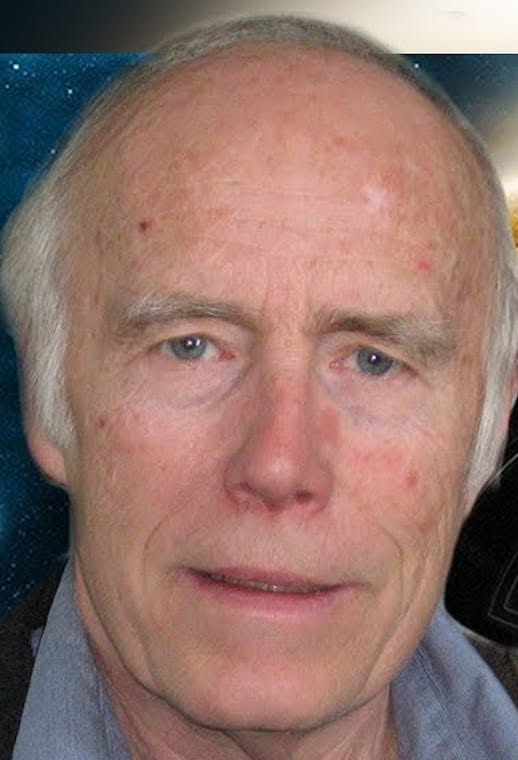
Photograph of Bruce Maccabee by Jacques Poulet, licensed under CC BY-SA 3.0 via Wikimedia Commons. The creator, license and source link should accompany the image wherever it is published.
SEO keywords
Bruce Maccabee, Bruce Maccabee optical physicist, Bruce Maccabee biography, UAP photo analysis, UAP photometry, UAP photogrammetry, UAP image forensics, McMinnville Trent photographs, McMinnville UAP analysis, Kaikōura Lights, New Zealand UAP sightings, Japan Airlines Flight 1628, JAL 1628 UAP case, Gulf Breeze sightings, Ed Walters photographs, radar visual UAP cases, UAP witness testimony, UAP sensor correlation, multimodal UAP evidence, UAP chain of custody, NICAP investigator, MUFON researcher, Fund for UFO Research, UAP archival research, experiencer researchers, UAP claims taxonomy, scientific UAP investigation, Bruce Maccabee publications, UAPedia