
Few UAP investigators have been as willing as Allan Hendry to disappoint everyone at once.
To committed critics, he left too many reports unresolved. To advocates of extraordinary explanations, he identified far too many as planets, aircraft, advertising displays and other familiar objects. Yet Hendry’s refusal to satisfy either camp is precisely what makes his work important.
He investigated witnesses without treating them as gullible. He searched for conventional explanations without assuming that every report must have one. He accepted testimony as evidence of what a person experienced and reported, but he did not confuse sincerity with perfect perception. Above all, he recognized that “unidentified” describes the status of an investigation, not necessarily the nature or origin of an object.
That sounds like an obvious distinction. In practice, it is one of the hardest rules in UAP research to maintain.
Hendry’s career in the subject was relatively brief, concentrated mainly between 1976 and 1981. His impact, however, remains visible wherever investigators discuss witness reliability, misidentification, radar correlation, hypnosis, missing information, database quality and the need to preserve original records.
His enduring question was simple: when a witness describes something extraordinary, how do we determine what happened without dismissing the witness or overstating the evidence?
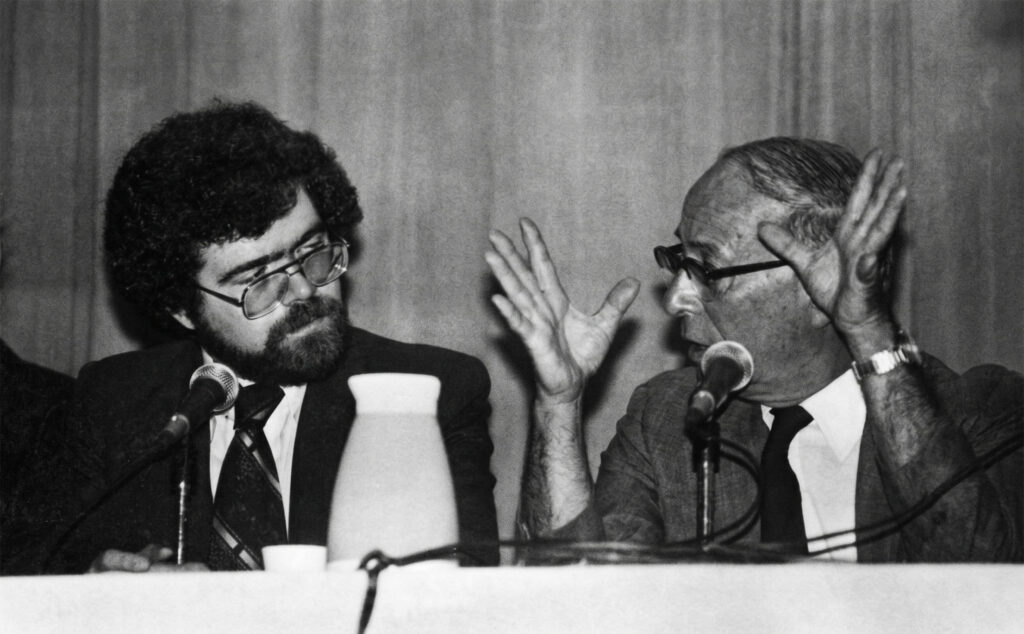
An investigator built for uncomfortable questions
Allan Hendry entered UAP research through the Center for UFO Studies, better known as CUFOS, the civilian research organization established by astronomer J. Allen Hynek.
Hendry studied astronomy at the University of Michigan and worked as a commercial artist. Contemporary biographical accounts differ over whether his astronomy studies constituted a minor or formed part of a degree combining astronomy and illustration, so the broader description is the safer one.
The combination was unusually well suited to field investigation. Astronomy helped him reconstruct what was visible in the sky. His visual background helped him translate witness descriptions of shapes, lights, angles and apparent movement into diagrams that could be examined.
He first met Hynek in 1972 and later assisted with research and publication work. In 1976, CUFOS hired him as its chief investigator. He also became managing editor of the International UFO Reporter, or IUR, which began publication under that title in November 1976. Contemporary issues identify Hendry as managing editor and Hynek as editor-in-chief. (Center for UFO Studies, 1977, p. 2)
The job placed Hendry at the receiving end of reports from members of the public, law-enforcement personnel, journalists, observatories, aviation facilities and civilian research groups. CUFOS operated a reporting system intended to obtain information quickly, while memories were still fresh and potentially relevant records might still exist.
This was long before smartphone video, satellite-tracking applications and public access to detailed aviation data. An investigator had to reconstruct events through telephone interviews, maps, astronomical charts, airport inquiries, weather reports and repeated questioning.
Even apparently simple details could be difficult to establish. Witnesses might remember that an event occurred “around ten” but not whether that meant 9:45 or 10:20. They might point toward “the north” when the actual direction was northwest. A light described as moving could have been stationary while the observer’s vehicle turned. A supposedly enormous object might have been a bright light whose distance was unknown.
Hendry became interested not only in reports that resisted explanation, but also in the mechanisms that allowed ordinary objects to become extraordinary experiences.
That decision shaped his career.
The investigation of 1,307 reports
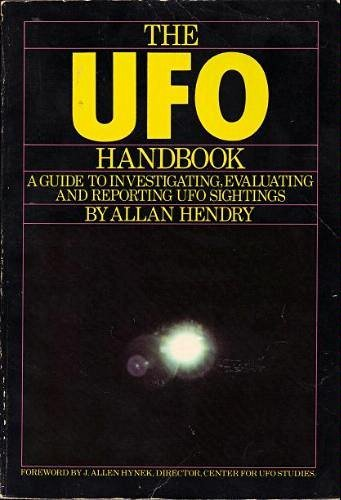
The statistical foundation of Hendry’s work was a collection of 1,307 reports investigated during approximately fifteen months, beginning in 1976. Hendry summarized the sample in The UFO Handbook, and sociologist Ron Westrum cited page 22 of the 1979 Doubleday edition when discussing Hendry’s finding that approximately 89 percent of the reports received prosaic identifications. (Hendry, 1979, p. 22; Westrum, 1982, pp. 381–400)
In addition to the identified cases, Hendry discussed 113 reports that resisted the conventional explanations available to him. A further residual group was placed outside a simple identified-versus-unidentified comparison because the information was inadequate, contradictory or otherwise unreliable.
The distinction matters because rounded percentages do not account for every case in the sample. The 113 reports were not literally every report left over after the identified cases. They were the reports Hendry considered sufficiently developed to discuss as unresolved.
In Chapter 9, he separated them according to evidentiary strength and the degree to which ordinary explanations had been excluded. His historical category names were “Near IFOs,” “Problematic UFOs,” “Good UFOs” and “Best UFOs.”
A contemporary review of the book reported that only twenty of the 1,307 cases entered Hendry’s highest category. Fourteen were nocturnal lights, four were daylight objects and two were close encounters of the first kind. Those twenty represented approximately 1.5 percent of the full sample. The same review reported Hendry’s finding that at least 93 percent of submitted nocturnal-light reports, approximately 80 percent of daylight-object reports and nearly 80 percent of close encounters of the first kind had received conventional identifications. (Klass, 1980, pp. 83–84)
Those numbers are often used to support two incompatible conclusions.
One conclusion is that because most reports were identified, the UAP question was effectively settled. That interpretation goes beyond Hendry’s findings. A high identification rate demonstrates that ordinary objects generate a large volume of unusual reports. It does not establish the nature of every report that remains after investigation.
The opposite conclusion is that the unresolved fraction demonstrates an exotic or non-human origin. Hendry did not support that leap either. An unresolved report may involve a genuinely unfamiliar phenomenon, but it may also remain unresolved because the witness supplied an incorrect time, the investigator arrived too late, radar data were not preserved, an aircraft record was unavailable or the information was simply insufficient.
For Hendry, “unresolved” was a legitimate result. It was not a destination.
Why solved cases were scientifically valuable
Many investigators are drawn toward the most dramatic reports, especially those involving close encounters, physical effects, missing time or apparent entities. Hendry spent an unusual amount of effort studying reports that had been solved.
He understood that identified cases formed a comparison group.
A witness might describe a silent, domed object that paced a vehicle and appeared to be only a few hundred feet away. Taken alone, the description sounds detailed enough to exclude a star, planet or aircraft. Yet other sincere witnesses have supplied equally detailed descriptions of confirmed advertising aircraft, astronomical bodies, balloons and conventional planes.
The lesson is not that witnesses habitually lie. The lesson is that human perception does not function like a calibrated sensor.
When distance is unknown, physical size cannot be reliably estimated. A bright light against a dark sky lacks familiar visual reference points. Autokinesis can make a stationary light appear to drift or dart. Atmospheric turbulence can cause stars and planets to flash in changing colors. An aircraft approaching nearly head-on may appear motionless before seeming to accelerate sideways as its angle changes.
Hendry explored these problems in the June 1978 IUR article “The Case for IFO Study: A Recent Example.” The article appeared on printed pages 5 through 7. He described how observers could infer structures between separate lights, perceive motion that was not present and add visual details to an initially ambiguous stimulus. (Hendry, 1978a, pp. 5–7)
In one case later discussed in The UFO Handbook, a witness reported what appeared to be a structured object with faces and rounded heads. Her husband’s description was less elaborate and resembled a star-like source. By reconstructing the viewing direction and celestial conditions, Hendry identified Venus as the probable stimulus.
The principal witness rejected the identification.
This is where Hendry’s approach becomes especially relevant to experiencer research. A witness can be truthful about what they remember seeing while remaining mistaken about the source. Investigators should therefore distinguish between honesty, perceptual accuracy and interpretation.
Those are three separate questions.
A handbook rather than a catalogue of marvels
Hendry’s principal publication, The UFO Handbook: A Guide to Investigating, Evaluating, and Reporting UFO Sightings, was published by Doubleday in 1979. The first edition contained 297 pages, including a short bibliography. Bibliographic records describe it as an examination of verification, perceptual error, reporting and investigative methodology rather than a general collection of famous cases. (Google Books; Open Library)
The book examined nocturnal lights, daylight objects, close encounters, radar, photography, physical traces, hypnosis, polygraphs, witness interviews and statistical analysis. Hendry repeatedly returned to one concern: investigators were collecting reports faster than they were learning how reports were produced.
That problem was not merely technical. It affected the conclusions that could responsibly be drawn from experiencer testimony.
A person who reports a frightening encounter may be sincere, observant and psychologically affected. None of those facts automatically determines the origin of the experience. Conversely, an investigator who identifies one portion of a report does not necessarily explain every aspect of it.
Hendry’s method demanded that each element be tested independently.
Stanford, Kentucky: testimony, hypnosis and memory
The Stanford, Kentucky case illustrates both the importance of first-hand testimony and the risks created when later investigative procedures are treated as direct observation.
On January 6, 1976, Elaine Thomas, Louise Smith and Mona Stafford were travelling by car near Stanford, Kentucky. According to the contemporary CUFOS account, they reported that a domed luminous object descended toward treetop level. The women said the vehicle accelerated unexpectedly and that their next clear recollection placed them several miles farther along their route. They subsequently reported physical discomfort and an interval they could not account for.
The case was described in “UFO Progress Report: Stanford, Kentucky,” published in the March 1977 issue of the International UFO Reporter. The report identified Leonard Stringfield as an investigator and discussed work by psychologist and hypnotist R. Leo Sprinkle and polygraph examiner James Young. (Center for UFO Studies, 1977, pp. 3–7)
During separate regression-hypnosis sessions, the women described being taken into a large object and examined by small humanoid figures. The published account also discussed reported eye irritation, skin effects and unusual behavior involving a watch and vehicle lights.
These elements should not be assigned equal evidentiary weight.
The women’s initial report of a luminous roadside encounter, apparent acceleration, disorientation and an unaccounted interval existed before the detailed hypnotic narratives. The onboard examination material emerged later through hypnosis, a procedure that can intensify imagery, confidence and emotional response but cannot independently authenticate the historical accuracy of the resulting account.
Polygraph examiner James Young reportedly concluded that the women appeared to believe they had experienced a UAP encounter. He also cautioned that earlier discussions and interviews could have influenced what they believed.
That qualification is essential. A polygraph does not determine whether an object existed or whether a medical examination occurred. It measures physiological responses under controlled questioning. A sincere belief can produce a sincere physiological response even when parts of the underlying memory are mistaken or reconstructed.
CUFOS later published “Are UFO Abduction Cases Accurately Recalled Under Hypnosis?” in the April 1978 IUR. The discussion warned that hypnosis can produce confident accounts of events that did not occur and urged investigators to use the technique cautiously. The article was subsequently cited in the Journal of UFO Studies. (Hendry, 1978b; Sprinkle, 1979, p. 108)
This does not mean that the Stanford witnesses fabricated their experience. Three named women described a disturbing event and continued to interpret it as an abduction. Their testimony belongs in the record. What remains uncertain is which later details originated in the initial event, which developed through memory reconstruction and which may have been shaped by questioning or shared interpretation.
Evidence
Three named witnesses reported a shared roadside incident involving a luminous object, unusual vehicle behavior, physical discomfort and an apparently unaccounted interval. Their claims were documented by contemporary investigators.
Witness Interpretation
The witnesses came to believe that they had been taken aboard an object and subjected to examinations by non-human beings.
Researcher Opinion
Stringfield and Sprinkle considered the case significant and regarded the witnesses as sincere. Young’s polygraph assessment supported sincerity while explicitly allowing for the possibility that previous interviews had influenced their beliefs.
Hypothesis
The initial event may have involved a physical aerial anomaly, an unusual environmental or psychological episode, or a combination of external stimulus and later memory reconstruction. The detailed abduction sequence may represent accurate recollection, hypnotic elaboration or a mixture of both.
Claims classification: Disputed. The witnesses and their report are documented. The physical origin of the roadside event and the historical accuracy of the hypnotically recovered examination narrative remain unresolved.
Ocala, Florida: when radar appears to confirm the eye
On May 14, 1978, personnel at the Pinecastle Electronic Warfare Range Tracking Station near Ocala, Florida, became involved in an observation after civilians asked whether a multicolored light was connected with Navy parachute flares.
Approximately a dozen people at or associated with the facility reportedly observed the light. The witnesses included air-control personnel, duty officer Robert Clark and radar operator Timothy Collins. The event was published under the title “Navy Radar-Visual in Florida” beneath the heading “UFO of High Merit” in the June 1978 International UFO Reporter. (Hendry, 1978c, pp. 4–5)
Visually, the source was generally described as a brilliant, flashing or multicolored light. Through binoculars, some witnesses thought it resolved into a compact grouping of lights. Collins also reported radar returns during the observational period, including a target that appeared in the general direction of the visual source.
The case initially appeared to contain the combination investigators most desire: multiple witnesses and instrumental support.
Hendry nevertheless identified major limitations. The observers had not maintained a precise synchronized timeline. The original report stated that reconstructing the chronology was nearly impossible because none of the Navy witnesses had recorded precise times or durations. The initial direction of the visual source raised possible astronomical candidates, particularly Venus and Jupiter, which were visible low in the sky. Witnesses later said that they could distinguish the planets from the unknown light, but the positional reconstruction depended partly on recollection after the event.
The radar evidence was also less straightforward than the phrase “radar confirmed” suggests. Investigators needed to determine whether a radar target was present at precisely the same time and bearing as the visual source, whether it represented the same object and whether calibration artifacts, false targets or unrelated returns had been excluded.
A September 1978 IUR update stated that a radar printout contained a possible target executing a sharp reversal, but emphasized that better witness-time estimates were required before the return could be separated from the many coincidental false targets on the record. (Hendry, 1978d, p. 8)
Philip J. Klass later argued that the visual observation could be explained by astronomical objects and that the radar circumstances had been overstated. Robert Sheaffer likewise challenged the radar-visual interpretation. Hendry rejected aspects of these reconstructions, and a dispute developed concerning interviews with Collins, the handling of recordings and whether different investigators had received materially different accounts. (Klass, 1980, pp. 83–85)
The controversy reveals why sensor evidence must be interpreted, not merely invoked.
Radar provides measurements, but those measurements emerge from a particular system operating in a particular mode. A return may represent an aircraft, weather, birds, anomalous propagation, electronic interference, equipment behavior or a physical target that has not been identified. Unless the radar and visual records are synchronized, their apparent agreement may be coincidental.
Evidence
Multiple witnesses reported a luminous object. A radar operator reported one or more returns during the broader period of the observation.
Witness Interpretation
The personnel believed the light was neither an ordinary flare nor a familiar aircraft. Some interpreted the radar return as confirmation of the visible source.
Researcher Opinion
Hendry considered the report potentially significant but documented weaknesses involving timing, astronomy and radar correlation. Klass and Sheaffer argued that planetary sources and radar conditions substantially reduced its evidentiary value.
Hypothesis
The incident may have combined a bright astronomical source with unrelated or ambiguously correlated radar returns. Alternatively, a physical aerial object may have been observed visually and detected by radar. The surviving public material does not establish a sufficiently precise correlation to decide between those possibilities.
Claims classification: Disputed. The witnesses and radar report are documented. The identity of the visual source and its relationship to the radar returns remain contested.
Val Johnson: a damaged patrol car without an identified cause
Shortly after 1:40 a.m. on August 27, 1979, Marshall County sheriff’s deputy Val Johnson was driving on a rural Minnesota road when he noticed a light near the roadway.
Johnson initially considered the possibility that an aircraft had made an emergency landing. He turned toward the light to investigate. He then reported that the light rapidly approached or entered his field of view, glass broke and he lost consciousness.
When Johnson regained awareness, his patrol car was damaged and had travelled several hundred feet before stopping across the roadway. The windshield was cracked, two antennas were bent, a headlight and emergency light were damaged, and the hood was dented. Johnson suffered eye irritation and a head injury. His wristwatch and the vehicle’s clock were reported to differ from the expected time by approximately fourteen minutes.
The Minnesota Historical Society notes that Johnson never claimed to have seen aliens or a spacecraft. He described a light and an unidentified force or object. The damaged patrol car and associated records were preserved by the Marshall County Historical Society. (Minnesota Historical Society, 2021)
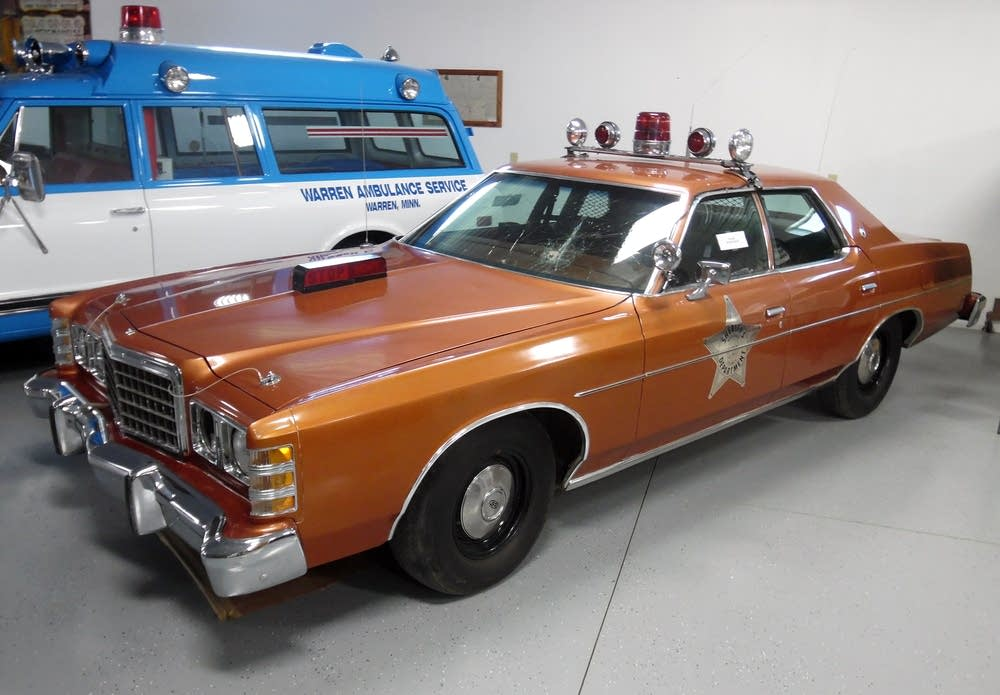
CUFOS investigator Guy Westcott recorded Johnson’s testimony on September 4, 1979, and Hendry later examined the case. Engineers and technical specialists inspected the vehicle. Honeywell engineer Roland Wardell reportedly concluded that no single familiar mechanism accounted neatly for all the damage and suggested that some features were consistent with an electrical field. Other researchers considered ball lightning or an unusual electrical phenomenon.
The case remains compelling because it left more physical material than most close-encounter reports. Yet the material does not identify its own cause.
A cracked windshield establishes that the windshield was damaged. Bent antennas establish that forces acted upon them. Johnson’s injuries establish that he experienced a consequential incident. None of those observations independently proves that a single aerial object caused every effect.
This is not a weakness unique to the Johnson case. It is a general rule of physical-trace investigation. Evidence of an effect must not be silently converted into evidence of origin.
Evidence
Johnson made a prompt report, received medical attention and was associated with a visibly damaged patrol car. Investigators documented the vehicle, scene and reported injuries. The car and substantial portions of the case record were preserved.
Witness Interpretation
Johnson believed that a luminous, unidentified force or object had struck or enveloped the patrol car. He did not claim to have observed occupants or identify the source as non-human technology.
Researcher Opinion
Hendry found no single explanation that satisfactorily accounted for the entire report. Technical examiners discussed electrical mechanisms, while other researchers proposed ball lightning, an ordinary accident or deliberate fabrication.
Hypothesis
An unusual electrical or plasma event may have interacted with the vehicle. A physical technological object may have been involved. It is also possible that separate ordinary mechanisms produced different portions of the damage and experience.
Claims classification: Verified for the report, injuries and vehicle damage; Disputed for causation. The surviving evidence establishes that a consequential incident occurred. It does not identify the light or demonstrate that one unknown agent caused every reported effect.
The controversy surrounding Hendry
Hendry’s critics came from opposing directions.
Some UAP advocates believed he placed excessive emphasis on misidentification and witness error. Because he identified most reports, his work could be interpreted as weakening the argument that UAP observations represented extraordinary technology.
Prominent critics had a different objection. Philip J. Klass praised The UFO Handbook as one of the most useful books published on the subject, but challenged Hendry’s treatment of particular cases, especially Ocala. Klass argued that unresolved reports should not be treated as evidence of genuinely anomalous objects when incomplete information or investigator error could remain.
Ronald Story also praised the book as an important methodological contribution. The result was unusual: a book produced inside a leading civilian UAP organization received substantial approval from critical reviewers precisely because it documented the scale of misidentification. (Klass, 1980, pp. 81–85; Story, 1980, pp. 85–87)
Yet Hendry stopped short of the conclusion those reviewers might have preferred. He did not argue that every unresolved case was merely an unidentified conventional object. He maintained that a small residue remained worthy of investigation, while acknowledging that the evidence did not establish a common source.
At a Smithsonian Resident Associates symposium in Washington on September 6, 1980, Hendry discussed an Illinois daylight observation involving two families who reported a silver, hat-shaped object moving rapidly near a freeway. Philip Klass responded that a report’s resistance to explanation did not make it scientifically conclusive. Contemporary newspaper coverage appeared in The Washington Post print edition on September 8. (Rohrer, 1980)
The exchange revealed the central tension in Hendry’s work.
Hendry asked what survived careful investigation.
Klass asked what the surviving evidence could prove.
A responsible inquiry requires both questions.
Why Hendry left CUFOS
Hendry’s departure from public UAP research is sometimes described as disillusionment. His own account was more practical.
In “A Special Note From Allan Hendry,” published in the March–April 1981 issue of the International UFO Reporter/Frontiers of Science, Hendry wrote that he was ending nearly five years as chief investigator and editor because CUFOS could no longer maintain salaried employees. He needed to move into other full-time work, although he intended to continue writing about science. (Hendry, 1981, p. 2)
The episode exposes a recurring weakness in civilian UAP research.
Serious investigation requires trained interviewers, travel, record preservation, technical consultants, secure archives and rapid access to information. Yet the field frequently relies on unpaid volunteers while demanding results comparable to those of well-funded scientific or law-enforcement institutions.
By the time an investigator reaches a witness, radar recordings may have been overwritten, weather data dispersed, physical traces disturbed and memories reshaped through discussion. The loss of information can turn a potentially resolvable event into a permanent mystery.
Hendry did not merely study unidentified events. He documented the infrastructure required to investigate them.
Hendry and official UAP studies
Hendry’s overall identification rate resembled the majority-identified pattern reported by earlier official projects, but his practical conclusions differed.
The United States Air Force stated that Project Blue Book received 12,618 reports between 1947 and 1969, of which 701 remained classified as unidentified. The Air Force concluded that its investigations had found no evidence of a national-security threat, technology beyond contemporary scientific knowledge or extraterrestrial vehicles. Those statements represent the Air Force’s institutional conclusions. They do not independently determine the cause of every individual report. (National Archives and Records Administration)
The University of Colorado study, commonly called the Condon Report, concluded that further large-scale study was unlikely to produce major scientific discoveries.
The National Academy of Sciences reviewed the Colorado project separately. Its panel stated that approximately 90 percent of reports could plausibly be associated with ordinary phenomena, while acknowledging that a positive familiar identification could not be made in every case. The panel considered the project’s methods generally appropriate to the evidence examined and supported its broad conclusions. (National Academy of Sciences, 1969, pp. 1–6)
These institutional findings should not be blended together. The Colorado project produced the individual case studies and principal conclusions. The National Academy panel assessed the project’s methodology and overall findings. Neither process established that every unresolved report had an ordinary cause.
Hendry agreed with the official studies on one central point: most incoming reports could be associated with familiar phenomena.
He differed in what he believed should follow from that result. Rather than treating the unresolved residue as irrelevant, he argued that investigators needed better methods for distinguishing unusual misperception from genuine anomaly.
A methodology that anticipated modern recommendations
NASA’s 2023 independent UAP study emphasized that analysis was hindered by poor sensor calibration, missing metadata, incomplete baseline information and the lack of multiple synchronized measurements. The report recommended systematic reporting, calibrated instruments, improved data collection and reduced stigma surrounding witnesses. (NASA, 2023, pp. 15–27)
Hendry’s work anticipated many of these recommendations.
He emphasized accurate times, viewing directions, angular measurements, observer movement, weather conditions and comparison with astronomical and aviation data. He warned that radar reports were meaningful only when system characteristics and timing were understood. He treated witness interviews as a source of data that could be improved or contaminated depending on the investigator’s methods.
The similarity does not establish a direct chain of influence between Hendry and NASA’s study team. It does show that modern UAP research continues to confront the same evidentiary problems he described in 1979.
More reports do not automatically create better knowledge.
Better knowledge comes from better-preserved reports.
For visual observations, this means documenting exact time, position, viewing direction, angular elevation, duration and environmental conditions. For photography, it means preserving original files and metadata. For radar, it means retaining raw returns, system configuration, calibration records and operator notes. For experiencer cases, it means recording the earliest unprompted account before hypnosis, group discussion or exposure to media narratives.
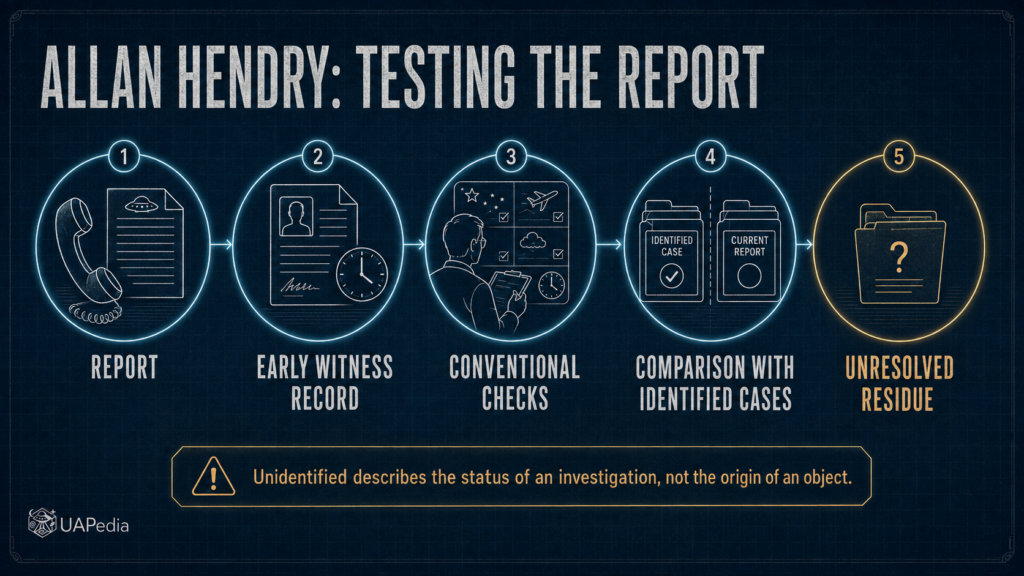
What Hendry offers experiencer research
Hendry is not primarily remembered as an abduction researcher. He did not build a theory around recurring entity descriptions, reproductive themes or alleged contact messages. His importance lies deeper, at the level of method.
Experiencer research is vulnerable to the collapse of distinct evidentiary categories. A witness’s emotional distress may be interpreted as proof of a physical abduction. Similar stories may be presented as proof of a common external source. A polygraph result may be mistaken for verification. A scar may be linked to an encounter without medical documentation establishing when or how it formed.
Hendry’s approach allows investigators to take the person seriously without automatically certifying the person’s explanation.
Testimony is evidence that someone reported an experience. Early, independently recorded testimony carries more weight than a narrative developed after repeated interviews. Multiple witnesses can strengthen a case, but only when their accounts were obtained independently. Physical effects add a separate evidentiary stream, but those effects must be dated, documented and connected to the event rather than merely assumed to be connected.
Convergence matters. Independence matters. Timing matters.
An ethical investigator should preserve the earliest account, avoid leading questions, document prior exposure to UAP narratives and keep witnesses from comparing details before separate interviews are completed. Medical claims should be examined by qualified professionals. Hypnosis should never be presented as a machine for recovering objective recordings of the past.
Witness care and evidentiary discipline are not opposites. A person can be supported through fear, confusion or ontological shock without being told that a particular interpretation has been proven.
Hendry’s lasting impact
Hendry’s public career as a full-time UAP investigator lasted only a few years, but The UFO Handbook remains one of the clearest demonstrations of why UAP investigation is harder than collecting unusual stories.
His most important contribution was not the statement that most reports had ordinary explanations. Earlier official projects had already reached similar statistical conclusions.
His contribution was showing how those explanations were found and why a remaining unknown could not safely be forced into either a conventional or extraordinary category.
He asked the question “Do you believe the witness?” with several more useful ones.
What did the witness report?
What was the witness in a position to observe?
Which details were recorded before later discussion?
What can be independently corroborated?
Which conventional causes were tested under the actual conditions?
What remains after uncertainty is stated openly?
These questions resemble the way testimony is assessed in other evidentiary settings. Courts do not assume that every sincere witness is perfectly accurate, nor do they discard testimony simply because perception can fail. They consider opportunity to observe, consistency, prior statements, corroboration, motive and compatibility with physical evidence.
Hendry brought the same discipline to UAP.
He demonstrated that open-mindedness is not measured by how many cases an investigator declares extraordinary. It is measured by a willingness to follow evidence in either direction. A capable investigator must be able to identify Venus without insulting the witness and preserve an unresolved case without pretending to know its origin.
That balance remains rare.
It is also indispensable.
Implications
Hendry’s work implies that the central problem in UAP research is not simply a shortage of reports. It is a shortage of reports gathered under conditions that permit decisive analysis.
His record also suggests that identified and unidentified cases should not be treated as opposing bodies of evidence. Identified cases teach researchers how perception, memory and circumstance transform ordinary stimuli. Unresolved cases test whether those lessons are sufficient.
For contact and abduction research, the implication is especially important. The more extraordinary the claim, the more carefully investigators must preserve the distinction between the initial experience and its later interpretation. Hypnosis, repeated interviews, group discussion and media exposure can alter a narrative even when everyone involved is sincere.
At the same time, a high rate of misidentification does not justify automatic dismissal. A small residue of reports may contain information about rare atmospheric processes, unknown technological activity, unusual psychological states, sensor effects or phenomena not yet understood.
The proper response is neither belief nor rejection.
It is a better investigation.
Claims taxonomy
Verified
Allan Hendry served as CUFOS chief investigator and as managing editor or editor of the International UFO Reporter during the late 1970s and into 1981.
His 1979 book, The UFO Handbook, was published by Doubleday and contained 297 pages.
Hendry’s principal study involved 1,307 reports. Approximately 89 percent received conventional identifications. Another 113 sufficiently developed reports resisted the conventional explanations available to him, while a further residual group was not usable within a simple identified-versus-unidentified comparison. Twenty cases entered his highest category, including fourteen nocturnal lights, four daylight objects and two close encounters of the first kind.
The Stanford, Ocala and Val Johnson reports were documented within the CUFOS investigative environment during Hendry’s tenure.
Probable
Hendry’s recommendations anticipated many later proposals involving structured reporting, calibrated sensors, preserved metadata, independent corroboration and disciplined witness interviewing.
His investigation strengthened the methodological distinction between a witness’s sincerity, the accuracy of the reported perception and the interpretation placed upon it.
Disputed
The nature of Hendry’s twenty highest-rated cases remains disputed. Their resistance to the explanations available at the time does not establish a common source.
The Stanford abduction interpretation remains disputed because its detailed onboard narrative was developed through hypnosis and after repeated investigative contact.
The Ocala case remains disputed because the visual observation and radar returns were not preserved with sufficient synchronization to establish that they represented the same target.
The cause of the Val Johnson incident remains disputed despite the documented report, injuries and vehicle damage.
References
Google Books. (n.d.). The UFO handbook: A guide to investigating, evaluating, and reporting UFO sightings. Bibliographic record.
Center for UFO Studies. (1977, March). UFO progress report: Stanford, Kentucky. International UFO Reporter, 2(3), 3–7. Archived issue.
Hendry, A. (1978a). The case for IFO study: A recent example. International UFO Reporter, 3(6), 5–7. Archived issue.
Hendry, A. (Ed.). (1978b, April). Are UFO abduction cases accurately recalled under hypnosis? International UFO Reporter, 3(4).
Hendry, A. (1978c). Navy radar-visual in Florida. International UFO Reporter, 3(6), 4–5. Archived issue.
Hendry, A. (1978d, September). Ocala radar-visual case update. International UFO Reporter, 3(9), 8. Archived issue.
Hendry, A. (1979). The UFO handbook: A guide to investigating, evaluating, and reporting UFO sightings. Doubleday.
Hendry, A. (1981). A special note from Allan Hendry. International UFO Reporter/Frontiers of Science, 3(3), 2. Archived issue.
Klass, P. J. (1980). Review of The UFO Handbook. The Skeptical Inquirer, 4(2), 81–85. Archived review symposium.
Minnesota Historical Society. (2021). Val Johnson incident, 1979. MNopedia.
National Academy of Sciences. (1969). Review of the University of Colorado report on unidentified flying objects. National Academy of Sciences. Archived report.
National Aeronautics and Space Administration. (2023). Unidentified Anomalous Phenomena Independent Study Team Report. NASA Science.
National Archives and Records Administration. (n.d.). Project BLUE BOOK: Unidentified flying objects. National Archives.
Open Library. (2023). The UFO handbook. Bibliographic record.
Rohrer, S. (1980, September 8). Tempest in a saucer: The Smithsonian’s symposium on UFOs. The Washington Post, B1. Archived article.
Sprinkle, R. L. (1979). Psychological aspects of UFO abduction reports. Journal of UFO Studies, 1, 101–108. Archived volume.
Story, R. (1980). Review of The UFO Handbook. The Skeptical Inquirer, 4(2), 85–87. Archived review symposium.
Westrum, R. (1982). Social intelligence about hidden events: Its significance for scientific research and social policy. Knowledge: Creation, Diffusion, Utilization, 3(3), 381–400. Publisher record.
SEO keywords
Allan Hendry, Allan Hendry UAP investigator, The UFO Handbook, CUFOS chief investigator, Center for UFO Studies, International UFO Reporter, J. Allen Hynek, UAP investigation methods, experiencer research, UAP witness testimony, witness reliability, identified aerial phenomena, UAP misidentification, Stanford Kentucky abduction, regression hypnosis and UAP, Ocala radar visual case, Val Johnson incident, physical trace UAP cases, radar UAP evidence, UAP data standards, civilian UAP investigation, UAP reporting protocols, contact and abduction research, polygraph evidence, missing time investigation, multi-witness UAP testimony, UAP case methodology, UAP cognitive bias, UAP sensor correlation, unresolved UAP reports, historical UAP investigators