Across decades of contact testimony, witnesses have described words without sound, emotionally charged images, sudden commands and entire “packets” of meaning. The experience is extensively represented in the literature. The identity of the supposed communicator, and even whether an external communicator was present, remains one of the most difficult questions in UAP research.

The message that never becomes sound
Telepathy in a UAP encounter rarely resembles an ordinary telephone conversation playing inside someone’s head. Witnesses more often describe something less familiar: meaning arriving already assembled.
There may be no audible voice, no visible movement of an entity’s mouth and no obvious sensory route through which information could have travelled. Yet the witness feels that a message has been received. Sometimes it appears as an instruction such as “do not be afraid” or “come with us.” Sometimes it arrives through images. In other reports, the communication is primarily emotional, producing calm, dread, paralysis, familiarity or an overwhelming concern for the future of the planet.
Experiencers often call this telepathy because everyday language offers few alternatives. The word can nevertheless conceal several different types of experience.
One person may be describing inner speech that seemed to come from elsewhere. Another may report a vivid mental image coinciding with the appearance of a UFO. A third may describe an unspoken exchange with an apparently nonhuman figure. Someone else may suddenly acquire a powerful conviction without being able to explain how it arose.
These experiences should not automatically be treated as one phenomenon simply because witnesses use the same label.
The distinction between experience and explanation is crucial. A reported experience may be sincere, accurately remembered in broad outline and profoundly consequential without establishing its ultimate cause. The witness may be certain that something happened while remaining uncertain about whether it arose from an external intelligence, an unusual neurological condition, memory reconstruction, expectation, an unfamiliar technology or a combination of factors.
The public evidence is therefore uneven. There is substantial documentation showing that people report communication without ordinary speech in UAP encounters. There is also a disputed experimental literature concerning anomalous information acquisition. The sources reviewed for this article did not identify a publicly documented UAP case in which the alleged sender, receiver, message and transmission process were all independently recorded under controlled conditions.
That finding does not make witness testimony meaningless. It defines the present evidential boundary.
What witnesses mean by telepathy
Telepathic contact claims exist along a spectrum.
At one end is speech-like communication. The witness perceives recognisable words but says the sound did not enter through the ears. At the other end is what experiencers sometimes call a “download,” in which a large body of information appears to arrive at once. The person may require days or years to translate the experience into ordinary language.
Between those extremes are visual sequences, symbolic impressions, emotional modulation and what might be called imposed certainty. An experiencer may not receive a sentence. Instead, the person suddenly “knows” that an entity is peaceful, that a UAP will return, that humanity is damaging the planet or that a particular action must be taken.
Some accounts describe an exchange. A witness mentally forms a question and perceives an immediate response. Others describe one-way influence, with the experiencer feeling watched, scanned, calmed, paralysed or compelled. Still others report that the communication seemed to originate from the UAP itself rather than from a visible occupant.
Terms such as “psionics,” “consciousness interface” and “mind-to-mind communication” are sometimes used to group these reports. They are descriptive categories, not established mechanisms. For related discussion, see UAPedia’s article on psionics and the consciousness interface.
A word born before the modern UAP era
The language of telepathy entered organised investigation long before the modern UAP era.
Frederic W. H. Myers, a founding member of the Society for Psychical Research, introduced the term during the early 1880s while researchers were attempting to examine apparent thought transference, apparitions and related experiences. The Society, established in 1882, created committees to investigate what was initially called thought-reading. “Telepathy” gradually became the more familiar term.
From its beginning, the subject occupied an unstable position between testimony, experiment, spiritual interpretation and scientific criticism. The Society for Psychical Research’s historical account and the Psi Encyclopedia biography of Myers describe this early development.
Religious and visionary traditions contain much older accounts of transmitted knowledge, prophetic dreams, divine voices and communication with nonhuman beings. These narratives offer important cultural parallels, but resemblance alone does not demonstrate that ancient people were reporting the same process described in modern UAP encounters. Such accounts should first be understood within the religious and cultural systems that preserved them.
The connection between telepathy and UAP became especially prominent during the contactee era of the 1950s. Writers such as Orfeo Angelucci described encounters in which advanced beings allegedly communicated philosophical and cosmic ideas. Angelucci’s 1955 book, The Secret of the Saucers, helped position mind-to-mind communication as a presumed capability of intelligence more advanced than humanity.
The supposed messages were usually moral rather than technical. Contactees reported warnings about nuclear weapons, human aggression, materialism and environmental destruction. This created an enduring feature of contact literature: the alleged communicator was not merely introducing itself. It was judging civilization.
That theme remains visible in later abduction accounts, school encounters and consciousness-based contact practices.
Case study: Betty and Barney Hill
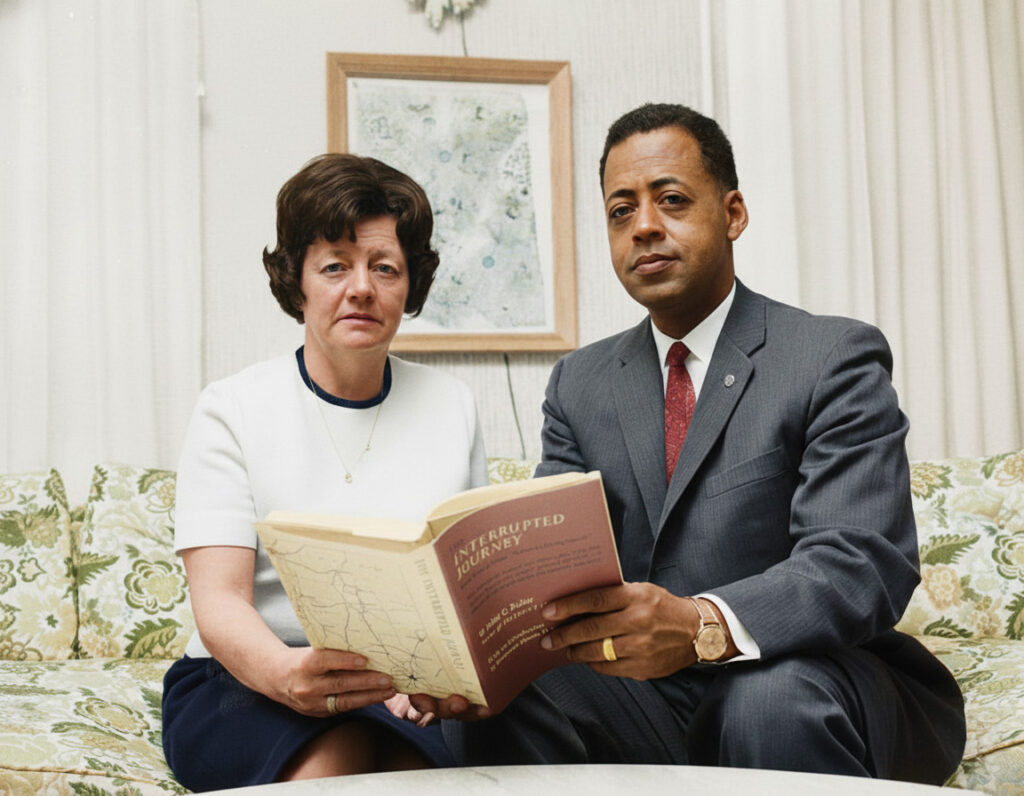
Betty and Barney Hill in 1966 for the release of The Interrupted Journey by John G. Fuller (UNH Archive | UAPedia)
The Betty and Barney Hill case became one of the earliest influential abduction narratives of the modern UAP era.
On the night of 19–20 September 1961, the Hills were travelling through New Hampshire when they reported observing a luminous object that appeared to follow or monitor their vehicle. They later became concerned about an apparently unexplained portion of the journey and a period of missing time.
The Hills subsequently underwent hypnosis sessions conducted by psychiatrist Benjamin Simon. During those sessions, both described an encounter involving unfamiliar figures and medical-style examinations aboard an apparent craft. The communication elements commonly associated with the case derive largely from these hypnotic narratives and later publications, particularly John G. Fuller’s 1966 book, The Interrupted Journey.
The University of New Hampshire holds the Betty and Barney Hill Papers, 1961–2006, which include correspondence, research material, photographs, notes and records associated with the case. The collection verifies the existence, development and investigation of the Hills’ claims. It does not independently verify that a telepathic exchange occurred.
Because many communication details emerged under hypnosis, the method is a central evidential limitation. Hypnosis can facilitate extended narration, but it is not a reliable method for recovering an uncontaminated record of an event. Confidence, imagery and emotional intensity can increase without a corresponding increase in historical accuracy. Questions, assumptions and later information may become incorporated into what feels like memory.
Simon treated hypnosis as a clinical method for investigating the Hills’ distress rather than as a scientific instrument capable of proving that an encounter with nonhuman beings had occurred. In the foreword and concluding discussion reproduced in Fuller’s The Interrupted Journey, Simon remained sceptical of a literal interpretation and considered psychological explanations for the narratives. His position is important because it shows that the clinician conducting the sessions did not regard hypnotically produced material as independent physical verification.
The case cannot fairly be reduced to an accusation of dishonesty. The Hills consistently presented the experience as troubling and consequential, and they submitted themselves to extended clinical examination. What the record establishes most securely is that they reported a disturbing anomalous experience. The source and mechanism of the detailed communication remain disputed.
Case study: Ariel School and the warning in the eyes
On 16 September 1994, pupils at Ariel School near Ruwa, Zimbabwe, reported seeing unusual objects and figures near the edge of the school grounds.
The number of children associated with the incident varies across retellings. Contemporary and later sources frequently refer to more than sixty pupils being present or interviewed, although not every child reported the same observations and not every pupil described a communication experience.
The children produced drawings and participated in recorded interviews. Their accounts contained recurring features, including bright or silvery objects, small dark figures and unusual eyes. The descriptions were not identical, which is expected in a multi-witness event but important when assessing claims of complete uniformity.
Several witnesses later described receiving powerful impressions related to environmental damage, technological danger or humanity’s future. The alleged communication was generally presented not as audible speech, but as a feeling, image or sudden awareness associated with looking at one of the figures.
The chronology matters. Early interview material concentrated heavily on what the children said they had seen. Environmental and telepathic interpretations became especially prominent in later interviews conducted by psychiatrist John E. Mack and in subsequent media accounts. Mack visited Zimbabwe and interviewed a selection of the children approximately two months after the reported event.
Later reporting, including a WHYY feature by Alan Yu, has documented the continuing importance of the event to several witnesses. Their later recollections should nevertheless be distinguished from recordings made closer to September 1994.
A 2024 critical analysis by Gideon Reid, “The Mysterious Events at Ariel School: The Puppet Hypothesis”, argues that interview timing, group discussion and the language used by later investigators may have influenced the telepathic and environmental framing. Reid’s proposed explanation is a critical interpretation rather than a definitive resolution, and it does not establish that the children fabricated the incident.
Children can provide accurate descriptions, particularly when interviewed promptly, separately and without leading questions. They can also be influenced by shared discussion, social reinforcement and suggestive interviewing. Both propositions are relevant to the Ariel case.
The strongest conclusion is layered. The participation of multiple child witnesses, the existence of drawings and recorded interviews, and the long-term impact on several participants are documented. The recorded behaviour and continuing testimony of many witnesses are consistent with sincere belief in what they reported. The conclusion that an external nonhuman intelligence transmitted a warning remains disputed.
Case study: Pascagoula and evidentiary drift
On 11 October 1973, Charles Hickson and Calvin Parker reported that they were taken from a fishing location near Pascagoula, Mississippi, by strange beings and examined inside an unfamiliar craft.
After the men reported the incident to law-enforcement officers, they were left alone in an interview room without realising that a tape recorder remained active. Their private conversation has attracted attention because they continued to express fear and confusion when they apparently believed no investigator was listening.
The University of Southern Mississippi’s archival feature on the recording confirms the circumstances in which it was made. The recording is relevant when evaluating the witnesses’ immediate emotional state and the possibility of a simple rehearsed performance. It does not independently establish that an abduction occurred.
Pascagoula also illustrates how communication labels can drift as a case is retold.
In Hickson’s later oral-history account, recorded in 1979 and preserved by the University of Southern Mississippi, he described an intense “zipping” sound accompanying the craft. He also stated that, while aboard it, he attempted to call out to Parker but could not hear his own voice. These details document sound, impaired speech or altered auditory perception, but they do not document an exchange of thoughts.
The surviving 1973 private recording provides near-contemporaneous evidence of the men’s emotional reactions, while the 1979 oral history preserves Hickson’s fuller description of the event. Neither source, as described by the holding institutions, records an explicit telepathic conversation. Later writers have nevertheless sometimes grouped Pascagoula with telepathic cases because no conventional spoken exchange with the reported beings was described.
Silence is not telepathy. Neither are gaze, paralysis, gesture, buzzing, an inability to hear one’s own voice or an inferred intention.
The larger Pascagoula incident remains disputed, but its communication modality should be classified according to the earliest available testimony rather than assigned retrospectively.
The impact on experiencers
Telepathic contact reports frequently affect witnesses long after the encounter.
Some develop intense concern about ecology, nuclear weapons, spirituality or human unity. Others experience anxiety, disturbed sleep, hypervigilance or a continuing sense of being watched. Relationships may suffer when family members interpret the experience differently. Public witnesses may encounter ridicule, intrusive attention or professional damage.
Several former Ariel School pupils continue to describe the event as formative. Others have disputed parts of the dominant narrative or expressed discomfort with the publicity surrounding it. Long-term impact does not identify the external source of an experience, but it is a legitimate part of the evidence.
Some experiencers undergo what is often called ontological shock: a disruption of foundational beliefs about reality, identity and humanity’s place in the universe. This may be frightening, liberating or both.
Researchers and contact communities have an ethical responsibility not to treat every internal voice or image as an infallible external authority. No alleged communicator should automatically be granted control over a person’s finances, relationships, medical treatment or personal safety. Support should combine respect for the reported experience with protection of individual autonomy.
The publications that created a vocabulary
UAP literature has not merely preserved telepathic claims. It has supplied the language through which later witnesses and investigators understand them.
Angelucci’s The Secret of the Saucers presented contact as morally and spiritually transformative. Fuller’s The Interrupted Journey placed hypnotically narrated communication within an abduction framework. Raymond Fowler’s The Andreasson Affair, published in 1979, described Betty Andreasson’s claimed encounters through a mixture of examination imagery, religious symbolism and communication with apparent nonhuman figures.
John E. Mack’s 1994 book Abduction: Human Encounters with Aliens approached related reports through psychiatry, biography and the possibility that extraordinary experiences might challenge familiar assumptions about consciousness and reality.
These works expanded the available vocabulary. Terms such as “voice in the head,” “download,” “screen memory,” “environmental warning” and “consciousness contact” became recognisable motifs within the field.
This does not establish that later witnesses copied earlier books. Cultural availability is not equivalent to fabrication. It does mean that investigators should ask when a witness first encountered these concepts, which words appeared spontaneously and which were introduced by interviewers, therapists, researchers or media.
A cultural framework can help a person describe a real event. It can also shape the memory and interpretation of an ambiguous one. Those possibilities can coexist.
What laboratory telepathy research shows
The experimental tradition most commonly discussed in relation to telepathy is the ganzfeld procedure, designed to test whether a participant can obtain information about a randomly selected target while ordinary sensory input is reduced.
In a typical study, a receiver rests under uniform visual and auditory stimulation while another participant concentrates on a target image or video. The receiver later compares impressions against several possible targets.
In 1994, psychologists Daryl Bem and Charles Honorton published a review of ganzfeld research and argued that the accumulated findings justified continued scientific investigation. Their paper, “Does Psi Exist? Replicable Evidence for an Anomalous Process of Information Transfer”, reported above-chance results and proposed improved experimental standards.
The debate continued. Julie Milton and Richard Wiseman’s 1999 meta-analysis did not find a significant overall replication across the studies they reviewed. Lance Storm, Patrizio Tressoldi and Lorenzo Di Risio reported a significant aggregate effect in a 2010 meta-analysis of free-response studies. Ray Hyman challenged their study-selection decisions and argued that the literature still lacked sufficiently consistent independent replication. Jeffrey Rouder and colleagues’ 2013 Bayesian meta-analysis further questioned the persuasiveness of the evidence.
The defensible conclusion is neither that telepathy has been conclusively demonstrated nor that the experimental literature contains nothing unusual. Some collections have produced statistical anomalies. Other reviews have not replicated them or have found that conclusions depend heavily on methodology, inclusion criteria and analytical choices.
Even a dependable human ganzfeld effect would not establish UAP telepathy. It would indicate only that anomalous information acquisition may occur under certain experimental conditions. It would not identify a nonhuman sender or validate the communication narratives of a particular encounter.
What official anomalous-cognition research found
United States government-sponsored remote-viewing research is frequently presented as official proof of psychic functioning. The documentary record is more divided.
In 1995, the American Institutes for Research evaluated the government’s remote-viewing programme. Statistician Jessica Utts argued that portions of the laboratory record demonstrated a genuine anomalous effect. Psychologist Ray Hyman accepted that some results were statistically unusual but disputed whether paranormal functioning had been established.
The AIR evaluation found statistically significant results in portions of the laboratory record, but its evaluators disagreed over what those results meant. The review also concluded that operational remote-viewing products had not demonstrated sufficiently reliable intelligence value.
Remote viewing is not identical to telepathy. It usually concerns acquiring information about a hidden target rather than receiving a deliberate message from another mind. The programme remains relevant because it demonstrates that anomalous cognition was studied, funded and debated within government institutions.
Government sponsorship verifies institutional interest. It does not validate the phenomenon being studied.
The same distinction applies to KONA BLUE. AARO’s 2024 Historical Record Report, Volume I reported that the proposed programme would have included alleged “human consciousness anomalies.” AARO was describing the proposal’s intended scope, not endorsing the validity of those claims. KONA BLUE was not established as an operational Special Access Program and did not receive the materials its proponents anticipated.
NASA’s 2023 UAP Independent Study Team Report and the Office of the Director of National Intelligence’s 2021 preliminary assessment focused on data quality, reporting consistency, sensor collection and unresolved observations. Neither document reported a controlled demonstration of UAP-associated telepathy.
Official records are valuable evidence about institutional activity. They are not complete or infallible accounts of reality.
The brain is not a passive recorder
The central instrument in a telepathic report is the human mind, which makes the subject unusually difficult to investigate.
Memory is reconstructive rather than a flawless recording. Recall is influenced by attention, emotion, later information and the language available when an event is described. An experience can be sincere, vivid and life-changing without being remembered with literal precision.
Richard McNally and colleagues examined psychophysiological reactions among people reporting alien-abduction experiences. When participants listened to scripts based on their claimed encounters, researchers recorded heightened physiological responses. The result demonstrated measurable emotional and physiological reactivity associated with the reported memories without establishing the nature of the originating event. The study is available through PubMed and was published in Psychological Science.
Susan Clancy and colleagues found that participants reporting recovered memories of alien abduction showed greater susceptibility to certain false-recall and false-recognition effects than comparison participants. Correct recall and recognition did not significantly differ between the groups. Their findings are described in “Memory Distortion in People Reporting Abduction by Aliens”.
This result is relevant to methodology, particularly when hypnosis and delayed reconstruction are involved. It does not establish that every participant was mistaken, and a group-level tendency cannot decide the accuracy of an individual case.
Sincerity and mechanism are separate questions. A witness may honestly report receiving a warning while misidentifying its source. It is also logically possible that a witness uses psychological language to describe an externally induced event that was not captured by available instruments.
Testimony alone rarely distinguishes conclusively between those alternatives.
Technology can imitate one feature of telepathy
Neuroscience has demonstrated that information derived from one participant’s neural activity can be conveyed to another participant through a technologically mediated brain-to-brain interface without spoken communication.
In 2014, Carles Grau and colleagues used electroencephalography to record signals from one participant. Computers encoded and transmitted simple information through the internet, while transcranial magnetic stimulation produced perceptible signals for another participant. The experiment is described in “Conscious Brain-to-Brain Communication in Humans Using Non-Invasive Technologies”.
This was not spontaneous telepathy. It depended on EEG equipment, computer processing, internet transmission and targeted brain stimulation. Its information capacity was extremely limited.
Its relevance is conceptual. Communication does not have to be audible to involve a physical process. A sufficiently advanced system might theoretically influence neural patterns associated with perception, language or emotion without producing ordinary sound.
That remains a hypothesis, not a demonstrated UAP capability.
A technologically induced communication event might be expected to correlate with measurable neural, electromagnetic or physiological changes. No such complete dataset was identified in the public sources reviewed for this article.
The principal controversies
The debate is often portrayed as a simple contest between belief and scepticism, but the major positions are more varied.
John E. Mack regarded experiencers as psychologically meaningful witnesses and resisted the assumption that every account should be reduced to conventional pathology. His approach helped reduce stigma, but critics questioned his interview methods, the influence of hypnosis and his openness to extraordinary explanations.
Jacques Vallée has proposed that UAP encounters may involve physical, psychological and symbolic dimensions simultaneously. Within this framework, communication experiences may be part of a broader interaction that affects belief, behaviour and culture.
Researchers such as Jessica Utts and Charles Honorton have argued that statistical results justify taking anomalous cognition seriously. Critics including Ray Hyman, Julie Milton, Richard Wiseman and Jeffrey Rouder have focused on replication, experimental controls, publication effects and analytical flexibility.
Clancy and McNally investigated memory and physiological response rather than the physical reality of UAP encounters. Their research can illuminate mechanisms that may contribute to some reports, but it does not adjudicate every case.
These researchers are addressing different levels of the problem. Laboratory researchers ask whether anomalous information transfer can be demonstrated under controlled conditions. Clinicians ask how experiences form and affect people. UAP investigators ask whether reported mental communication coincides with an independently detectable anomaly. Historians and anthropologists ask how culture shapes the message.
An answer at one level should not be mistaken for a complete answer at all levels.
How future claims should be investigated
A strong investigation begins before interpretation becomes fixed.
Witnesses should create timestamped accounts as soon as practical and before discussing details with one another. Interviews should be recorded in full, and investigators should begin with open questions rather than introducing words such as telepathy, download or nonhuman intelligence.
The perceived message should be preserved separately from its interpretation. “I saw images of dead trees” is a report of mental content. “They were warning humanity to abandon industrial civilization” is an interpretation.
When a message contains a prediction, coordinates, a technical statement or other specific information, it should be documented and securely timestamped before the claimed outcome. Statements that acquire specificity only after an event cannot be treated as successful predictions.
Repeated or intentionally initiated contact attempts should employ independent observers and synchronised optical, infrared, radio-frequency, magnetic, acoustic and physiological measurements. Randomised targets could test whether a participant receives information unavailable through ordinary channels. Analysts should be blinded to the selected target.
Raw data, metadata and an auditable chain of custody should be preserved. Edited videos and witness summaries cannot substitute for original recordings.
Hypnosis-derived material should not be treated as independent verification. Any information produced under hypnosis requires corroboration through records, sensors or testimony obtained without suggestive methods.
The purpose of these controls is not to remove meaning from the experience. It is to prevent meaning from being confused with measurement.
Implications of verification
A controlled demonstration of UAP-associated telepathic communication would have consequences well beyond UAP studies.
Communication theory would need to account for a channel absent from standard models. Neuroscience would need to investigate how externally supplied information becomes conscious meaning. Searches for nonhuman intelligence might expand beyond radio and optical signals, although any consciousness-based research would require strict safeguards against bias and self-deception.
The national-security implications would be substantial. A technology capable of placing information or emotional states into conscious awareness could potentially be used for communication, deception, influence or coercion. That possibility would demand rigorous measurement, medical ethics, informed consent and international oversight.
Verified external access to conscious experience would also challenge assumptions about mental privacy, personal autonomy and legal responsibility.
The moral content of reported messages requires separate analysis. Ecological and anti-nuclear themes may originate in an external communication, the witness’s cultural environment or an interaction between them. The social value of a message does not authenticate its source. A wise warning is not proof of a nonhuman speaker.
Conclusion
Telepathic communication is one of the most persistent motifs in contact and abduction testimony. It appears in early contactee literature, hypnotically narrated abduction cases, multiple-witness encounters and contemporary consciousness-based contact practices.
These reports should not be dismissed simply because the alleged channel is unfamiliar. Testimony is evidence, especially when it is recorded promptly, independently and with attention to consistency. Laboratory studies have also produced anomalies significant enough to sustain decades of technical debate.
The public evidence nevertheless supports the existence of reported experiences more strongly than it supports an external transmitter. Hypnosis, memory reconstruction, cultural influence and interview conditions complicate several prominent cases. Official interest demonstrates investigation rather than validation. Statistical anomalies in psi research do not automatically establish communication with a UAP or nonhuman intelligence.
The most coherent position is open but discriminating.
Something important is being reported. In some cases, witnesses appear to have encountered an external anomaly and subsequently associated it with unusual mental effects. Whether those effects represent an unknown intelligence, an advanced communication technology, anomalous cognition, neuropsychological processing or a mixture of mechanisms remains unresolved.
Progress will depend not on using the word telepathy with greater confidence, but on recording the witness, message, environment and suspected source at the same time.
Claims taxonomy
Article-level assessment: Disputed, with verified testimony, documentation and institutional research but no publicly demonstrated UAP-associated telepathic mechanism identified in the sources reviewed.
| Classification | Assessment |
|---|---|
| Verified | Named witnesses have reported communication without ordinary speech. Interviews, drawings, recordings, archives, books and peer-reviewed anomalous-cognition studies exist. Government-sponsored research into remote viewing and proposed work involving consciousness anomalies is documented. |
| Probable | Many witnesses sincerely experienced unusual internal communication, imagery or compelling nonverbal impressions. Some reported experiences were followed by measurable physiological reactions or lasting psychological, social and worldview changes. |
| Disputed | The existence of an external sender, the identity of a nonhuman intelligence, the transmission mechanism and the literal accuracy of messages in the Hill, Ariel and related cases remain unresolved. |
| Legend | Religious, visionary and traditional narratives may contain motifs resembling modern telepathic-contact reports. They should be presented within their original cultural settings rather than reclassified as verified UAP communication. |
| Misidentification | Some accounts may misclassify buzzing, gaze, intuition, paralysis, inner speech, dreams or hypnotically reconstructed imagery as telepathy. Later use of the label in relation to Pascagoula may represent evidentiary drift unless supported by early testimony. |
| Hoax | None of the principal cases discussed here can be classified as a hoax merely because the telepathic mechanism remains unverified. This classification requires affirmative evidence of deliberate deception or manufactured evidence. |
Speculation labels
Witness Interpretation
The experiencer understands the message as originating outside the self, commonly from an entity, a UAP, a nonhuman intelligence or an unseen presence associated with the encounter.
This interpretation is direct evidence of how the event was experienced. It is not independent verification of the alleged sender.
Researcher Opinion
Some researchers interpret telepathic reports as evidence of a consciousness interface through which UAP-associated intelligence interacts with human perception. Others attribute the same reports to altered states, source-monitoring errors, dissociation, expectation, social transmission or memory reconstruction.
A further interpretation proposes that an external anomaly and the witness’s psychological processing may interact. Under that model, an encounter might have an external component while its perceived imagery and message are partly shaped by the witness’s mind and culture.
Hypothesis
Possible mechanisms include anomalous cognition, technologically induced neural stimulation, misattributed inner speech, altered states or interactions between an external stimulus and human perception.
Different reports may have different causes. The public evidence does not establish one universal mechanism.
References
All-domain Anomaly Resolution Office. (2024). Report on the historical record of U.S. government involvement with unidentified anomalous phenomena, Volume I. U.S. Department of Defense. https://media.defense.gov/2024/Mar/08/2003409233/-1/-1/0/DOPSR-2024-0263-AARO-HISTORICAL-RECORD-REPORT-VOLUME-1-2024.PDF
Angelucci, O. M. (1955). The secret of the saucers. Amherst Press. https://sacred-texts.com/ufo/sos/index.htm
Bem, D. J., & Honorton, C. (1994). Does psi exist? Replicable evidence for an anomalous process of information transfer. Psychological Bulletin, 115(1), 4–18. https://doi.org/10.1037/0033-2909.115.1.4
Clancy, S. A., McNally, R. J., Schacter, D. L., Lenzenweger, M. F., & Pitman, R. K. (2002). Memory distortion in people reporting abduction by aliens. Journal of Abnormal Psychology, 111(3), 455–461. https://doi.org/10.1037/0021-843X.111.3.455
Fowler, R. E. (1979). The Andreasson affair. Prentice-Hall.
Fuller, J. G. (1966). The interrupted journey: Two lost hours aboard a flying saucer. Dial Press. https://archive.org/details/interruptedjourn00full
Grau, C., Ginhoux, R., Riera, A., Nguyen, T. L., Chauvat, H., Berg, M., Amengual, J. L., & Ruffini, G. (2014). Conscious brain-to-brain communication in humans using non-invasive technologies. PLOS ONE, 9(8), e105225. https://doi.org/10.1371/journal.pone.0105225
Hyman, R. (2010). Meta-analysis that conceals more than it reveals: Comment on Storm et al. Psychological Bulletin, 136(4), 486–490. https://doi.org/10.1037/a0019676
Mack, J. E. (1994). Abduction: Human encounters with aliens. Scribner.
McNally, R. J., Lasko, N. B., Clancy, S. A., Macklin, M. L., Pitman, R. K., & Orr, S. P. (2004). Psychophysiological responding during script-driven imagery in people reporting abduction by space aliens. Psychological Science, 15(7), 493–497. https://doi.org/10.1111/j.0956-7976.2004.00707.x
Milton, J., & Wiseman, R. (1999). Does psi exist? Lack of replication of an anomalous process of information transfer. Psychological Bulletin, 125(4), 387–391. https://doi.org/10.1037/0033-2909.125.4.387
Mumford, M. D., Rose, A. M., & Goslin, D. A. (1995). An evaluation of remote viewing: Research and applications. American Institutes for Research. https://nsarchive2.gwu.edu/NSAEBB/NSAEBB438/docs/doc_57.pdf
National Aeronautics and Space Administration. (2023). UAP Independent Study Team report. https://science.nasa.gov/wp-content/uploads/2023/09/uap-independent-study-team-final-report.pdf
Office of the Director of National Intelligence. (2021). Preliminary assessment: Unidentified aerial phenomena. https://www.dni.gov/files/documents/FOIA/DF-2021-00275-Preliminary-Assessment-Unidentified-Aerial-Phenomena.pdf
Reid, G. (2024). The mysterious events at Ariel School: The puppet hypothesis. Scepticisme scientifique, 2, 25–39. https://revue.comitepara.be/wp-content/uploads/2024/10/Scepticisme_Scientifique_12_2024_SI.pdf
Rouder, J. N., Morey, R. D., & Province, J. M. (2013). A Bayes factor meta-analysis of recent extrasensory perception experiments. Psychological Bulletin, 139(1), 241–247. https://doi.org/10.1037/a0029008
Society for Psychical Research. (n.d.). Our history. https://www.spr.ac.uk/about/our-history
Storm, L., Tressoldi, P. E., & Di Risio, L. (2010). Meta-analysis of free-response studies, 1992–2008: Assessing the noise-reduction model in parapsychology. Psychological Bulletin, 136(4), 471–485. https://doi.org/10.1037/a0019457
University of New Hampshire Library. (n.d.). Betty and Barney Hill Papers, 1961–2006. https://archives.unh.edu/repositories/3/resources/107
University of Southern Mississippi Libraries. (2014, March). Sermon about Pascagoula alien abduction. https://www.lib.usm.edu/spcol/exhibitions/item_of_the_month/march_2014.html
University of Southern Mississippi Libraries. (2022, June). Hickson oral history (1979). https://lib.usm.edu/spcol/exhibitions/item_of_the_month/iotm_june_2022.html
Yu, A. (2023). Documentary explores the UAP sighting that changed the course of 62 children’s lives. WHYY. https://whyy.org/segments/documentary-explores-the-ufo-sighting-that-changed-the-course-of-62-childrens-lives/
SEO keywords
telepathic communication claims, UAP telepathy, UAP contact modalities, contact and abduction experiences, mind-to-mind communication, anomalous cognition, UAP consciousness interface, Betty and Barney Hill communication, Ariel School telepathic message, Pascagoula encounter, John E. Mack, Jacques Vallée, ganzfeld experiments, Star Gate remote viewing, UAP experiencers, nonhuman intelligence communication, brain-to-brain interface, ecological warnings in UAP encounters, psychic contact claims, UAP witness testimony